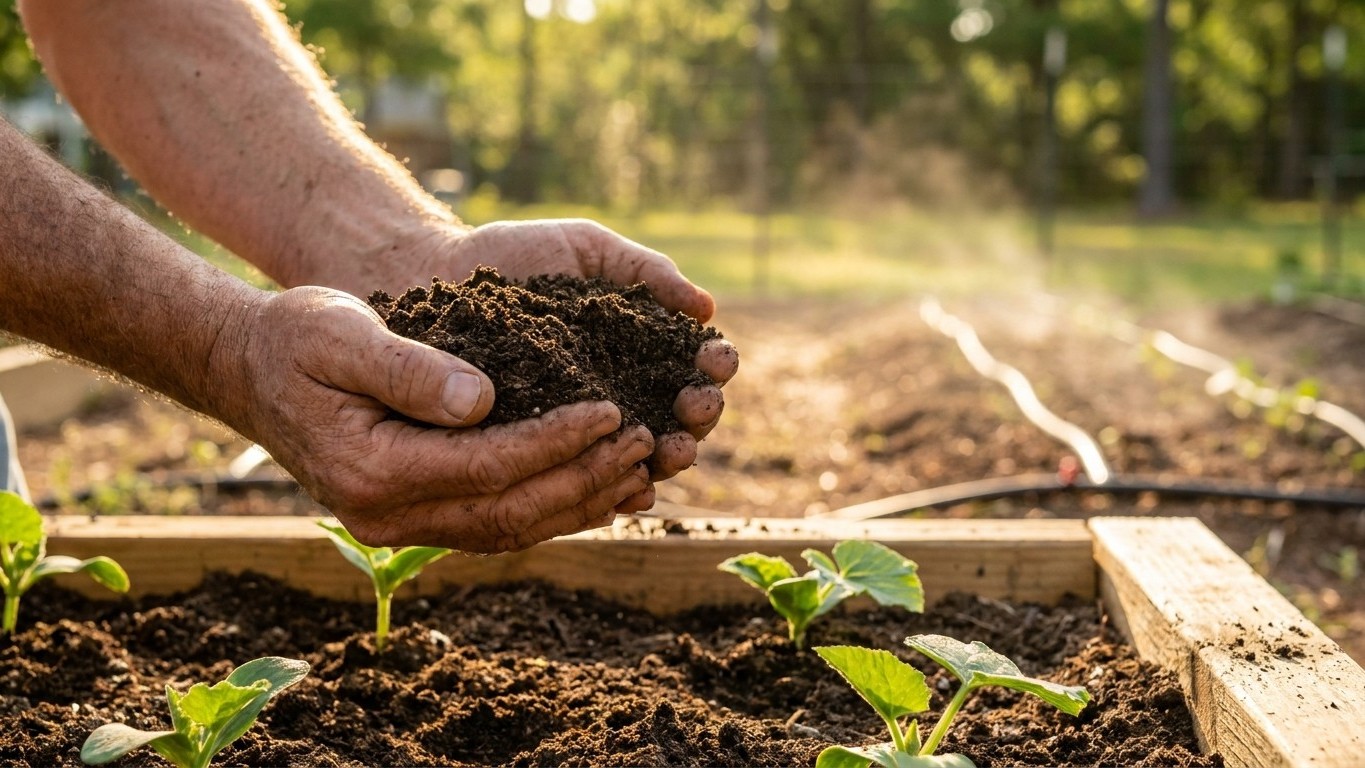

Plant Summer Squash in New Hampshire once the soil itself has warmed, not simply once the calendar clears the last frost date. In most of the state that means late May into early June, with a growing window that runs into September or beyond depending on how close a garden sits to the reference weather station used for these normals.
When the soil is warm enough in New Hampshire
The question gardeners actually ask is “when do I plant,” and the honest answer starts with a probability, not a promise. At the reference station used for New Hampshire’s climate normals (station USW00014710, per NOAA’s 1991-2020 U.S. Climate Normals), the last spring frost falls somewhere between April 16 and April 27. That is a 30 to 70 percent freeze-probability band, meaning frost risk is meaningfully present right up to the end of April, and sometimes past it in a cold year.
Here is the part that trips people up: frost date is a proxy, not the real trigger. Summer squash does not care about frost as such, it cares about soil temperature, and soil lags air temperature by days to weeks. A patch of ground can sit well past the frost-risk window and still be too cold at root depth for a squash seed to germinate reliably or for a transplant to avoid stalling. Cold, wet soil rots seed and stunts young plants faster than a light frost would have killed them anyway. The practical move is to wait until the soil itself feels warm to the hand a few inches down, generally one to two weeks after the local last-frost date, not the moment the date passes on a calendar.
That NOAA figure is also a single-station number. It comes from an airport weather station, and airport stations tend to sit in open, low-lying ground that behaves differently from a suburban yard or a rural garden tucked against a hillside. Suburban and rural gardens in New Hampshire typically see the last spring frost land later than the station’s date, sometimes by one to two weeks, and more at elevation. A garden in the Monadnock foothills or up in Coos County should treat late April as optimistic, not typical. Checking a county-level frost record, or simply tracking a few years of personal observation, beats leaning on a single regional figure.
New Hampshire’s hardiness range, according to the USDA Plant Hardiness Zone Map (2023 edition, built on 1991-2020 normals), spans zones 3b to 6a across the state. That is a wide spread built on one variable, the average annual extreme minimum temperature, and it says nothing directly about summer squash timing. What it does confirm is that a garden in the state’s north or at higher elevation is working with a meaningfully colder baseline than one near the reference station, which matters more for overwintering perennials than for an annual vegetable, but it is a useful reminder that “New Hampshire” covers a lot of climate ground.
Before committing seed to soil, a simple soil thermometer is the cheapest insurance available: summer squash germinates and grows away confidently once soil temperature is reliably warm at planting depth, and pushing earlier than that mostly buys a longer wait for the same result, not an earlier harvest.
How long the season lasts here
Run the two frost dates together and New Hampshire’s frost-free window comes into focus, though it moves depending on which end of each range gets used. Using the more conservative pairing, the latest likely spring frost (April 27) to the earliest likely fall frost (October 13), the frost-free stretch runs roughly 169 days, about 24 weeks. Using the earlier spring date and later fall date (April 16 to October 26), the same window stretches to about 193 days, closer to 27-28 weeks. The real number for any given garden sits somewhere inside that range, and both dates come straight from the same NOAA station cited above, so the spread reflects genuine year-to-year variability, not guesswork.
What that length allows matters more than the exact day count. A window of roughly 24 to 28 weeks is generous enough that a single spring sowing of summer squash is rarely the only shot at a harvest. Squash plants are productive for a limited stretch before vigor and pest pressure catch up with them, so a season this long supports a second sowing in early to mid-summer, timed to take over just as the first planting starts fading. That second wave also sidesteps some of the squash vine borer and squash bug pressure that tends to build against an aging first planting, since a fresh stand of young plants is simply less attractive and less vulnerable early on.
Where a garden sits toward the shorter end of that window, whether from elevation, a north-facing slope, or simply being farther from the milder coastal pocket near the reference station, the calculus shifts. A shorter effective season makes the first sowing the one that has to count, and it raises the value of starting from transplants rather than direct seed. Squash resents root disturbance, so transplanting only pays off when the time saved (typically a couple of weeks of head start) is actually needed to fit the harvest inside a tighter window. In a long-season garden, direct seeding is simpler, cheaper, and avoids the transplant setback altogether.
Anyone planning a second sowing, or deciding whether their own frost window justifies it, will get more out of a dedicated look at timing intervals and cutoff dates than a single paragraph here can cover, worth checking the site’s succession sowing guide for the specifics of spacing plantings through a New Hampshire summer.
Heat and water in New Hampshire
New Hampshire is not a hot-summer state by the numbers, and that changes what actually threatens a squash crop here. At the Manchester reference station, NOAA’s 1991-2020 normals put the average at 10.9 days a year reaching 90°F or higher. That is a modest heat load compared with warmer regions, and it means the classic hot-climate squash problem, pollen going sterile in prolonged upper-90s heat, is a minor concern across most of the state in most years. Some inland and valley locations run warmer than the coastal station on individual summer days, but as a statewide pattern, extreme heat is the exception, not the rule.
Rainfall tells a similarly moderate story. Summer rainfall across the reference station’s normals runs about 10.7 inches over June, July, and August combined, with June at 4.04 inches, July (the driest of the three) at 3.3 inches, and August at 3.35 inches. That is a reasonably wet summer by national standards, and it means the dominant risk for New Hampshire squash growers isn’t drought stress, it’s the opposite: excess moisture sitting on leaves and around the crown in a cool, damp stretch.
Squash’s giant leaves are efficient at losing water and equally efficient at holding humidity right at leaf level when air stays still and skies stay overcast. In a New Hampshire summer, that combination shows up as powdery mildew coating the leaf surface by mid to late summer, and as fruit that ripens more slowly than expected because sunlight and heat units are simply lower than in a hotter climate. Slower ripening isn’t dangerous on its own, but it does compress the productive window, especially for a planting that’s already working with the shorter end of the frost-free season described above.
The practical response here looks different from what a gardener in a hot, dry state would do. Instead of prioritizing irrigation and afternoon shade, the higher-value practices in New Hampshire are ones that improve airflow and reduce leaf wetness: spacing plants generously rather than crowding them, watering at the soil line rather than overhead, and siting the bed where morning sun dries dew quickly. A rain gauge on site still earns its keep, since a wet month on paper can still leave a raised bed with sandy fill dry within a day or two, but the bigger lever in this particular climate is managing humidity around the plant, not chasing water to it.
Reading the numbers together
| Factor | Reference figure | What it means for squash |
|---|---|---|
| Days above 90°F (Manchester station) | 10.9 per year | Low heat load; pollen sterility from extreme heat is rarely the limiting factor |
| Summer rainfall (June-Aug) | 10.7 in. total, July driest at 3.3 in. | Generally sufficient; the risk runs toward too much leaf moisture, not drought |
Which summer squash suit New Hampshire
Given a moderate-length season, mild heat, and a damp-leaning summer, the type of squash that suits New Hampshire best is one bred first for disease resistance, particularly to powdery mildew, and only second for speed. In a hotter, drier territory the priority order would flip toward earliness and heat tolerance at the root zone; here, a plant that shrugs off mildew through August has more practical value than one that ripens a few days sooner but collapses under fungal pressure before the second sowing even gets going.
Within the summer squash category, that generally points toward compact bush-type plants over sprawling vining types, since bush forms improve airflow around the leaf canopy in exactly the humid conditions New Hampshire summers tend to produce. For gardeners planning that second, succession sowing discussed earlier, an early-maturing type sown direct in early summer avoids the transplant-shock question entirely and still has time to finish well before the first fall frost risk arrives in mid-October at the earliest.
What this page will not do is name a specific variety. That is a deliberate choice, not an omission. Variety trial results are collected locally precisely because performance shifts by region, soil, and even by the specific summer’s weather, and a name printed on a general climate page has no guarantee of being tested anywhere near a given garden. The one recommendation that actually means something is the one built from local trial data, gathered on New Hampshire soil, under New Hampshire summers.
That data lives with the University of New Hampshire Extension service, which runs and publishes exactly this kind of regional variety trial and can point to strains with a track record of standing up to the mildew pressure and moderate season length described above. Their site is at extension.unh.edu, and a call or visit to a county office there beats guessing from a printed variety name every time. Pair that local guidance with the practices already covered here, generous spacing, soil-line watering, a second sowing timed to the frost-free window, and the choice of type becomes the last decision left to make, not the first.