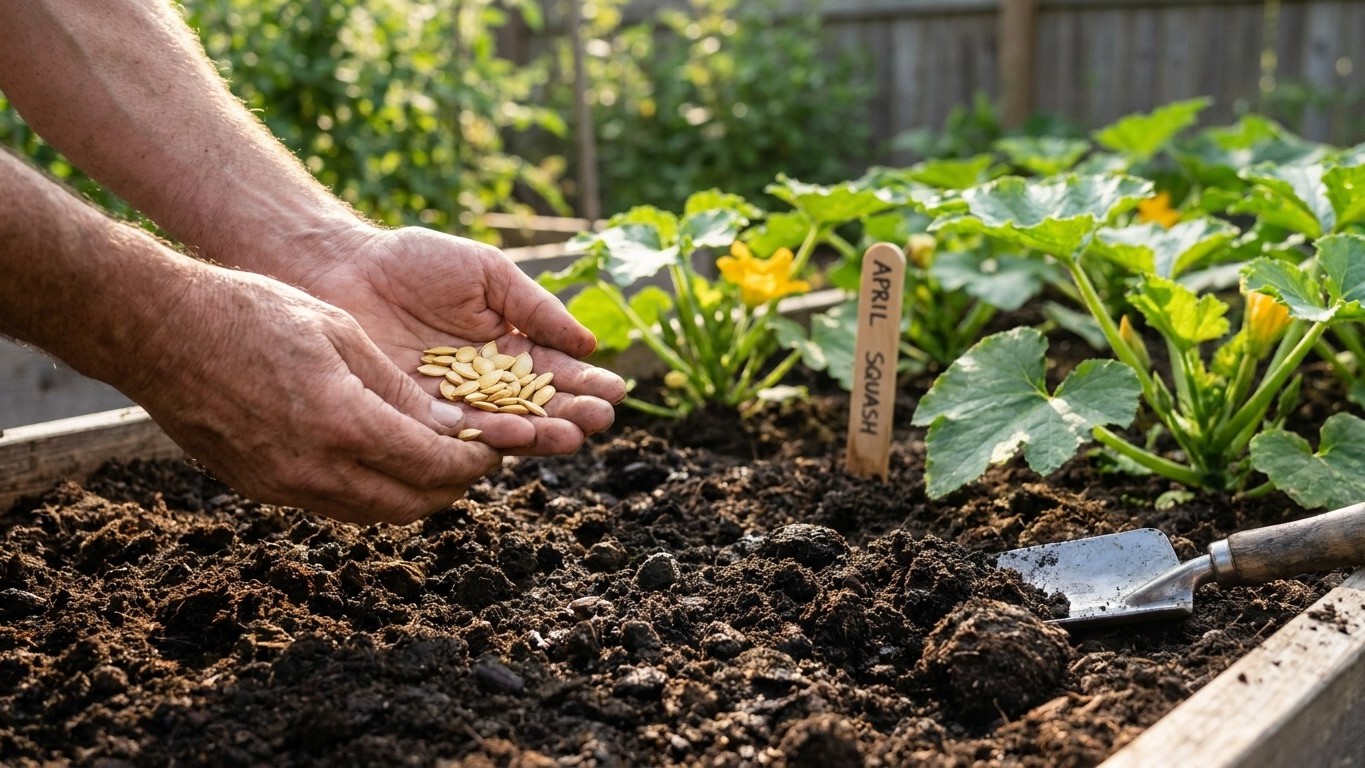

Sow Summer Squash in New Mexico after the last spring frost window closes, which at the Albuquerque reference station runs March 31 to April 12. That’s a probability range, not a guarantee, and soil temperature matters more than the calendar date. Gardens outside the metro area, especially at elevation, should expect that window to arrive later.
The short answer for New Mexico
The frost dates in the facts above come from one station: Albuquerque, tracked by NOAA over the 1991-2020 period. The March 31 to April 12 spread is the 30-70% probability band for a 32F freeze, meaning that even inside that window there’s real risk on either end. A gardener who plants on March 31 is accepting meaningfully more frost risk than one who waits until April 12. Neither date is “correct.” They’re two points on a curve.
Summer squash germinates poorly in cold soil and stalls out below roughly 60F at the root zone, so the safer play in most Albuquerque-area gardens is to treat April 12 as the starting line, not the deadline. Direct-seeding a week or two after that date, once soil has had time to warm under spring sun, usually beats an anxious late-March sowing that then sits doing nothing.
Work backward from the other end of the season and the picture gets easier. First fall frost at the same station falls between October 29 and November 9. Summer squash varieties typically reach harvest in 45 to 65 days from seed. Even using the earlier fall-frost date and the later spring-frost date, the gap between April 12 and October 29 is around 200 days. That’s roughly three full squash cycles, with room to spare for a slow start or a second planting after the first one fades.
That math matters because it tells you the real constraint in this state isn’t day length. It’s heat and water, which the next section covers. Season length is the one variable New Mexico gardeners mostly don’t need to worry about, at least not in the Albuquerque-area reference climate. Higher, cooler pockets of the state compress that window considerably, which is addressed further down.
So the short version: plant after April 12 as a default, treat the two weeks before that as increasingly risky the earlier you go, and don’t feel pressure to rush a second planting before late June or early July if you want a fall harvest before the late-October to early-November frost arrives.
What will not work here
A watering schedule built for a wetter state fails here fast. Summer rainfall at the reference station averages about 3.5 inches across June, July, and August combined, with June the driest month at just 0.57 inches. Compare that to a squash plant’s actual water appetite during fruit set, and the shortfall is obvious. A once-a-week soak that would carry a garden through summer in a place getting an inch of rain weekly leaves New Mexico squash roots dry for days at a stretch, especially once temperatures climb.
And they do climb. The reference station averages 42.5 days a year at or above 90F. That’s not an occasional hot spell, it’s six weeks’ worth of days scattered through the growing season, concentrated right when squash plants are trying to set fruit. High heat during flowering causes blossom drop and can make pollen sterile in the hottest hours, so a plant that looks vigorous can still produce almost nothing if the heat load is severe enough. Gardeners transplanting or direct-seeding into the hottest stretch of July without a watering plan are setting themselves up for a lot of yellow flowers and very few squash.
The mismatch that trips people up
Advice written for humid states often pushes wide spacing to fight fungal disease, and warns against overhead watering because of mildew risk. Those are legitimate concerns in a wet climate. They matter far less here, where low humidity and long dry stretches are the actual threat, not fungus. A gardener who imports that humid-climate caution wholesale, watering lightly and infrequently to “avoid disease,” ends up under-watering in a climate where the real risk runs the opposite direction. The fix isn’t more space between plants, it’s a deeper, less frequent soak that reaches the root zone, plus mulch to slow evaporation between waterings.
One more failure mode: counting on a single summer thunderstorm to carry the garden for a week. Monsoon rain in New Mexico tends to arrive hard and fast, and a lot of it runs off rather than soaking into dry soil, particularly on any slope or compacted patch. A rain gauge reading of half an inch after a storm doesn’t mean the root zone actually absorbed half an inch. Checking soil moisture by hand a day later is the only way to know.
What changes across New Mexico
New Mexico spans USDA hardiness zones 4b through 9a, one of the widest ranges of any state in the country, and that spread is built on the USDA Plant Hardiness Zone Map’s single variable: average annual extreme minimum winter temperature. It says nothing directly about spring frost timing, but the two track closely enough that the zone spread is a useful signal of just how different the state’s gardens are from one another.
A garden near the low end of that range, in the colder, higher-elevation parts of the state, is working with a meaningfully shorter frost-free season than the Albuquerque reference figures suggest. Mountain valleys and high-desert plateaus commonly see their last spring frost run weeks later than the April 12 upper bound cited here, and their first fall frost can arrive well before the October 29 figure. For those gardens, the safe window for direct-seeding summer squash shrinks substantially, and starting seedlings indoors a few weeks early, then transplanting after frost risk clears, is often the more realistic path.
A garden near the 9a end, in the state’s lower, warmer southern desert stretches, sits at the opposite extreme. Frost risk clears earlier and the growing season stretches longer, but the heat-load problem described above only intensifies. More days above 90F, not fewer, is the tradeoff for that earlier start.
There’s no single planting date that fairly represents a state stretching across five hardiness zones. A reader in a mountain valley and a reader in the low desert are gardening in different climates that happen to share a state line. Rather than guess which end of that range applies to a given yard, check the USDA Plant Hardiness Zone Map directly for the exact location in question.
Where to check this for your own county
New Mexico State University’s Cooperative Extension Service, at aces.nmsu.edu, works from local trial data and local frost records. Everything above comes from one weather station and one statewide hardiness range. A county extension office works from local trial data and local frost records, which is a different, more precise thing.
Two items are worth hunting for specifically. First, a county-level planting calendar, if the local office publishes one, will reflect the actual frost pattern for that county rather than the Albuquerque station cited here. That matters most for anyone gardening at elevation or in one of the state’s colder pockets, where the gap between the county reality and the statewide figures can run to several weeks in either direction. Second, look for any list of summer squash varieties the office has trialed locally. Extension programs frequently test varieties against regional heat, soil, and pest pressure, and a variety that performs well in a county trial has already been vetted against the exact conditions a local gardener is facing, rather than against a national average.
A county recommendation beats a state one every time, for the simple reason that it’s built on less averaging. A local office narrows both of those down to something closer to an actual backyard.
Some gardeners also time this by the Moon: when to plant zucchini by the moon, as almanac tradition rather than fact.
Checking this against your own garden
None of the dates above outrank what’s happening in the actual soil. Three simple checks tell a gardener more than any calendar can.
- Soil warmth by feel: push a hand a few inches into the planting bed in the morning. If it still feels cold rather than cool, the soil hasn’t caught up to the calendar yet, regardless of what the frost-date window suggests, and seed sown now will likely just sit.
- The first flush of male flowers: summer squash typically produces male blooms before female ones. Their appearance signals the plant has shifted out of pure vegetative growth and is gearing up to fruit, which is useful for judging whether an early-season plant is on a normal track or lagging.
- The first true leaves: the rounded seed leaves that emerge first aren’t the plant’s real foliage. The first true leaves, the more deeply lobed, squash-shaped ones that follow, are the better sign that a seedling has established itself and is ready for the growth push ahead.
Any one of these running noticeably ahead of or behind what the frost-date window would predict is useful information about a specific yard’s microclimate, a south-facing bed that warms early, a low spot that collects cold air, a windbreak that shifts everything by a week or two. That local read is worth more than any station-derived date.