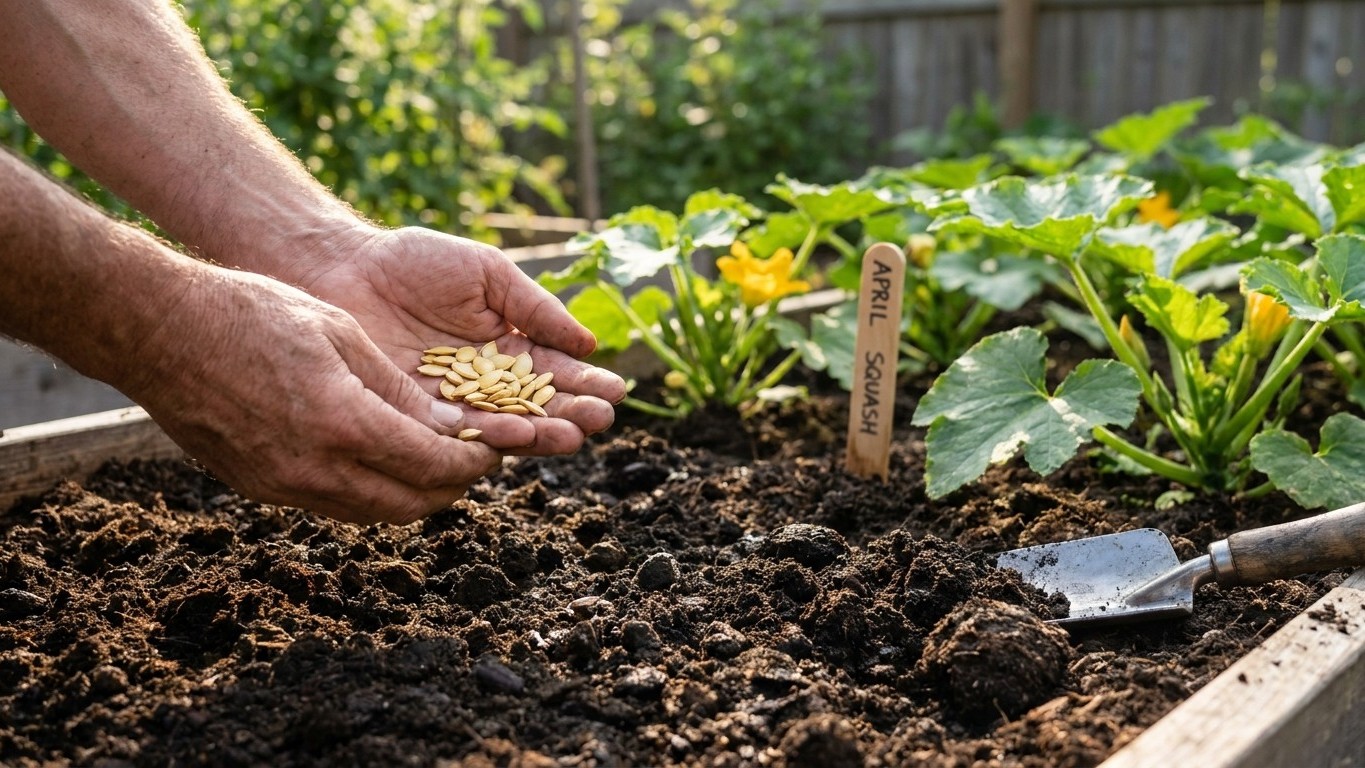

Summer Squash in North Dakota goes in the ground between May 15 and June 1, once soil has warmed and the frost risk has genuinely dropped, not just once the calendar flips to a friendly-looking date. Plants set out earlier gamble against a freeze that still has real odds of showing up.
The short answer for North Dakota
NOAA’s 1991-2020 climate normals put the last spring frost for this region’s reference station somewhere between May 4 and May 15. That’s not a single date, it’s a probability band: on May 4, there’s still roughly a 70% chance of another 32F freeze; by May 15, that risk has fallen to around 30%. Summer squash has zero frost tolerance at the seedling stage, so the safer play is to sow at the far end of that window, not the near end. Direct-seed or transplant between May 15 and the first week of June, once the band has tipped in your favor.
On the other end of the season, the same station shows a first fall freeze arriving between September 25 and October 5, with September 25 marking the 30% risk point and October 5 the 70% point. That gives a realistic outdoor growing window of roughly 133 days if you plant conservatively and harvest before the early edge of that fall band, stretching toward 154 days for a gardener willing to gamble on the late end of both windows.
Summer squash varieties (zucchini, yellow crookneck, pattypan) typically reach first harvest 45 to 65 days after seeding. Even the slower end of that range fits comfortably inside a 133-day window, which means the sowing date itself isn’t the tight constraint here. What matters more is not planting so early that a late freeze wipes out the seedlings, and not planting a second or third succession so late that it runs into the September 25 fall-frost risk before it matures.
This page gives the state-level version of that math. It’s built from a single reference station’s data, and North Dakota is a big state with a lot of microclimate variation, which the next two sections get into.
What will not work here
Planting before mid-May is the single most common way summer squash fails here. The soil is still cold, germination stalls, and even if seeds sprout, a freeze in that 30-70% risk band can take out the whole planting overnight. Waiting until soil has actually warmed, rather than trusting a mild afternoon in late April, is what separates a squash bed that thrives from one that gets replanted twice.
On the other side of the season, a third succession sowing timed for late July or early August is a gamble that often doesn’t pay off. Count backward from September 25, the early edge of the fall-frost band, and a 60-day variety sown after late July is racing a clock it may lose. A single planting in late May, maybe a second one in mid-June, uses the season more realistically than stretching for a third round.
Watering on a once-a-week schedule is another common failure point, and it’s specific to this region’s summer weather pattern. Summer rainfall here averages about 10 inches across June, July, and August, but August, the peak fruiting month for most plantings, is also the driest at 2.6 inches. Combine that with 11.7 days a year hitting 90F or hotter, and you have a stretch where evaporation demand is high right when rainfall is lowest. A weekly soak might have worked in a wetter, cooler climate; here it often leaves squash roots dry for days at a time during the hottest stretch of summer, which shows up as stunted fruit, blossom drop, or a plant that just stops producing.
There’s also a rainfall-pattern trap worth naming directly: North Dakota’s summer precipitation tends to arrive as thunderstorms rather than steady soaking rain. A single 1-inch storm on cracked, sun-baked clay mostly runs off instead of soaking down to the root zone, so the seasonal total can look adequate on paper while the actual soil moisture squash roots can reach stays low. Checking soil moisture by hand a few inches down, rather than trusting the rain-gauge total for the month, catches this before the plants show stress.
What changes across North Dakota
USDA hardiness zones across the state span 3a to 4b, which is a wide enough range that there’s no single “North Dakota answer” to when the ground is safe. That spread reflects the average annual extreme minimum temperature, the one variable the USDA zone system measures, and it tracks fairly closely with how far north or how far from any moderating water body a garden sits.
A garden in the colder end of that range, generally the northern tier of the state, should expect the frost-free window to run shorter than the reference-station dates above, with both a later safe planting date in spring and an earlier real fall-frost risk. A garden in the warmer 4b pocket has more room on both ends, closer to the dates already given, sometimes slightly better.
Elevation and local terrain matter too, even within a single county. Low-lying spots where cold air pools overnight, sometimes called frost pockets, can see frost weeks after a garden just a few hundred yards away on higher ground has cleared the risk. None of this means guessing which zone applies to a specific yard from a state-level article is a good idea. The USDA’s hardiness zone map is built for exactly this kind of lookup, and it takes a street address, not a general sense of “up north” or “down south.”
The practical takeaway: treat the May 15 to June 1 window as a starting point, then shift it later if local knowledge, a nearby extension office, or a neighbor’s experience says the local frost pattern runs behind the reference station’s.
Where to check this for your own county
North Dakota State University’s Extension service is the right next stop, and it exists specifically to translate state-level normals into something usable at the county level: North Dakota State University Extension.
Two things are worth looking for once there. First, a local planting calendar, if one exists for your county or region, which will reflect the specific frost pattern of that area rather than the single reference station cited throughout this page. Second, variety trial results for summer squash that NDSU or its county offices have run locally. Varieties that mature reliably in a trial plot near Fargo aren’t automatically the ones that perform best near the Canadian border or in the western part of the state, and county-level trial data is the closest thing to a real answer for that.
A county-level recommendation, when one exists, outranks everything on this page. State-level data like the frost normals cited here comes from one weather station, and it’s built to describe a broad pattern, not a specific yard. A county extension agent, or a county-specific bulletin, has usually already done the work of adjusting for local terrain, soil type, and microclimate that a state-wide article simply can’t account for. Treat this page as the starting estimate, and the county office as the correction.
Checking this against your own garden
No date on this page beats what the garden itself is showing. Three signs are worth watching, and all three can be checked without any tool beyond a hand and an eye.
Soil warmth, checked by pushing a finger a few inches into the bed in the morning, is the first and most reliable signal. Summer squash seed germinates poorly in cold soil regardless of what the calendar says, so if the ground still feels cool and slightly damp-cold rather than warm, waiting another few days usually pays off more than sticking to a fixed date.
The first flush of male flowers on an already-planted squash tells you something about how the season is progressing relative to a normal year in that spot. Male flowers typically open before female ones, and if they’re appearing noticeably earlier or later than in past seasons, it’s a rough signal of whether the local season is running warm or cool that particular year.
First true leaves, the second set that appears after the initial seed leaves, mark the point where a seedling has shifted from living off stored seed energy to actually photosynthesizing on its own. A slow, stalled seedling that hasn’t pushed true leaves within a couple weeks of sprouting is often a sign the soil was still too cold at planting, useful information for timing the next succession or next year’s first sowing a little later.