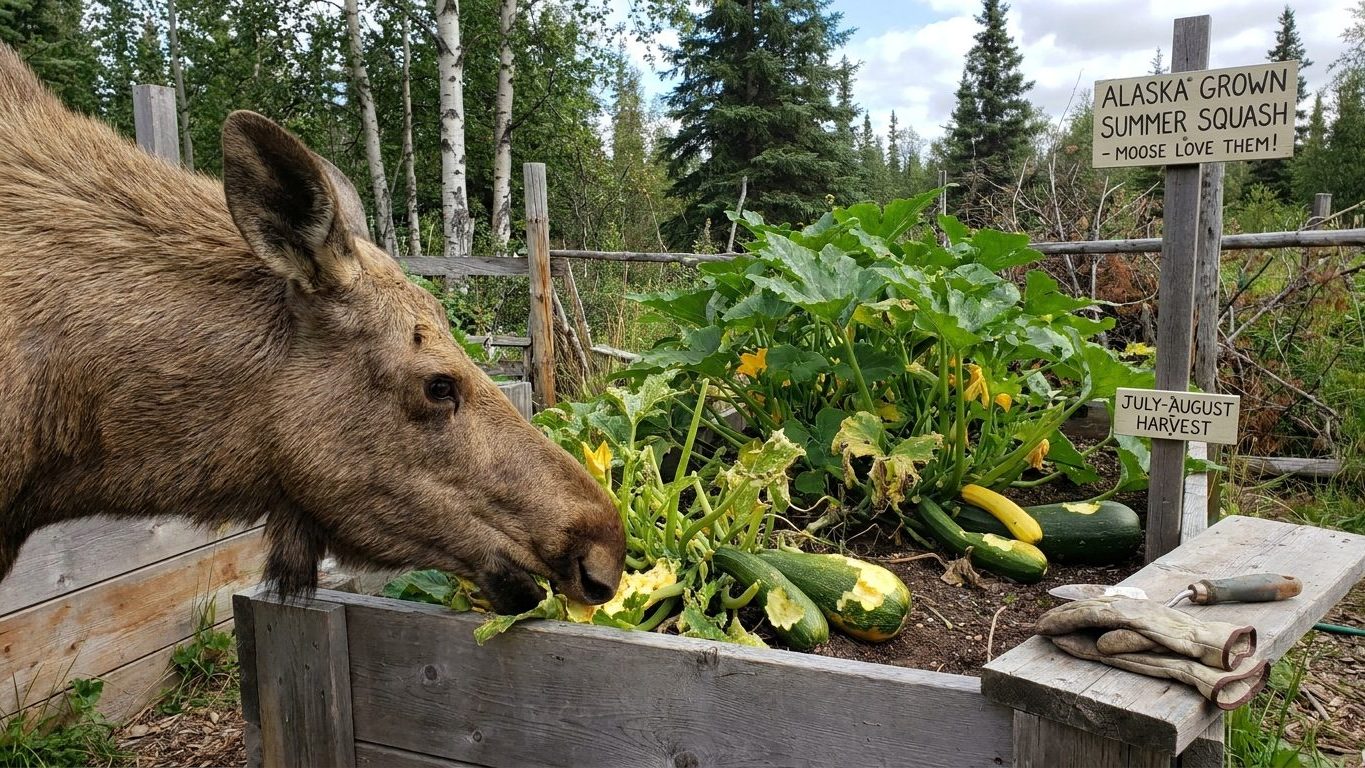

Squash vine borer and squash bugs, the two pests every general vegetable guide warns about, don’t show up in Alaska gardens at all. What actually damages summer squash near Anchorage is a shorter list: aphids, cutworms and slugs, and slugs in particular move faster here than most gardeners expect because the soil rarely dries out. Check seedlings for slime trails and severed stems within the first weeks after transplanting, before assuming any damage is frost related.
Which pests attack summer squash in Alaska

The UAF Cooperative Extension documents five pests for this territory: aphids, cutworms, root maggots, slugs and spruce beetle. Not all five have any business in a squash bed, and a gardener who treats for the wrong one wastes a short season chasing nothing.
Spruce beetle is a bark beetle that attacks live spruce trees, not garden vegetables, so it never touches summer squash foliage, stems or fruit. Root maggots are the larvae that tunnel into the roots of cabbage, broccoli and onions, and their target is brassicas and alliums, not the roots of a cucurbit. Neither belongs on a squash pest list, whatever the extension service’s territory-wide document says about the state as a whole.
That leaves three worth watching if you’re growing summer squash in Alaska:
- Aphids: small, soft-bodied insects that cluster on the undersides of leaves and along new growth, feeding by piercing plant tissue and drawing sap.
- Cutworms: night-feeding caterpillars living in the top inch of soil, severing young stems at ground level.
- Slugs: soil-and-leaf feeders that rasp irregular holes in foliage and can scar the skin of low-hanging fruit.
Aphid colonies build fast once established. A handful of individuals on one leaf can turn into a visible cluster within a week, and the sticky honeydew they leave behind attracts sooty mold that further weakens the plant. Cutworms spend the day curled just under the soil surface and come out after dark, which is why a healthy-looking seedling can be found chewed through at the base the next morning with no insect anywhere in sight.
Of the three, slugs cause the most consistent damage in gardens near Anchorage, and the reason is climate rather than the plant. NOAA’s 1991-2020 climate normals put the average number of days at or above 90°F at the Anchorage reference station at zero. Without the heat load that dries out soil and slows slugs elsewhere, they simply keep feeding through more of the season here than they would in a warmer state.
When each one shows up, and what it does first
Squash goes into the ground only once the danger of frost has passed. NOAA’s 1991-2020 climate normals put the last spring freeze for the Anchorage-area reference station at May 3 to May 12, and the planting calendar for summer squash in Alaska works from that same window. Other parts of the state, especially the Interior, freeze later and thaw earlier, so treat this as an Anchorage-area figure rather than a statewide one.
Aphids

Aphids tend to show up early, not long after transplants go in, favoring the tender growth at the tip of the vine. The first sign isn’t the insect itself but a leaf that looks slightly curled or puckered, followed by a faint sticky sheen on the leaf just below it. Only when you turn the leaf over do you see the actual cluster feeding along the vein.
Cutworms

Cutworms strike earliest and fastest, often within the plant’s first days in the ground while the stem is still thin enough to sever in one bite. A seedling that stood upright the evening before and lies flat, cut through at the soil line, by morning, with no insect visible anywhere near it, is the signature sign. They feed at night and burrow back down by day, which is why the culprit is almost never caught in the act.
Slugs

Slugs feed all season but get worse as it goes on, tracking the soil moisture more than the calendar. NOAA’s 1991-2020 normals for the Anchorage-area station put summer rainfall at about 1.02 inches in June, the driest month, rising to 2.93 inches in August, the wettest. Slug damage tends to follow that same curve: ragged, irregular holes through the middle of leaves, not just the edges, that expand through the second half of the season, along with a silvery slime trail on the soil, the leaf, or the fruit itself.
Because Anchorage’s growing season runs only from that May thaw to a first fall freeze NOAA puts at September 22 to October 1, roughly 143 frost-free days by the same 1991-2020 normals, a squash plant has a fairly narrow window to outgrow its most vulnerable early stage. A cutworm hit or a slow-building aphid colony in the first few weeks matters more here than it would in a longer season further south.
Telling the damage apart from everything else
Not everything that looks like pest damage is pest damage. Alaska’s short, cool, often overcast summers produce plenty of leaf yellowing, stunted growth and blossom drop that have nothing to do with aphids, cutworms or slugs, and treating for an insect that isn’t there wastes time the plant doesn’t have to spare.
| What you see | Likely cause | What actually confirms it |
|---|---|---|
| New leaves curled or puckered, sticky sheen underneath | Aphids | Flip the leaf over: a cluster of soft-bodied insects along the vein, not just even yellowing across the leaf |
| Seedling flat and severed at the soil line overnight | Cutworms | A clean cut right at ground level with the root ball still intact, rather than a wilted plant that’s still rooted |
| Ragged holes through the middle of leaves, worse after rain | Slugs | A silvery slime trail on the soil, the leaf, or the fruit |
| Yellowing between leaf veins, no holes or chew marks anywhere | Not a pest | Check soil moisture and drainage first; this pattern usually points to watering or nutrients, not insects |
The detail that actually confirms a pest is almost never the hole or the yellow patch by itself. It’s the secondary evidence next to it: the slime trail, the intact root ball, the insect on the underside of the leaf. If you’re looking at damage with none of those signs present, don’t guess. Photograph it and send it to your local extension office rather than assuming which of the three pests, if any, is responsible.
What actually works here, and what is a waste of time
On a season this short, timing beats treatment. A physical barrier put down before a pest arrives does more good than any product applied after the damage is already visible.
What works
Floating row cover, set over the bed right after transplanting and left on until the plant needs pollinator access for flowering, keeps aphids off the foliage during the weeks they’d otherwise be establishing a colony. A simple cardboard or foil collar pushed an inch into the soil around each stem at planting time blocks a cutworm from ever reaching the stem it would otherwise sever overnight. For slugs, copper tape around a raised bed’s edge, hand removal during an evening check, and keeping mulch pulled back a few inches from the stem so the soil surface dries between rains all reduce the population without needing to identify a product at all.
What doesn’t
Spraying anything without a confirmed target is a waste of time here, because a general treatment applied after the fact rarely reaches a cutworm that’s already back underground or a slug that fed at night and is gone by morning. Waiting until damage is obvious before doing anything is the other common mistake. By the time holes are large or a seedling is down, the pest responsible has usually already moved on to the next plant. Choosing a faster-maturing squash, covered in the best summer squash varieties for Alaska, and pairing it with early row cover shortens the window during which any of these three pests can do real damage before the plant outgrows its most vulnerable stage.
Where to check this for your own county
Everything above comes from a statewide document, and pest pressure inside Alaska is not uniform. A garden in a damp, shaded yard near Anchorage can have a heavier slug problem than one two miles away on well-drained soil, and the Interior’s shorter, drier season changes the balance again.
The UAF Cooperative Extension is the named source for the pest list on this page, and its county and district offices are the right next step for a damage sample or a photo the table above didn’t resolve. Start at the UAF Cooperative Extension Service and look up the office serving your borough or census area rather than relying on a statewide list to diagnose one plant.
Bring a sample if you can, root ball intact if it’s a cutworm question, and note what time of day and what weather preceded the damage. That detail, more than any photo, is what lets an extension agent tell you which of the three documented pests you’re actually dealing with, or whether it’s something the statewide list doesn’t cover at all.