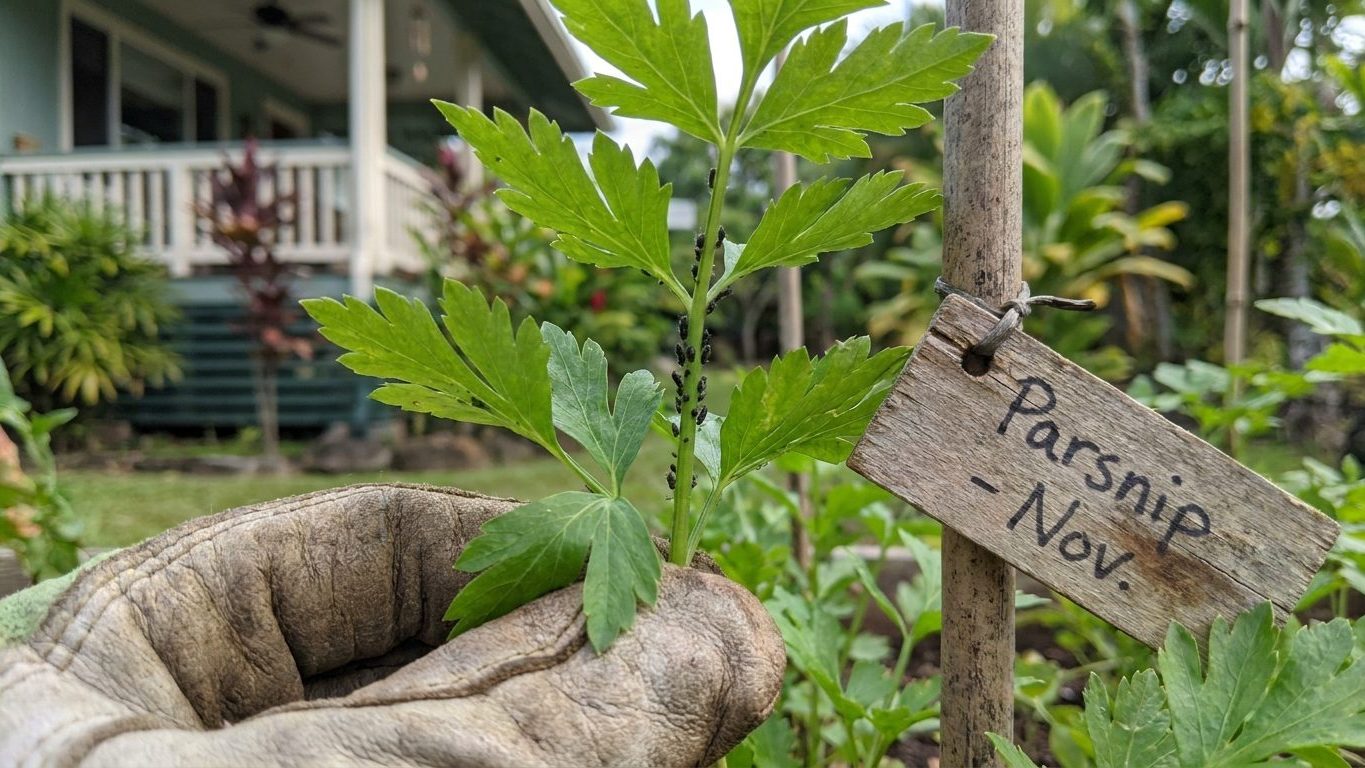

Hawaii’s parsnip patches draw only a handful of the insects that trouble other island vegetables, and most of the state’s worst pests skip it entirely. Aphids, whiteflies, and leafminers on the ferny top growth are the ones actually worth watching, since parsnip carries no fruit or head for the fruit flies and beetles that hit other crops. Check the leaves every week starting from the seedlings’ first true leaves, not the row itself, because damage shows up on the foliage well before it ever reaches the root.
Which pests attack parsnip in Hawaii

University of Hawaii CTAHR Extension documents a set of insect pests for vegetable growing across the islands, and only part of that list has anything to do with a root crop like parsnip. The full documented set includes Aphids, beet armyworm, cabbage webworm, Chinese rose beetle, Leafminers and bean fly, Whiteflies (the same list separates out the greenhouse and spiraling types), melon fly, and Southern green stinkbug and mites, along with a note flagging some of these as major virus vectors. The same CTAHR listing also names beans, corn, cucumber and ginger, eggplant, and grapes, but those are other crops covered in the same index, not additional pests, and none of them belong in a parsnip bed.
What actually feeds on parsnip
Parsnip is grown for its root, but the pest pressure lands on the ferny foliage that feeds that root all season. Aphids, whiteflies, and leafminers are the three to expect, because all three are generalist feeders that settle on any tender vegetable leaf, parsnip included, and aphids and whiteflies both carry the added weight of being named major virus vectors in CTAHR’s listing, meaning the damage isn’t only cosmetic. Beet armyworm chews foliage broadly across vegetable crops too, and Southern green stinkbug and mites will feed on parsnip leaves and, later, on the flower stalks if a plant bolts.
- Aphids: small, soft-bodied insects that cluster on new growth and leaf undersides
- Whiteflies: tiny white insects that lift off in a cloud when foliage is disturbed
- Leafminers: pale winding trails inside the leaf itself, no insect visible on the surface
- Beet armyworm: pale green to dark caterpillar that chews ragged holes, most active after dark
- Southern green stinkbug and mites: shield-shaped bug and near-invisible mites that both leave stippled, pale patches
What doesn’t belong on this list
Chinese rose beetle is documented in Hawaii, but CTAHR’s own note on it is that it feeds at night on rose and ornamental foliage, not vegetable crops, so it has no business in a parsnip bed. Melon fly targets the fruit of cucumber and other cucurbits, and parsnip is a root crop with no fruit for a fruit fly to sting, so that one is off the list too. Cabbage webworm is tied to brassica crops, and bean fly to beans specifically, so a parsnip grower can cross both off without a second thought. Naming what doesn’t apply matters as much as naming what does, because treating for a pest that was never going to show up wastes attention the actual foliage feeders deserve.
When each one shows up, and what it does first
Hawaii’s lowland gardens never see a frost that resets the pest clock, so the calendar here runs off the plant’s own growth stage instead of a month on the wall. Parsnip seed takes 14 to 21 days to germinate, according to Utah State University Extension, and that slow start is the most vulnerable stretch of the whole season. Bare, damp soil in a freshly sown bed draws early feeders in well before there’s a true leaf to inspect. Getting the timing of that sowing right narrows this exposure, and When to Sow Parsnips in Hawaii walks through how that decision gets made on this crop.
The first three weeks
Aphids are usually the first sign, arriving on the first true leaves almost as soon as they unfold, showing up as small clusters on the leaf underside with a faint stickiness on the leaf surface below them. Whiteflies follow close behind, and the giveaway is behavioral more than visual at first: brush the foliage and a small cloud of tiny white insects lifts off and resettles within seconds. Leafminers show up as pale, winding trails pressed into the leaf tissue itself, visible before any insect ever is, since the larva making the trail feeds inside the leaf, not on its surface.
Midseason and beyond
Once the plant has a full rosette of leaves, beet armyworm becomes the one to check for after dark with a flashlight, since it does most of its chewing at night and leaves ragged, sometimes skeletonized patches behind by morning. Southern green stinkbug and mites tend to arrive later still, showing up as stippled, bleached patches across older leaves rather than holes. Because no fall frost ever arrives to knock the population back, unlike a mainland bed where the first freeze effectively ends the pest season, pressure on a Hawaii planting can build steadily right through to harvest, so scouting has to continue well past the point where a colder-climate grower would stop.
Telling the damage apart from everything else
Not every ragged leaf or pale patch in a parsnip bed is an insect at work, and a forked or split root is almost never a pest problem at all. Heavy or stony ground forces the taproot to split around an obstruction, and overwatering does something similar by encouraging shallow side roots instead of one clean taproot. Those are two separate causes, not one, and neither shows up as insect feeding on the leaves.
Symptom by symptom
| What you see | Likely cause | What settles it |
|---|---|---|
| Ragged holes, worse overnight | beet armyworm | caterpillar or dark droppings visible with a flashlight after dark |
| Insects lift off when leaves are brushed | whiteflies | sticky honeydew and dark sooty mold on the leaf underside |
| Pale winding trail inside the leaf | leafminers | no insect on the surface, trail visible held up to light |
| Small clusters on new growth | aphids | sticky residue, ants tending the cluster |
| Stippled, bleached older leaves | Southern green stinkbug or mites | patches spread evenly rather than in one spot |
| Forked or split root, leaves look fine | heavy or stony soil, or overwatering | check soil texture and drainage, not the foliage |
| Even yellowing across the whole bed | nutrient shortage or inconsistent watering | affects every plant in the row, not scattered individuals |
A table narrows things down, but it doesn’t replace a diagnosis. If a pattern doesn’t match anything above cleanly, or a whole planting is failing rather than a few leaves here and there, that’s a question for a county extension agent with the plant in hand, not a guess made from a description.
What actually works here, and what is a waste of time
If the bed itself still needs planning, Growing Parsnips in Hawaii covers the deep, sandy soil prep this crop needs, since Utah State University Extension notes that heavy soil must be double dug before sowing, well before pest pressure becomes a factor. A physical barrier put over the bed within the first few weeks after seeding beats any treatment applied once a problem is established. A length of fine insect netting or row cover laid over the seedbed as soon as it’s seeded, and left on through germination, keeps aphids, whiteflies, and the moths that lay beet armyworm eggs off the leaves before they ever land. Parsnip takes 100 to 120 days from seeding to harvest according to Utah State University Extension, so that’s a long window to keep covered, but also a long window in which an early infestation can spread if nothing is in the way.
What doesn’t help
Waiting on cooler weather to thin out pest numbers is not a strategy that works here. Even in the coldest month, Honolulu’s average low sits at 66.8°F according to NOAA’s 1991-2020 climate normals, and other parts of the state run cooler at higher elevation, but nowhere in a lowland garden does the temperature drop far enough to slow an insect population the way a hard freeze does elsewhere. A gardener used to a winter die-off on the mainland will find populations simply carrying on. Treating a bed that shows no symptoms yet is also wasted effort: since aphids, whiteflies, and leafminers all have visible early signs, a weekly look at the undersides of the leaves catches them in time to act.
Handpicking and destroying a heavily infested leaf, rather than leaving it on the plant, matters more for aphids and whiteflies than for the chewing insects, because both are named among CTAHR’s major virus vectors. Removing them promptly limits how far a virus already in the bed can spread to the rest of the row. This site does not recommend a specific spray or rate, since product registration changes and only the extension office in the state knows what’s currently labeled for a home vegetable garden.
Where to check this for your own county
Everything above comes from a single statewide list published by University of Hawaii CTAHR Extension, and a statewide list is a starting point, not a description of any one garden. Pest pressure inside Hawaii varies by elevation and by whether a garden sits windward or leeward, and a county’s own CTAHR office is the one place that can say what’s actually active nearby right now, rather than what’s documented for the islands as a whole.
Contacting your county office
Call before treating anything, especially if the damage doesn’t match the symptoms described above cleanly. An agent can usually work from a description over the phone, though bringing in an affected leaf, or a photo of one, speeds up an identification more than a description alone. Do this before the damage spreads past a few plants, since most of what’s documented here, aphids and whiteflies especially, moves through a bed faster than parsnip’s own 100 to 120 day season runs.
Common questions
Do I need to spray parsnip on a schedule in Hawaii?
No. None of the pests documented for parsnip here need a preventive schedule. Aphids, whiteflies, and leafminers all show visible signs early enough to act once you spot them, and spraying on a calendar rather than on symptoms wastes effort and can harm the insects that keep aphid numbers down on their own.
Will Chinese rose beetle damage my parsnip?
It’s documented in Hawaii, but CTAHR’s own note on this pest is that it feeds at night on rose and ornamental foliage, not vegetable crops, so it isn’t expected to touch a parsnip bed. If leaves are being chewed at night, beet armyworm is the more likely cause here.
Does frost ever kill off the pests on my parsnip?
No, and that’s a real difference from mainland vegetable growing. NOAA’s 1991-2020 climate normals record zero days at or below freezing for the Honolulu reference station, and while higher elevations elsewhere in the state run cooler, nothing about the local climate knocks a pest population back the way a hard freeze would elsewhere. Scouting has to continue through the whole season instead of stopping once the weather turns.
My parsnip roots are forked. Is that a pest?
Not from anything on this list. A forked or split root traces to the ground itself, either heavy or stony soil that splits the taproot around an obstruction, or overwatering that pushes the plant toward shallow side roots instead of one straight one. Neither cause shows up as insect feeding on the foliage, so check the soil before assuming a pest is involved.