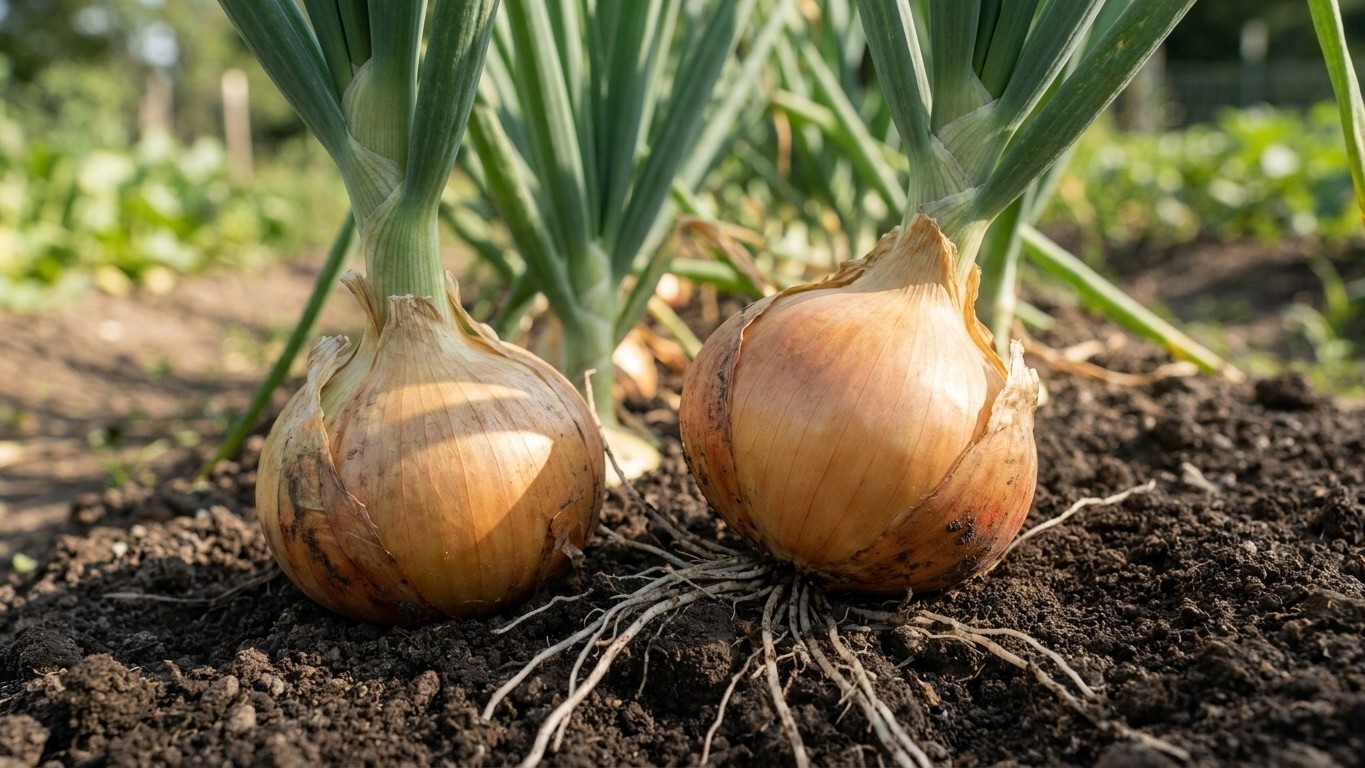

Idaho’s onion pests come down to a short, specific list: onion maggot, aphids, cutworms, wireworms, and grasshoppers, according to University of Idaho Extension. Onion maggot moves in right after transplanting or seeding, cutworms and wireworms attack from below almost as early, aphids build up once the canopy fills in, and grasshoppers become the bigger worry later, as surrounding vegetation dries out. Which one is actually in a given bed depends on the plant’s growth stage more than the date on a calendar.
Which pests attack onion in Idaho
University of Idaho Extension documents eleven pests across its home garden guides: aphids, carrot rust fly, Colorado potato beetle, cutworms, grasshoppers, imported cabbageworm, onion maggot, pea leaf weevil, squash bug, tomato hornworm, and wireworms. That list covers garden vegetables broadly, not onions specifically, and most of it has no business showing up in an onion row.
The five that actually feed on onion
- Onion maggot: larvae tunnel directly into the bulb and roots of onion and other alliums.
- Aphids: colonize onion foliage, feeding on sap and sometimes spreading virus between plants.
- Cutworms: soil-surface caterpillars that sever seedling stems at night, indifferent to what crop they’re cutting.
- Wireworms: click beetle larvae living in the soil that bore into bulbs and roots, onion included.
- Grasshoppers: general leaf feeders that chew onion tops along with almost anything else standing in a dry year.
The six that don’t belong here
Carrot rust fly targets the carrot family (carrots, parsley, celery), not the onion family, so a healthy onion bed gives it nothing to feed on. Colorado potato beetle feeds on potato-family foliage, meaning potatoes and eggplant, and leaves onion leaves alone. Imported cabbageworm is a caterpillar of brassica crops (cabbage, broccoli, kale) with no onion connection. Pea leaf weevil notches the leaf edges of peas and other legume seedlings, a plant family away from onion. Squash bug lives and feeds on cucurbit vines, squash and cucumber among them, and has no reason to be on an onion row. Tomato hornworm feeds on tomato-family foliage, tomato, pepper, potato, and an onion leaf simply isn’t on its menu.
Five of the eleven pests University of Idaho Extension tracks for home gardens actually feed on onion; the other six belong to entirely different plant families and finding one of them nearby doesn’t mean it’s touching the onion crop at all.
When each one shows up, and what it does first
Timing here tracks growth stage, not a fixed date on the calendar, since planting dates shift from one part of Idaho to another.
Early after planting
Cutworms are usually the first threat a young onion stand faces. Cutworms do their damage overnight, and a row of seedlings that looked fine at dusk can be flattened or missing by morning, cut clean at the soil line. Onion maggot follows close behind: adult flies lay eggs at the base of young plants soon after transplanting or seeding, and the first visible sign is a seedling wilting and yellowing that pulls out of the ground with almost no root left attached. Wireworms are already present in the soil before either shows up, especially in beds converted recently from lawn or grass sod, and their damage looks like stunted, off-color seedlings scattered in patches rather than across the whole row.
Later in the season
Aphids build up as the canopy fills in and the plant moves toward the bulbing stage. At the reference city’s latitude of 43.57 degrees north, the longest day of the year holds 15 hours and 15 minutes of daylight, and it’s day length rather than warmth that pushes an onion into bulbing. That stretch of long days, when the plant is putting most of its energy into leaf and bulb growth, is also when aphid colonies tend to cluster on the softest new growth, first showing up as curled leaf tips with a sticky residue. Grasshoppers arrive later still, once native vegetation nearby has dried down and populations move into irrigated gardens, leaving ragged notches chewed inward from the leaf margins, usually worse near field or fence edges.
Telling the damage apart from everything else
Onion problems that look like insect damage often aren’t, and the fastest way to guess wrong is to skip the check that actually tells the two apart.
| What you see | Could also be | What distinguishes it |
|---|---|---|
| Wilting seedling that pulls out easily | Basal rot disease, transplant shock | Check the root and bulb base for maggots or tunneling; shock recovers within days, maggot damage doesn’t |
| Seedling severed at the soil line | Hoe damage, foot traffic | Cutworm cuts are clean and low, often with a curled larva in the soil right next to the plant |
| Stunted, off-color plants in patches | Compacted soil, nitrogen deficiency | Dig around the root for shiny, jointed wireworms; deficiency shows as even yellowing across the whole bed, not scattered patches |
| Curled, sticky leaf tips | Drought stress, sunscald | Look for the insects or their sticky residue and sooty mold; drought damage is dry and brittle, not sticky |
| Ragged notches along leaf margins | Hail bruising | Grasshopper feeding progresses over days; hail damage happens all at once, tied to one storm |
Pull one affected plant and check the base before assuming anything, since the same wilted look can point to insect feeding, root rot, or nothing more than an underwatered week. None of this replaces a confirmed identification, and a county extension office can look at an actual sample when the table above still leaves it unclear.
What actually works here, and what is a waste of time
On a growing season this short, timing beats treatment almost every time.
Barriers and rotation, not sprays
A floating row cover sealed over the bed before onion maggot flies are active blocks egg-laying entirely, and it’s more reliable than anything applied after a seedling has already wilted. Cover the bed before planting damage shows, not after, since once maggot larvae are inside the root nothing sprayed on the leaf reaches them. For cutworms, a simple collar around each seedling stem or waiting for the soil to warm before transplanting cuts losses noticeably. Wireworms live in the soil for years, so the real fix is rotation: keeping onion beds off ground recently converted from lawn or grass sod matters more than any in-season response.
What wastes a growing season
Waiting until aphid colonies or grasshopper notching are obvious, then reaching for a treatment, tends to catch the damage after the population has already established itself. Idaho’s long-day onions build pungency from volatile sulfur compounds, the same compounds that let them store into winter, and a bulb tunneled by wireworm or onion maggot during the growing season won’t make it to the root cellar regardless of how well it stored otherwise. Protecting the bulb while it’s still in the ground matters more here than in a garden growing quick, sweet onions meant to be eaten within weeks. Anything involving an actual pesticide belongs in a conversation with a county extension office, since they know what’s currently labeled for home garden use in Idaho, and that changes from year to year.
Where to check this for your own county
University of Idaho Extension publishes this list at the state level, and that’s not the same thing as a guarantee about any one garden.
Latitude matters even within one state
The reference latitude used here, 43.57 degrees north, belongs to Boise, in the southwestern part of the state. A garden in the northern panhandle or at higher elevation sits at a different latitude with a different day-length curve and a different frost pattern, which shifts both planting dates and pest timing. Presence documented at the state level doesn’t mean a pest is actually in one particular garden; soil history, nearby crops, and local weather all move the odds.
The next call to make
A county extension office tracks what’s actually turning up in gardens nearby this season, not just what’s possible statewide. Before treating for anything, checking with that office, or looking at a current pest bulletin if one is published, answers whether wireworms or onion maggot have been reported in the area recently, or whether the patchy seedlings in question are pointing to something else entirely.