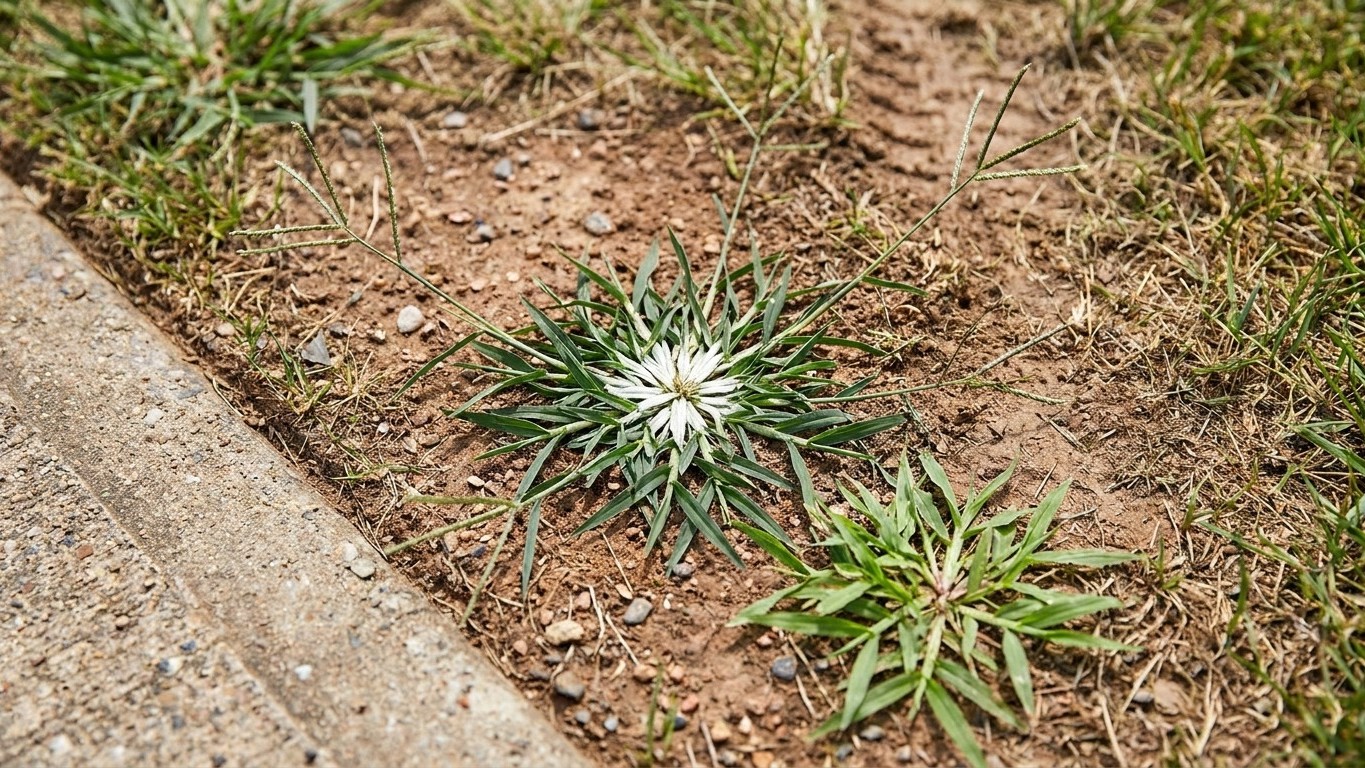

Georgia grows lawns from both ends of the grass calendar, which is why the “mow at three inches” advice that works in Ohio or the Carolinas only applies to half the yards here. A tall fescue lawn wants that height. A zoysiagrass or bermudagrass lawn wants less than half of it, cut down to 1 to 2 inches. Find out which grass you actually have before you touch the deck height lever.
The mowing height for Georgia lawns
Georgia sits in what turf agronomists call the transition zone, and it grows recommended lawns from both the cool-season and warm-season groups. The Clemson Cooperative Extension, in its Selecting a Lawn Grass guide (HGIC 1214), lists tall fescue, Kentucky bluegrass and perennial ryegrass on the cool-season side, and zoysiagrass and bermudagrass on the warm-season side. Each carries its own published mowing height, and the two groups are not close enough to round off against each other.
| Grass | Season type | Mowing height |
|---|---|---|
| Tall Fescue | Cool-season | 3 to 3.5 inches |
| Kentucky Bluegrass | Cool-season | 2 to 3 inches |
| Perennial Ryegrass | Cool-season | 1.5 to 2.5 inches |
| Zoysiagrass | Warm-season | 1 to 2 inches |
| Bermudagrass | Warm-season | 1 to 2 inches |
The cool-season grasses, tall fescue in particular, carry most of their food-making leaf surface above ground and lean on a deep, coarse root system to get through a Georgia summer. Cut a fescue lawn down to bermudagrass height and you strip away the shade the plant casts on its own soil, and the roots that were built for a three-inch canopy cannot support a one-inch one. Zoysiagrass and bermudagrass work the opposite way. They spread by stolons and rhizomes that creep along the surface, so they build density sideways rather than upward, and a low, tight cut is what encourages that spread instead of fighting it.
Neither grass family is the automatic right answer for a Georgia yard, which is the trade-off that makes this state’s lawn advice harder than most. A cool-season fescue lawn stays green through winter but struggles and can thin badly in the heat of a Georgia July. A warm-season bermudagrass or zoysiagrass lawn shrugs off that same July heat but goes dormant and brown from roughly October through April. Neither is a mistake. It is a decision about which season you are willing to look at a less-than-green lawn, and the mowing height follows from whichever grass you already chose or inherited with the house. If you are still working out the basics of blade sharpness, mowing frequency and clipping management, the fundamentals in Mowing a Lawn are worth reading before you fine-tune height by species.
Raising the deck when the heat comes
The heights in the table above are not fixed year-round. Most guidance for both grass families is to run the deck at the upper end of the range through the hottest stretch of summer, which for tall fescue means holding closer to 3.5 inches than 3, and for zoysiagrass and bermudagrass means sitting nearer 2 inches than 1. A taller blade shades the soil surface and the crown of the plant, and that shade is what slows the moisture loss a Georgia summer is otherwise very good at causing.
What the summer rainfall figures mean for your mower
At the Atlanta reference station, NOAA’s 1991-2020 climate normals put summer rainfall at about 13.6 inches across June, July and August, out of roughly 50.4 inches for the year. Broken down by month, that is 4.54 inches in June, 4.75 in July, and a drier 4.3 inches in August, the driest of the three summer months. That sounds like enough rain to carry a lawn on its own, but it rarely arrives that way. A lot of Georgia’s summer rain comes as a single afternoon thunderstorm that dumps hard and runs off a compacted or clay lawn before it soaks in, and on sandy soil the same rain can drain through within a day. Days that reach 90°F or higher push evaporation up regardless of what fell the day before. None of that is a fixed number you can plan a mowing schedule around. It is a reason to keep the deck high enough to buy the lawn some shade, and to let a rain gauge on your own property, not a station average, tell you when supplemental watering is actually needed.
Other parts of Georgia will not match the Atlanta figures. The coastal plain tends to run wetter and milder, north Georgia and the mountains cooler, and a lawn on a slope or in a rain shadow can see a fraction of what falls a few miles away. Treat the Atlanta normals as a starting expectation, not a guarantee for your own yard.
The one-third rule, and why it is not arbitrary
The rule that gets repeated everywhere, never remove more than a third of the leaf blade in a single cut, is not a rounded-off suggestion. A grass plant stores a portion of its energy reserves in the lower part of the leaf and in the crown, and taking off more than a third at once forces the plant to draw on root reserves to recover, right when you want those reserves going into root growth instead. Do this repeatedly and the root system shrinks, which is exactly the wrong direction in a state where deep roots are what get a lawn through a dry August.
Running the math against the heights above
The one-third rule only means something once you attach it to an actual mowing height. Take a tall fescue lawn kept at 3 inches. The one-third limit means you should be back out mowing before the grass reaches about 4.5 inches, not waiting until it is knee-high and then scalping it back down to 3 in one pass. A bermudagrass lawn held at 1.5 inches has far less room to work with: by the one-third rule, that lawn needs cutting again before it reaches roughly 2.25 inches, which in fast summer growth can mean mowing every four or five days rather than once a week.
- Fescue at 3 inches: mow again by about 4.5 inches
- Bluegrass at 2.5 inches: mow again by about 3.75 inches
- Zoysiagrass at 1.5 inches: mow again by about 2.25 inches
- Bermudagrass at 1.5 inches: mow again by about 2.25 inches
This is also why a lawn that got away from you during a rainy week should be cut down gradually, over two or three mowings a few days apart, rather than forced back to its normal height in one go. It costs you an extra pass with the mower. It does not cost you the lawn.
The first and last cut of the year
Timing the first and last mow of the season matters as much as the height you set. NOAA’s 1991-2020 climate normals for the Atlanta station put the last spring freeze between March 11 and March 29, and the first fall freeze between November 13 and December 1. Those are ranges, not single dates, because freeze timing genuinely varies year to year and county to county. North Georgia and the mountains tend to freeze several weeks earlier in fall than that Atlanta window, and the coastal plain tends to run milder on both ends.
Spring green-up
For warm-season lawns, bermudagrass and zoysiagrass, many Georgia gardeners scalp the lawn down low in early spring, before green-up starts, to remove the winter’s dead tan blades and let sunlight reach the crown faster. That scalp is a one-time exception to the normal mowing height in the table above, done once green-up is clearly underway rather than on a fixed calendar date, since the freeze range above shows how much that timing can shift year to year. Cool-season fescue does not get scalped. It simply resumes mowing at its normal 3 to 3.5 inches as spring growth picks up.
The last cut before dormancy
Going into fall, the pattern reverses. Cool-season fescue is approaching its most active growth period as temperatures drop and should stay at its regular height or a touch higher, never scalped, heading into winter. Warm-season bermudagrass and zoysiagrass, on the other hand, are heading into dormancy and are often mowed slightly lower for their last couple of cuts before growth stops, so the lawn does not go into winter carrying excess leaf that mats down under cold, wet weather. Because the first fall freeze at the Atlanta station falls somewhere in that November 13 to December 1 window, and other parts of the state freeze earlier or later still, the safest approach is to watch the grass itself, its growth rate slowing and color starting to fade, rather than mowing to a date on the calendar. If you want more detail on adjusting frequency rather than just height across the season, the practical steps in Mowing a Lawn cover that ground.
Common questions
What happens if I mow bermudagrass at fescue height?
It will thin out and get puffy rather than dense, because bermudagrass builds thickness through low, tight growth and a tall cut lets it go leggy instead. It also opens the canopy to weeds that a properly low, dense bermuda lawn would normally crowd out.
Can I mix a cool-season and warm-season lawn in the same yard?
It happens more than people plan for, usually where bermudagrass creeps into a fescue lawn from a neighboring yard or a previous owner overseeded warm-season turf with ryegrass for winter color. Mowing height has to be a compromise in that situation, and neither grass will look its best, which is one more reason to know which grass dominates before setting the deck.
Do I need to change my mower blade for a lower cut like bermudagrass?
Not the blade itself, but a sharp blade matters more at low heights, not less, because a dull blade tears rather than slices and that damage is far more visible on short turf than on a tall fescue lawn where the cut edge is higher up and less noticeable.
How do I know which grass is actually in my lawn?
Look at growth pattern and season: a lawn that stays green through winter and grows fastest in spring and fall is almost certainly a cool-season grass like tall fescue, while one that turns brown after the first fall freeze and greens back up once it warms is warm-season, most likely bermudagrass or zoysiagrass in Georgia. If it is not obvious, the county office of the UGA Extension (extension.uga.edu) can help identify it.