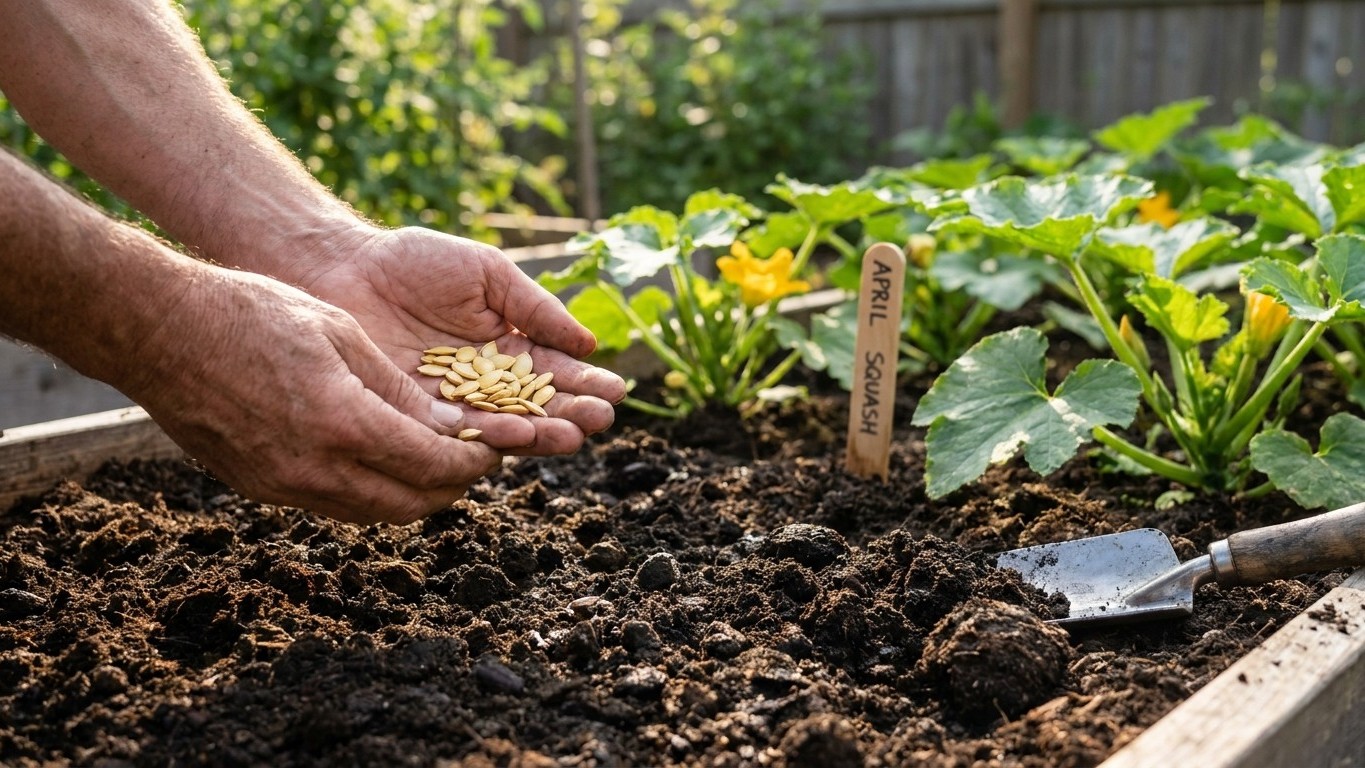

In western Washington, direct-seed summer squash outdoors from late May through mid-June, once soil has actually warmed, not simply after the last frost date passes. The frost window itself (February 27 to March 18) is misleading here: it tells you when freezing risk drops, not when the ground is warm enough for a squash seed to sprout instead of rot.
The short answer for Washington
The frost dates on this page come from NOAA’s 1991-2020 Climate Normals at station USW00024233, and they cover western Washington only, the mild maritime side of the state. Last spring frost falls between February 27 and March 18. First fall frost arrives between November 13 and November 30. That’s a long freeze-free window on paper. In practice, summer squash growers here don’t plant in March or even April, because cold, waterlogged soil and short daylight keep germination weak no matter what the thermometer says overnight.
What actually sets the sowing date is soil temperature catching up with the calendar, which in this climate happens well after the frost risk has faded. Late May through the first two weeks of June is the practical window for direct seeding in western Washington’s maritime zone. Gardeners who want a head start can set out transplants a couple weeks earlier, but only under some kind of cover, since squash seedlings sulk in cold, damp ground even when the air temperature looks fine.
Work backward from the fall side too. First frost lands sometime between mid-November and the end of the month. Most summer squash varieties need somewhere in the neighborhood of 50 to 65 days from seed to first harvest. Planting in late May to mid-June leaves a wide cushion before that fall frost date, which is exactly why there’s no rush to push seeds into the ground earlier than the soil allows. The real constraint in this territory isn’t running out of season, it’s waiting for the season to actually start warming the soil.
One more thing worth flagging: these frost dates come from a single reference station representing the mild, marine-influenced part of the state. Nothing in this page’s facts describes eastern Washington’s high desert conditions, and that gap matters enough that it gets its own section below.
What will not work here
Seeding early because the last-frost window opens in late February is the most common mistake in this region. A gardener who plants Summer Squash in March or early April, reasoning that the frost risk has already dropped, will usually watch the seeds sit and rot rather than sprout. Western Washington’s spring soil stays cold and heavy with moisture long after air temperatures climb, and squash seeds are unforgiving about that: they need genuinely warm ground, not just frost-free air, to germinate reliably.
Treating this like a hot-summer garden is another failure point. The reference station logs an average of only 3.0 days a year at or above 90F. That’s a low heat load compared to inland growing regions, and it means summer squash here rarely gets the sustained warmth that pushes rapid fruit set. Varieties bred and marketed for scorching, high-heat climates can underperform in this cooler maritime pattern, setting fewer flowers and ripening slower than their seed-packet timelines suggest.
Watering on a fixed weekly schedule is the third trap, and it cuts the opposite direction from what a “rainy Washington” reputation implies. Summer rainfall across June, July and August averages only about 3.0 inches total, with July, the driest month, delivering just 0.6 inches. Squash has shallow, thirsty roots, and a July dry stretch on fast-draining soil can leave plants stressed well before a once-a-week watering schedule catches up. The general dampness of the region doesn’t mean summer moisture takes care of itself.
Finally, planting too densely under western Washington’s characteristically overcast, dew-heavy summer mornings invites airflow problems. Squash packed tight in a maritime climate holds moisture on its leaves longer after those cool, damp nights, which is the kind of condition that lets powdery mildew take hold. Wider spacing than a seed packet’s generic recommendation earns its keep here.
What changes across Washington
Washington’s USDA hardiness zone range runs from 4a all the way to 9a, one of the widest spreads a single state can post, and that gap alone should warn against treating any statewide planting date as universal. The frost and rainfall figures cited above come from a reference station representing the mild, marine-tempered western side of the state. Eastern Washington, once you’re past the Cascades, is high desert country: shorter growing seasons, harder winter cold, and a very different relationship between last frost and soil warm-up than what’s described here.
A gardener at higher elevation, whether in the Cascade foothills or in a colder eastern valley, is working with a compressed season on both ends: a later last frost and an earlier first frost than the western Washington dates given above. That squeeze means summer squash there needs faster-maturing varieties and a planting date that doesn’t wait as long into June as the maritime window allows, since there’s less season to spare after that.
None of this can be pinned down to a single number for “eastern Washington” or “high elevation Washington” on this page, because the facts available here are specific to the western reference station. What the hardiness zone range makes clear is that there is no single Washington planting date. A gardener should locate their own zone on the USDA Plant Hardiness Zone Map rather than assume the western Washington window applies to their yard, especially if they’re gardening east of the mountains or at meaningful elevation anywhere in the state.
Where to check this for your own county
Washington State University Extension, at extension.wsu.edu, is the resource built for exactly this gap between a statewide page and a specific backyard. This page describes what’s true across a territory using climate normals from one reference station and a hardiness zone range that spans nearly the whole USDA chart. A county extension office works from local trial data instead, and that’s a different, more precise kind of information.
Two things are worth hunting for once there. First, a county-level planting calendar, which will reflect the actual frost pattern and soil warm-up timeline for that specific area rather than the western maritime station cited on this page. Second, variety trial results for summer squash grown and evaluated in that county, since performance under local heat, rainfall, and season length can diverge meaningfully from a seed packet’s generic promises, particularly given how much Washington’s growing conditions vary from the Puget Sound lowlands to the Columbia Basin to mountain valleys.
A county recommendation beats a state recommendation every time, and this page is deliberately the state-level one: useful for understanding the mechanics of the calendar and the reasoning behind it, but not a substitute for what a local extension office has already worked out for a specific patch of ground. Anyone gardening seriously in Washington’s more extreme corners, whether that’s a cold eastern valley or a fog-prone coastal strip, will get more mileage from that county-specific data than from any statewide window.
Checking this against your own garden
None of the dates above outrank what’s actually happening in the soil. A gardener’s own observation settles the question better than any calendar, and three simple checks do most of the work.
Soil warmth by feel comes first. Reach a hand into the planting bed, a few inches down, in the morning before the sun has warmed the surface. If it feels cold and heavy rather than mild and workable, the ground isn’t ready for squash seed yet, no matter what the date says. This single check catches the most common mistake in this territory: planting on schedule instead of on soil condition.
The first flush of male flowers is the second signal. Summer squash reliably produces male blossoms before female ones, so an early run of males with no fruit-bearing females isn’t a problem, it’s the normal order of things. What’s worth watching for instead is whether female flowers eventually follow within a couple weeks; if male flowers keep appearing alone for much longer than that, it usually points to a stretch of unusually cool or overcast weather slowing the plant down, which is useful information about that particular yard’s microclimate.
First true leaves, the ones that appear after the initial rounded seed leaves, mark the third checkpoint. How quickly they show up after germination is a rough read on how warm and favorable that specific bed has been, and a gardener who tracks this from one season to the next builds a better sense of their own plot’s timing than any regional average can offer.