
Connecticut gardeners get one real shot at a melon season: transplants go in around late May to early June, after soil has had real time to warm, and the harvest window closes with the first fall frost in late October or November. Between those two points, heat load stays modest and humidity, not drought, is usually the bigger threat to a sweet melon.
When the soil is warm enough in Connecticut

The question gardeners actually ask, “can I plant now,” almost always gets answered with a frost date. For the Bridgeport reference station (USW00094702), NOAA’s 1991-2020 Climate Normals put the last spring freeze at 32°F somewhere between April 2 and April 12, based on the 30-70% probability band. That’s not a single day circled on a calendar. It’s a range in which a freeze is neither a sure thing nor a fluke, and treating it as a promise is how a tray of melon transplants ends up damaged in a cold snap that arrived exactly on schedule for the statistics, if not for the gardener’s plans.
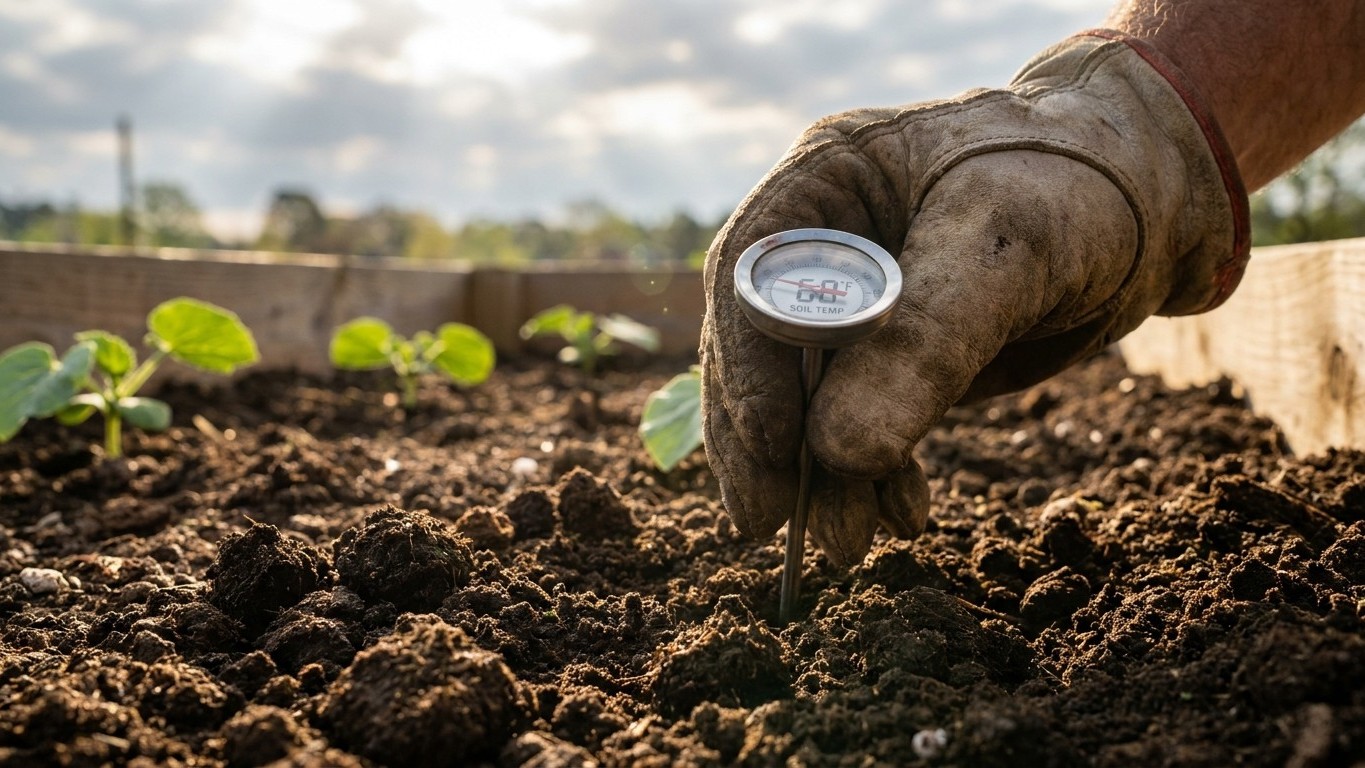
Here’s the part that trips people up: that frost date is a proxy, not the real trigger. Melons don’t care about frost risk directly. They care about soil temperature, and soil warms on its own schedule, usually two to three weeks after the last frost risk has faded. Cold, wet soil in April will rot melon seed before it germinates and will stunt a transplant’s roots even if the air temperature looks fine on a given afternoon. So the practical answer for most of Connecticut is: wait until soil in the planting bed has warmed well past that April window, not until the calendar clears the frost date.
Why zone and station matter here
Connecticut sits across USDA Hardiness Zones 6a to 7b, a range built on a single variable, average annual extreme minimum winter temperature, and it says nothing about spring soil warmth on its own. The Bridgeport station used for these frost dates sits on Long Island Sound, which makes it the mildest reference point in the state. Inland valleys and the northwest corner, including the Litchfield Hills, freeze measurably later in spring and earlier in fall than the coast does. A gardener in Torrington working from Bridgeport’s April dates alone is working from the wrong end of the state.
Two techniques do real work in closing that gap between frost date and soil readiness. Black plastic mulch laid over the bed a week or two before transplanting absorbs solar heat and warms the root zone faster than bare soil would on its own. A floating row cover placed over young plants right after transplanting buys a few extra degrees of protection on a marginal night and also blocks early insect pressure. Neither trick moves the calendar much, but together they can turn a marginal early-June planting into a safe one. For which melon types respond best to an early push versus a later, simpler planting, Connecticut gardeners are better served checking current trial results through the UConn Extension service than trusting a general date.
How long the season lasts here
Stack the two frost windows together and Connecticut’s frost-free stretch runs somewhere between about 229 and 252 days, depending on which edge of each probability band gets used, from an early last-frost date of April 2 through a late first-frost date of November 10 at one extreme, to a later spring start of April 12 and an earlier fall end of October 28 at the other. Either way, that’s roughly seven and a half to eight months of frost-free calendar, though the melon-growing season itself is shorter once the soil-warming delay on the front end and the ripening slowdown on the back end are subtracted.
That length matters because it decides a real gardening choice: is there room for a second sowing, or does the whole crop ride on one planting? In a genuinely long window, a gardener who direct-seeds or transplants in late May has enough season left after harvest to consider a fast second round timed to finish well before the fall frost risk climbs. Connecticut’s window, at its longest, gives just enough margin for that kind of succession planting if the first melons are started promptly and the type chosen matures on the earlier side. At the shorter end of the range, particularly inland where fall frost risk arrives sooner than the Bridgeport dates suggest, the first sowing is effectively the only sowing, and that changes the transplanting decision too: a gardener working a tight window benefits more from starting indoors and checking that transplants have healthy, undamaged roots before they go in the ground, since a stalled or rootbound start eats into a season that has little room to spare. The general logic of stacking plantings for a longer harvest is covered in more detail in this site’s succession sowing guide.
Heat and water in Connecticut

Melons ripen on accumulated warmth, not on the calendar, and Connecticut’s numbers say plainly that warmth is the limiting factor here, not water scarcity. At the Bridgeport reference station, the 1991-2020 normal is just 6.2 days a year reaching 90°F or higher. That’s a modest heat load. It means the growing season rarely delivers the long stretch of genuinely hot days that pushes sugar into a melon fast in the final weeks before harvest. In a territory with a heat count this low, the type of melon chosen and the soil-warming groundwork done back in spring matter more than trying to time planting around a heat wave that mostly doesn’t come.
Rainfall tells the other half of the story, and it points the same direction: away from drought stress and toward moisture management. Summer rainfall across June, July and August averages about 11.1 inches at the same station, broken down as 3.77 inches in June, 3.32 in July (the driest of the three months) and 3.98 in August. That’s a reasonably wet summer by the standards of melon country. It’s not a figure that demands the kind of irrigation planning a grower in a hot, dry territory would need to think through, where every gallon delivered in the final two weeks before harvest shapes both fruit size and sugar content.
What a cooler, wetter summer brings instead is a different set of problems. Humidity sitting on leaves for hours after a rain, or after a heavy morning dew, is what powdery mildew and other foliar diseases need to get established, and once mildew takes hold on melon foliage, ripening slows further because the plant has less working leaf area to feed the fruit. Airflow around plants, spacing that lets foliage dry out between rains, and watering at the soil line rather than overhead all matter more in this kind of climate than any drought-proofing measure would. A rain gauge on the actual garden bed, not just these regional normals, is still the only way to know whether a particular week needs supplemental water or not, since a slope, a tree line or a neighborhood’s own microclimate can push real totals well off the station average.
Which melons suit Connecticut
Given a modest heat count, a wetter-than-average summer and a frost-free window that runs long on the coast but tightens up inland, the type of melon that suits Connecticut best is one bred to finish early and to shrug off the fungal pressure that comes with humid air. Earlier-maturing types make sense almost everywhere in the state, since they don’t need to bank as many warm days to ripen, and that matters more in a territory averaging only 6.2 days a year above 90°F than it would somewhere hotter. Disease resistance, particularly to the mildews that a wet June and August favor, deserves to be the first line item checked when choosing a type, ahead of size or flavor claims, because a plant that loses its leaves to mildew in August won’t finish ripening well regardless of what the seed packet promised.
Seed catalogs change their offerings yearly, disease pressure shifts from one growing season to the next, and a variety that performs well on Long Island Sound’s mild coast may behave differently in a cooler valley in Litchfield County. The only recommendation worth trusting is one based on local trial data, gathered from actual Connecticut growing seasons, and that data lives with the UConn Extension service, not with a general gardening article. Extension trial results get updated as new disease-resistant types come to market and as growers report back on what actually finished ripening before frost in a given county.
The broader pattern holds regardless of which specific type a gardener eventually picks: favor earlier maturity over size, favor disease resistance over yield claims, and pair either choice with the soil-warming and airflow practices already covered above. A short, humid growing season punishes a slow, disease-susceptible plant far more than it punishes a smaller melon that ripens reliably before the first November frost closes things out.