
Melons can absolutely produce in Iowa, but the state’s swing-y spring, moderate heat load and humid summers mean the calendar and the type you pick matter more here than in warmer Territories. Get the soil-warming timing right, choose a resistant type, and manage water through July’s driest stretch, and a decent crop is realistic even in a 173-to-196-day window.
When the soil is warm enough in Iowa

The question every Iowa gardener asks first is simple: when can I put melons in the ground? NOAA’s 1991-2020 Climate Normals put the last spring frost, measured as the date with a 30 to 70 percent chance of a 32F freeze, somewhere between April 12 and April 24 at the reference station used for these normals (USW00014933). That’s a probability band, not a promise: some years the freeze risk clears earlier, some years it lingers past the 24th, and a late cold snap can still surprise a garden that planted on the early end of that window.
Worth flagging: Iowa State Extension’s own county-level data, built from 1950-2021 records, tends to run about four days later in spring than that airport-based figure. If you’re gardening outside the immediate metro area covered by the reference station, lean toward the later end of the range, or check your county’s own extension numbers before you commit.
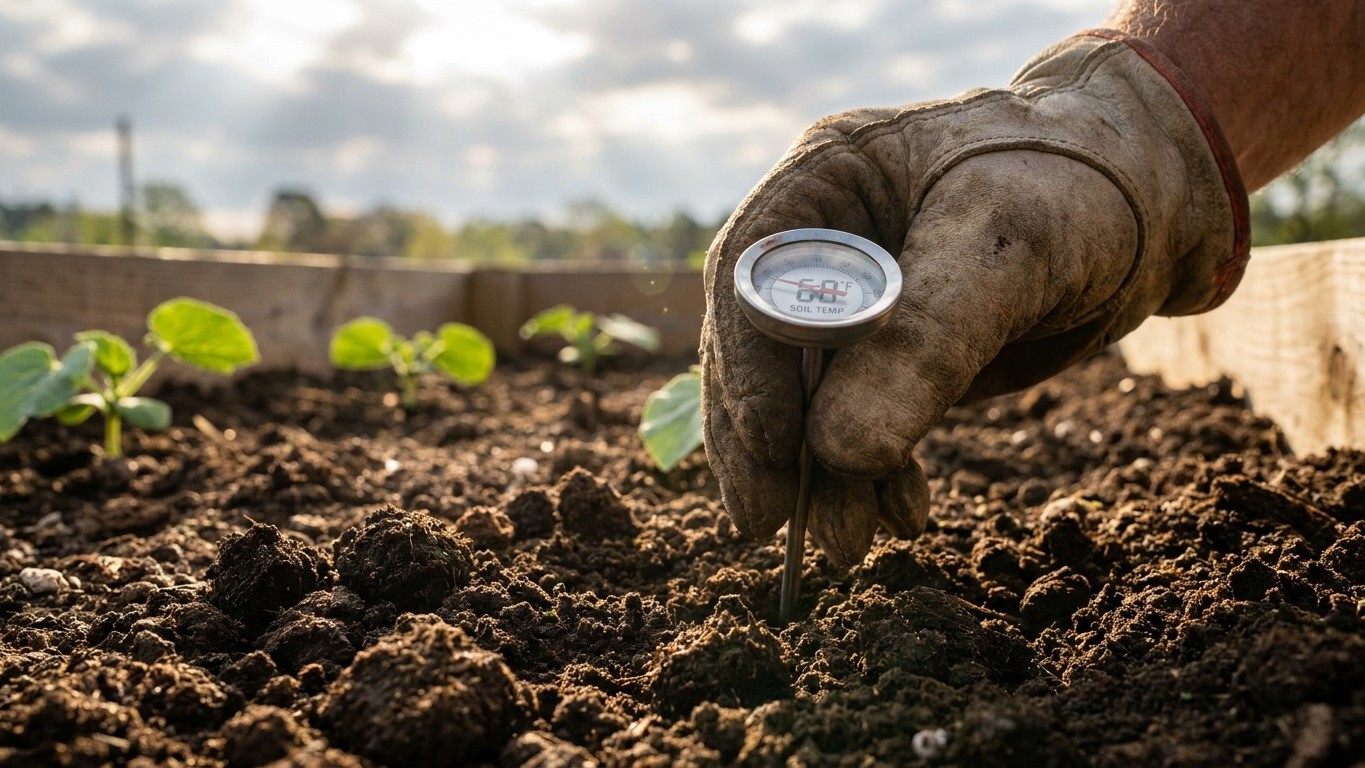
Here’s the part that trips people up. Frost date is a stand-in for the number gardeners actually need, which is soil temperature. Melon seed germinates poorly, and transplants sulk, in soil that’s still cold from winter, even once the air has stopped freezing at night. Soil lags behind air temperature by days to weeks, especially in heavier ground, so the honest rule is to wait until the soil itself has warmed rather than counting days off the frost date. Black plastic mulch, raised beds, or simply waiting two to three weeks past the last-frost window are the practical ways gardeners close that gap in a state where spring can stall.
Iowa’s hardiness range, 4b to 6a on the USDA Plant Hardiness Zone Map (2023 edition, built on 1991-2020 normals), reflects that same variability: it’s a statewide range built on winter extreme lows, not a single number, and it shifts depending on where in the state you’re standing. None of this tells you which melon type to plant yet, only when the ground is ready to receive it. For that, talk to your local Iowa State University Extension office, which tracks soil temperature data specific to your county rather than a single statewide average.
A variety name or a days-to-maturity number can’t be handed out without a source. Those figures depend on which type you’re growing and where you source seed, and an invented number is worse than no number at all.
How long the season lasts here
Put the two frost dates together and you get the frost-free window, and in Iowa that window has real elasticity. On the milder end, from an April 12 last frost to an October 25 first fall frost, you’re looking at roughly 196 frost-free days. On the tighter end, from an April 24 last frost to an October 14 first fall frost, that drops to about 173 days. Both numbers come straight from the same NOAA station data, and the gap between them, 23 days, is exactly the kind of swing that makes a fixed planting calendar risky in this state.
That range changes what’s realistic in a garden. A window pushing 196 days gives some room to experiment: an early-maturing melon type sown as soon as soil allows, followed by a second, faster-maturing sowing a few weeks later if the first planting gets ahead of schedule or suffers early losses. A window closer to 173 days removes that margin. In the tighter version of Iowa’s season, the first sowing is effectively the only sowing, which raises the stakes on getting soil temperature and transplant timing right the first time, since there’s no real second attempt if a late frost or a rough transplant sets things back.
That distinction also affects whether transplanting from indoor-started seedlings makes sense versus direct-seeding. Melons dislike root disturbance, so transplanting only pays off when the season is short enough to justify the risk of a check in growth, or when a gardener has a controlled way to start seed early without crowding roots. In the shorter version of Iowa’s window, that calculation tips toward transplants started a few weeks ahead indoors; in the longer version, direct-seeding once soil has warmed is often the simpler, lower-risk path.
Anyone weighing a second sowing, or trying to stagger harvest instead of getting everything at once, should read the succession sowing guide on this site before deciding, since the math changes depending on which end of Iowa’s frost range applies to a given county.
Heat and water in Iowa

Melons are a warmth-accumulation crop before they’re a calendar crop: what matters is the total heat they bank over the season, not just how many frost-free days they’re given. That’s where Iowa is a middling territory rather than a hot one. The Des Moines reference station averages 18.4 days a year at or above 90F, a modest count next to the warmer melon territories further south. That number means Iowa gardeners shouldn’t assume heat will do the work automatically. Choosing a faster-maturing type and using soil-warming techniques, like dark mulch or raised beds that heat up faster than flat ground, matters more here than picking a planting date and hoping.
Rainfall tells a different part of the story. Summer rain across June, July and August averages about 13.2 inches, out of 36.5 inches for the year, with July running driest at 3.82 inches against June’s 5.26 and August’s 4.17. That’s not a drought pattern, and it’s not the kind of dry-summer territory where irrigation alone decides fruit size and sugar. It’s closer to the opposite problem: with moderate heat and a summer that isn’t especially parched, the bigger risk in Iowa is too much moisture sitting around plant leaves and root zones, not too little.
What a moderate, humid summer means for melons
A cooler, damper summer, relative to hot-climate melon country, brings its own set of headaches: powdery and downy mildew find easy footing on melon foliage when humidity lingers, ripening slows when heat accumulation falls short, and fungal disease pressure builds over a wet July more than it would in a drier, hotter state. None of that means irrigation is irrelevant, since July’s 3.82 inches can still fall as a handful of heavy storms rather than steady soaking rain, leaving gaps between them where a sandy garden dries out fast even in a summer with decent totals on paper. But the bigger lever in Iowa is airflow, spacing and disease-resistant stock, not simply running more water.
| Month | Average rainfall |
|---|---|
| June | 5.26 in |
| July | 3.82 in |
| August | 4.17 in |
These are 1991-2020 normals for one reference station, not a forecast and not a guarantee for any individual yard. Soil type changes how far that rain goes, since a sandy garden lets July’s rain drain through in a day while clay holds it for a week, and a rain gauge on the actual plot settles the question better than a regional average ever will.
Which melons suit Iowa
Given all of that, the right way to answer “which melon” is by type, not by name. Iowa’s moderate frost-free window, sitting between 173 and 196 days depending on location, favors earlier-maturing types over ones bred for long, hot growing seasons; a type that needs a very long stretch of accumulated heat to finish is fighting both the state’s modest 18.4 days above 90F and its tighter-end frost window at the same time. Types bred for shorter seasons and cooler soil tolerance are the more forgiving starting point across most of the state.
The state’s humidity and summer rainfall pattern raise disease resistance to the top of the list of things worth checking before buying seed, ahead of size or flavor claims. A type with some built-in resistance to powdery mildew or other foliar disease has a real advantage in a state where July humidity lingers around the plant canopy. Airflow, spacing plants further apart than a seed packet’s minimum, and keeping foliage as dry as practical when watering all support whatever resistance the type itself brings.
Seed catalogs turn over, regional trial results shift year to year, and a name printed here could be discontinued or simply wrong for a specific county’s soil and microclimate by the time someone reads it. The trial data that actually matters, which varieties performed well in Iowa’s own test plots under Iowa’s own conditions, lives with Iowa State University Extension, and that’s the only recommendation worth trusting over a generic list. That caution is not a gap. It’s the same caution that should apply to any planting advice that claims to know a specific county’s soil and season better than the county’s own extension service does.