
Yes, melons grow well in Nebraska, though the state’s continental swings make timing the real skill. Wait until the soil itself has warmed, not just until the frost risk passes near Omaha in mid-to-late April, and count on a frost-free window of roughly six months. Summers run hot enough for good sugar, but rainfall alone won’t carry a melon patch through July.
When the soil is warm enough in Nebraska
Most gardeners fixate on the frost date, but that date is only a proxy for the number that actually matters: soil temperature at root depth. At the Omaha reference station, NOAA’s 1991-2020 Climate Normals put the last spring 32°F freeze in the 30-70% probability band between April 12 and April 23. That’s a range built from three decades of freeze data, not a single guaranteed date, and it describes the airport station itself. Gardens in suburban yards and rural low spots typically see their own last frost run later, sometimes by one to two weeks, so treat the airport figure as a starting reference and confirm timing against your own county’s pattern before you commit seed to ground.
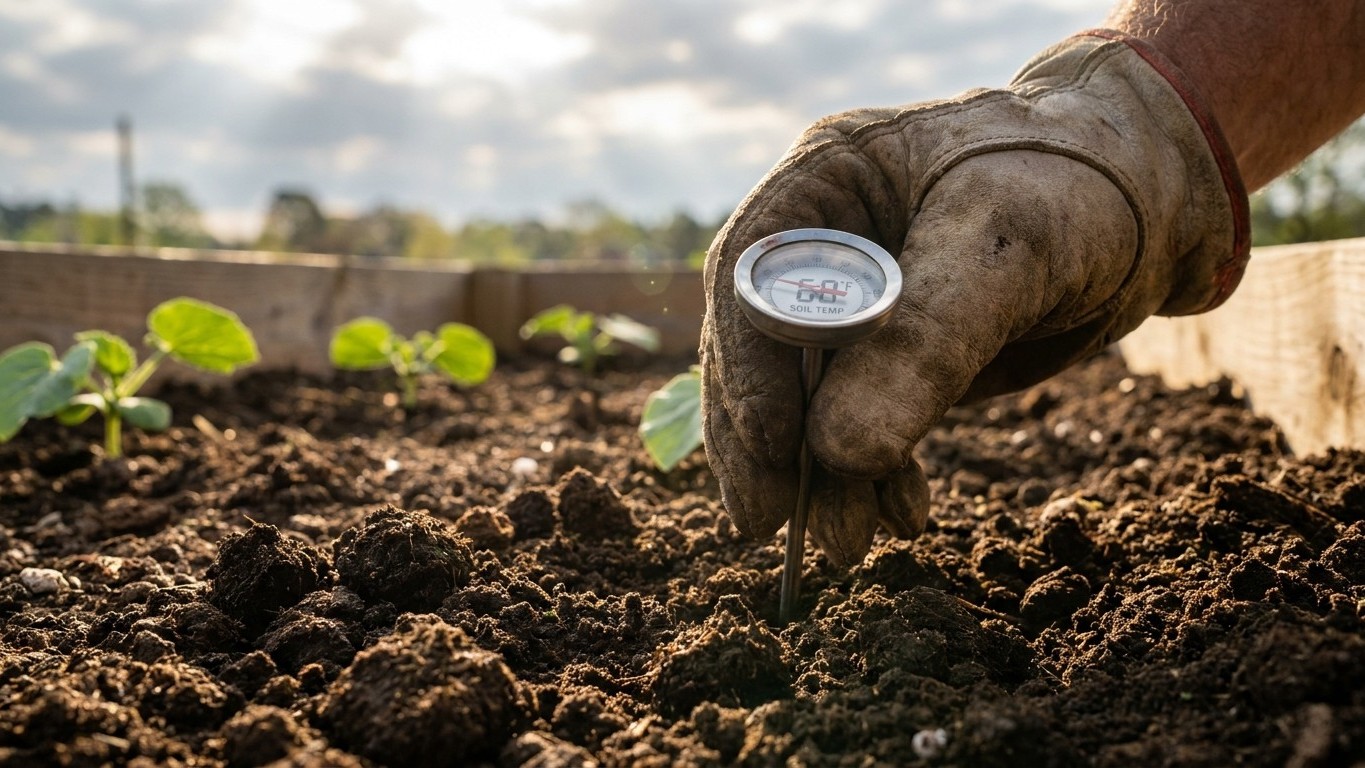
Melon seed germinates poorly and roots sulk in cold soil, and a chilled seedling rarely catches up over the season. Soil at four inches down usually needs a run of consistently warm days before it holds enough heat for melons, which in practice means waiting two to three weeks past the last frost date rather than sowing the moment frost risk clears. That gap is where a soil-warming practice earns its keep: laying dark plastic mulch over the bed a week or two before planting, or using low tunnels and row cover early on, both raise root-zone temperature faster than bare soil left to warm on its own.
Nebraska’s hardiness zones, under the USDA Plant Hardiness Zone Map (1991-2020 normals), run from 4a in the state’s colder northwest to 5b in parts of the southeast. That range is built on one variable, the average annual extreme minimum winter temperature, so it speaks to what survives winter, not to spring planting dates directly. Still, it’s a useful shorthand for how much cold risk a given part of the state carries, and it’s worth checking where your own county falls before assuming Omaha’s dates apply exactly to you.
None of this points to a specific variety name, because no single cultivar list fits the whole state. Your best move is checking which melon types have actually been trialled for your region through the University of Nebraska-Lincoln Extension, since a variety that performs well in the Panhandle’s shorter season may struggle in the warmer southeast, and vice versa.
How long the season lasts here
Pair the last spring frost (April 12 to April 23) with the first fall frost, which NOAA’s same 1991-2020 normals place in the 30-70% band between October 15 and October 26 at the Omaha station. Do the subtraction consistently, using the earlier date at both ends or the later date at both ends, and the frost-free window comes out to roughly 186 days, a little over six months. That’s a genuinely workable season for melons, which need sustained warmth more than any single early planting date to reach full ripeness.
A season this length changes what’s worth attempting. Six months gives enough runway that a first sowing failure, from a cold snap or a patchy germination, isn’t necessarily fatal: there’s often still time for a second, later sowing to mature before fall frost arrives, provided that second planting goes in reasonably early in the window rather than at the tail end. It also means the choice between direct-seeding and transplanting carries real weight. Transplants started indoors a few weeks ahead can buy extra maturing time in a marginal year, but melon roots resent disturbance, so any transplant needs a root check, and gentle handling, or the head start gets erased by transplant shock.
Where the window runs shorter, closer to the April 23-to-October 15 combination that a late spring frost paired with an early fall one would produce, that safety margin narrows and the first sowing effectively becomes the only realistic attempt. In that situation, succession sowing loses most of its appeal and the priority shifts entirely toward getting the first planting right: warm soil, healthy transplants if used, and no gambling on an early sowing date that risks a cold-soil setback.
For the mechanics of staggering plantings, and deciding whether a second sowing makes sense given your own frost dates, the succession sowing guide on this site walks through the timing math in more detail.
Heat and water in Nebraska
Melons ripen on accumulated warmth, and Nebraska supplies plenty of it. The Omaha reference station averages 28.1 days a year at or above 90°F, per NOAA’s 1991-2020 Climate Normals. That’s a substantial heat load, well above what a cool-summer northern state would show, and it means the sowing-date question matters less here than it would in a marginal climate: the type of melon and the soil-warming steps covered above do more of the work than squeezing out an extra week of calendar time.
Rainfall is the other half of the equation, and it doesn’t keep pace with that heat on its own. Summer rain at the same station averages about 12.6 inches across June, July and August, out of 31.9 inches for the full year, with July running driest at 3.55 inches.
| Month | Average rainfall |
|---|---|
| June | 4.44 inches |
| July | 3.55 inches |
| August | 4.6 inches |
That July dip lands right in the stretch when melon vines are sizing fruit and evaporation, driven by all those 90°F-plus days, is at its worst. Rain that does fall often arrives as a single thunderstorm rather than a steady soak, so a fair share of it runs off instead of reaching the root zone, especially on compacted or sloped ground. Sandy soil drains that same inch of rain within a day; clay holds it for a week; neither pattern means the garden can skip watering through July on rainfall alone. In a hot, rain-light state like this one, irrigation decides how large the melons grow, and the final two weeks before harvest, kept evenly watered rather than alternating drought and deluge, decide how sweet they end up.
Which melons suit Nebraska
Given a roughly 186-day frost-free window and a solid 28.1 days of 90°F-plus heat, most standard-season melon types have enough time and warmth to mature here, which is more forgiving than many northern states can offer. That said, gardeners in the shorter-season pockets of the state, particularly the Panhandle where zone 4a conditions and a later effective spring warm-up narrow the margin, do better sticking to the earliest-maturing types within whatever melon category they’re growing, simply to build in a buffer against a cool or late spring.
The heat load also shapes which growing habits succeed. Vines given good airflow, whether through spacing, trellising, or simply not crowding the bed, handle August humidity and heat stress better than a dense, sprawling planting, and airflow is one of the cheapest defenses against the fungal issues that build up in a hot, occasionally muggy Nebraska summer. Root-zone protection matters too: mulch that keeps soil moisture even through that dry July stretch reduces the stress cracking and blossom-end problems that uneven watering causes in melons generally.
What this page won’t do is hand over a specific variety name, and that’s a deliberate choice rather than an oversight. Melon cultivars are trialled county by county and station by station precisely because soil, disease pressure, and microclimate shift enough across a state this size that a name that thrives in a southeastern Nebraska garden can underperform in the Panhandle, or the reverse. The University of Nebraska-Lincoln Extension (extension.unl.edu) keeps current, locally-tested variety recommendations for exactly this reason, and checking there before buying seed is the one step that turns general climate knowledge into a planting decision that actually fits your ground.