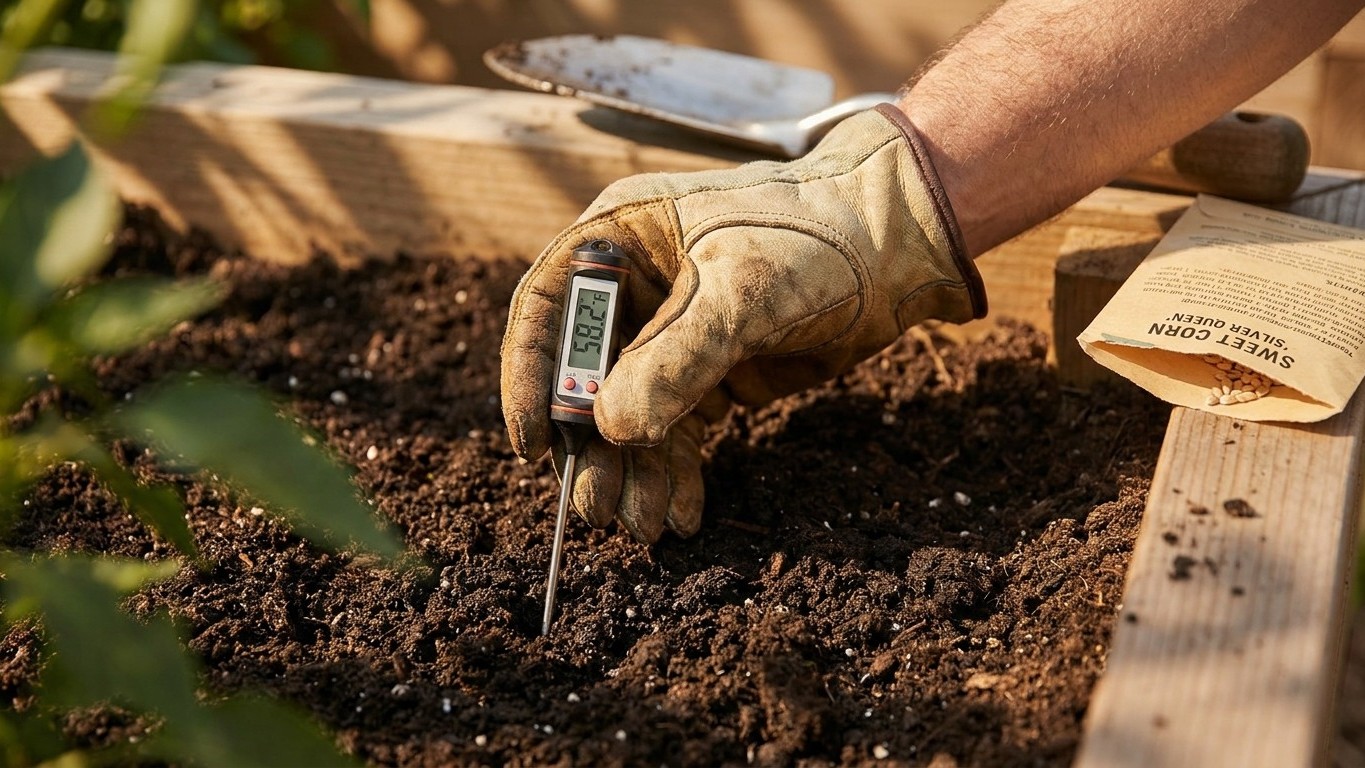

Nebraska gardeners can plant sweet corn once soil temperature holds at 60°F or above, which typically arrives well after the last spring frost of April 12 to April 23. From that planting date, a variety needs 60 to 90 days to mature, and that window has to close before the first fall frost of October 15 to October 26, a comfortable stretch in most years, but one worth checking against your own soil, not the calendar.
The short answer
The last spring frost at the reference station used here lands between April 12 and April 23. That date matters for tender transplants and tomatoes, but sweet corn seed doesn’t care about frost the way those crops do, it cares about soil temperature. Corn seed sitting in soil below 60°F simply stalls. It doesn’t die outright the way a frost-bitten tomato leaf does, but it rots more easily, germinates unevenly, and often loses the early-season vigor that determines how strong the stand looks all summer. That’s the piece that trips up a lot of first-time growers: they see the frost date pass, assume the coast is clear, and plant into soil that’s still too cold to do the seed any good.
In practice, that means Nebraska gardeners are usually waiting past the frost date itself before soil is reliably at 60°F. In a cool, wet spring that wait stretches longer; in a dry spring closer to the Kansas line, it can come sooner. There’s no single date for it here, and no source we’re citing publishes one for this region, so the honest answer is to check the ground directly rather than trust a calendar square. A simple soil thermometer, pushed a couple inches down at mid-morning on a few consecutive days, tells you more than any planting chart.
Once that 60°F threshold is met, the math shifts to the other end of the season. Sweet corn needs 60 to 90 days from planting to harvest, depending on the variety, and that stretch has to fit before the first fall frost, which averages between October 15 and October 26 at the reference station. Even accounting for a later-than-usual soil warm-up, the gap between a reasonable planting window and that fall frost date leaves real room to work with in most of the state. It’s tighter in a cold, delayed spring, and it’s tighter still if you’re gardening at higher elevation or in a low-lying spot that traditionally frosts earlier than the county average, both the spring and fall dates here can run a week or two off from what a home garden actually experiences, later in spring and earlier in fall. Check your own site’s history before you lock in a date.
Does a late variety fit here?
A 60-day variety
A short-season type maturing in around 60 days is the easy case. Planted once soil hits 60°F, even a cautious estimate puts harvest well within summer, with a wide cushion before the first fall frost arrives in mid-to-late October. There’s little risk of running out of season with a 60-day variety in Nebraska, which is part of why it’s the safer choice for gardeners who got a late start, had a cool spring, or simply want a lower-stress first planting. The tradeoff, as with short-season corn anywhere, is usually flavor and yield compared to a longer-maturing type, but the timing itself isn’t the concern.
A 90-day variety
A full 90-day variety asks more of the calendar, but it still fits within Nebraska’s frost windows in most years. Even a planting that gets pushed later than ideal by a slow, wet spring should still mature well before an October 15 first frost, given how much runway sits between a realistic planting date and that fall threshold. Where a 90-day variety runs into trouble in this state isn’t frost at all, it’s heat. The reference station averages 28.1 days a year at 90°F or above, and a lot of that heat load lands right in the stretch when a longer-season variety is tasseling and trying to pollinate. Extreme heat during that narrow window can dry out silks and reduce kernel fill even when the season, calendar-wise, was never in doubt. So the honest caution on a 90-day variety here isn’t “it won’t fit before frost” — it generally will, it’s that the hottest weeks of summer can land squarely on its most vulnerable stage, and that’s worth planning around with watering and timing more than worrying about the fall frost date.
| Event | Typical window (reference station) |
|---|---|
| Last spring frost | April 12 – April 23 |
| First fall frost | October 15 – October 26 |
| Days per year at 90°F or higher | 28.1 |
These figures come from the airport weather station used as the regional reference, not a statewide guarantee. Suburban and rural gardens commonly see the last spring frost land later and the first fall frost arrive earlier than this station shows, sometimes by one to two weeks, and more at elevation. Check your own county’s pattern before setting a date.
What goes wrong here
- Soil sown too cold. Planting the moment the frost date passes, without checking soil temperature, is the most common mistake in this climate. Seed sitting below 60°F germinates poorly and rots more easily. The fix is simple: test the soil directly with a thermometer over several consecutive days rather than going by the calendar, and hold off until it’s consistently at or above 60°F.
- A variety too late for the season. This is a smaller risk in Nebraska than in shorter-season states, since the fall frost window here runs into late October in a good year. But in a cold, delayed spring combined with an early fall frost near October 15, a full 90-day variety planted late loses much of its margin. The remedy is to match variety length to how late the spring actually ran that year, not how it usually runs, and to lean toward shorter-season types after a slow start.
- Sweetness lost to cross-pollination, which has nothing to do with climate. Standard (su), sugary-enhanced (se), and supersweet (sh2) types lose their distinct sweetness and texture when they tassel at the same time as each other, because their pollen mixes. This is a timing and layout problem, not a weather problem. The remedy is to avoid planting different sweetness types so that they tassel together, and to grow each variety in its own block of three or more rows rather than a single thin row, which also improves pollination overall.
Common questions
Can I plant sweet corn right after the last frost in Nebraska?
Not reliably. The last frost date (April 12 to April 23) marks when freezing air temperatures become unlikely, but soil often takes additional time beyond that to reach the 60°F sweet corn needs. Planting the same week as the frost date, without checking soil temperature, is a common way to end up with weak, uneven germination.
How many days does sweet corn actually need before harvest?
There are two separate clocks, and it’s worth keeping them apart. The 60 to 90 days you’ll see on seed packets counts from planting to harvest and tells you whether a variety fits the season at all. A second, much shorter count, 17 to 24 days, runs from when silks first emerge to when the ear is ready to pick, and that’s the number that tells you which week to start checking ears, not whether the whole crop will mature in time.
How do I know an ear is actually ready to pick?
Look for three signs together, not just one: silks that have turned brown and dry, husks that are still moist and green rather than dried out, and a kernel that releases milky juice when punctured. Any one of those signs alone can be misleading, dry silks can appear before the kernels are filled, so check all three before pulling ears.
Do I need to separate different types of sweet corn by a set distance?
The guidance behind this article doesn’t publish a distance in feet or rows, so it’s not repeated here as if it were. What matters, according to that guidance, is timing: su, se, and sh2 types lose their sweetness when they tassel at the same time. Stagger planting dates so tasseling doesn’t overlap, or stick to one sweetness type per garden in a given season, and grow each variety in a block of three or more rows rather than a single line.