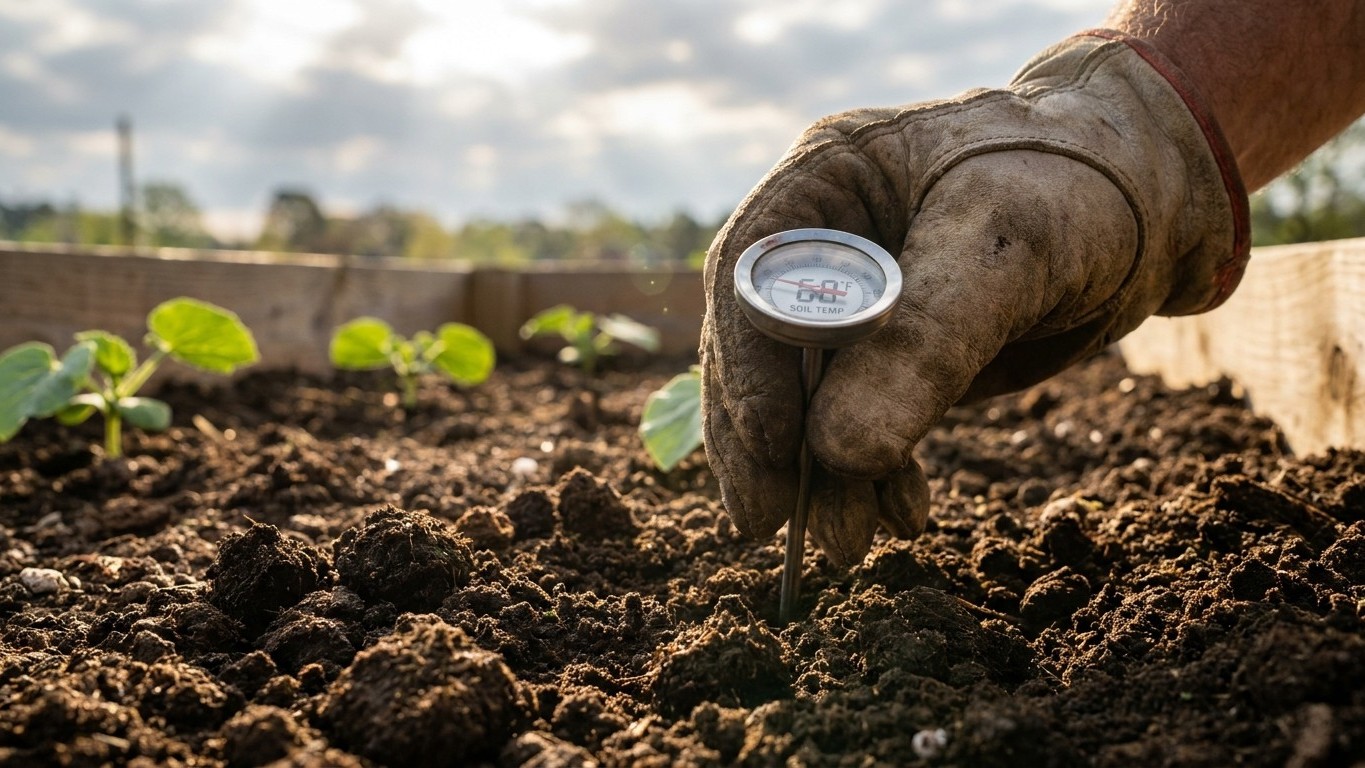

Most New Jersey gardeners can safely set out melon transplants or direct-sow seed once nighttime soil temperatures hold above 65F, which typically lines up with mid-to-late May depending on the county. The state’s frost calendar, its roughly seven-month growing window, and its humid, thunderstorm-fed summers all shape which melon types actually ripen before fall, and Rutgers Cooperative Extension keeps the variety trial data that fills in the rest.
When the soil is warm enough in New Jersey

The question every melon grower asks first is a date. At the Newark Liberty International Airport reference station, NOAA’s 1991-2020 Climate Normals put the last spring frost somewhere between March 29 and April 6, based on the 30-70% probability band for a 32F freeze. That’s the number most New Jersey planting charts borrow from, and it’s a reasonable starting point for the northern and central parts of the state.
But that date answers the wrong question for melons. Frost risk and soil temperature are not the same clock. A frost-free morning in early April tells you the air won’t kill a tender seedling that night, it says nothing about whether the ground six inches down is warm enough for a melon root to grow, or for a seed to germinate instead of rot. Melon roots stall in cold, wet soil, and seeds planted too early often just sit there while fungi get the head start. Soil in New Jersey’s clay-heavy inland areas and its sandier coastal plain warms at different rates even under identical air temperatures, which is part of why the frost date is a proxy and not an instruction.
Treat the March 29 to April 6 window as the point after which frost becomes unlikely, not the point at which planting becomes wise. Most growers here wait another three to five weeks past that date, letting the soil climb well into the 60s before seed or transplant goes in. Black plastic mulch, raised beds, or simply waiting for a warm, settled stretch in mid-to-late May all serve the same purpose: getting the root zone warm before asking it to work.
Remember, too, that a frost date is a probability, not a promise, a year can still deliver a cold snap outside that band, especially away from the paved, heat-retaining airport tarmac where these normals are measured. Suburban lawns and rural low spots tend to frost later in spring and earlier in fall than the station record shows, sometimes by a week or two. New Jersey’s hardiness range, according to the USDA Plant Hardiness Zone Map (built on average annual extreme minimum temperature), spans 6a to 7b across the state, another reminder that a single date or zone number doesn’t describe every backyard. Check your own county’s frost history, and when in doubt, ask Rutgers NJAES which melon types and soil-warming methods their trials have actually validated near you.
How long the season lasts here
Stack the two frost windows together and New Jersey’s frost-free season runs from that late-March-to-early-April start through a first fall frost of November 4 to November 16, also from the Newark reference station’s 1991-2020 normals. Depending on which end of each probability band you use, that works out to somewhere between roughly 212 and 232 days without frost, a genuinely long season by Northeastern standards, closer to what you’d expect from a mid-Atlantic climate than a New England one.
That length matters more than the raw number suggests. A window of seven-plus months gives melons, which need sustained warmth to mature, real room to work with. It also opens a door many shorter-season states don’t have: a second sowing. Gardeners in the warmer, southern half of New Jersey, especially near the coastal plain, can often get a spring-planted melon crop off the vine with enough season left to try a shorter-cycle succession sowing, rather than treating the first planting as the only shot of the year.
In the cooler northern counties and at higher elevations, where frost risk lingers later into spring and returns earlier in fall, that safety margin shrinks. There, the first sowing tends to be the only one that matters, which changes the calculus on transplants versus direct seed. Transplants save two to three weeks of field time, but melon roots resent disturbance, a root check (holding a transplant too long in a small cell tray until roots circle and stress) can undo that time advantage entirely. In a shorter effective window, a clean, undamaged root system becomes worth more than the head start.
Growers weighing whether their own season supports a second planting, and how to time it against the first, should work through this site’s succession sowing guide, which walks through spacing sowings against a known frost-free window like the one calculated here.
Heat and water in New Jersey

Melons are a crop that cares less about the calendar and more about accumulated warmth, degree-days, not just frost-free days. At the Newark reference station, the 1991-2020 normals count 20.8 days a year at or above 90F. That’s a moderate heat load: enough to push melons through their sugar-building final weeks in most summers, but nowhere near the sustained 90-degree stretches of the Deep South or the desert Southwest. It puts New Jersey in a middle zone where the type of melon chosen and the soil-warming groundwork done in spring matter more than simply picking an early planting date and hoping.
Water tells the rest of the story. Summer rainfall at the same station averages about 13.2 inches across June, July, and August, out of 46.6 inches for the year : June brings 4.34 inches, July 4.66, and August, the driest of the three, just 4.15 inches. That’s not a drought-prone total on paper, but it arrives unevenly. New Jersey’s summer rain tends to fall as thunderstorms: heavy bursts that run off a hard or sloped surface rather than soaking deep into the root zone, especially paired with the evaporative pull of those 90-degree days.
Why August dryness lines up with ripening
August being the driest month is not a small detail. It’s also, for most New Jersey melon plantings, the stretch when fruit is sizing up and building sugar, the exact window where a shortfall in soil moisture either stunts the melon or, if it’s a controlled, intentional pullback near harvest, concentrates flavor. The difference between the two is whether the grower is managing water deliberately or simply hoping August behaves. On sandy coastal-plain soils, that August rain deficit drains through fast and needs supplementing; on the state’s heavier inland clay, the same rainfall total holds longer, but drainage becomes the concern instead. A rain gauge on the actual plot, tracked against these normals, tells a grower far more than the regional average ever will.
Which melons suit New Jersey
None of this points to a single named variety, and it shouldn’t. New Jersey’s roughly seven-month season, its moderate but real heat load, and its humid, storm-fed summers each pull the decision in a specific direction by melon type, not by brand or cultivar name, and this page has no way to verify which named varieties are performing well in Rutgers’ own current trial plots.
Reasoning from the territory’s own numbers gets a grower most of the way there. The season length calculated above is generous enough to support both early-maturing and mid-season types, which is useful insurance against a cold, late spring that delays planting. The moderate heat load argues for melon types that don’t demand the longest, hottest stretches to finish, paired with soil-warming practices, like dark mulch or raised beds, that get the root zone ready sooner rather than later. And the humidity that comes with New Jersey’s thunderstorm-driven rainfall pattern makes disease resistance, particularly against the leaf and vine diseases that thrive in wet, still air, the first filter to apply before anything else, including flavor or size.
What a grower should not do is take a variety name from a national seed catalog or a gardening forum and assume it was bred with New Jersey’s particular mix of humidity and moderate heat in mind. Rutgers New Jersey Agricultural Experiment Station, reachable at njaes.rutgers.edu, runs the variety trials that actually test melon types against this state’s soils and disease pressure, county by county. That local trial data, updated as new types come through testing, is the only recommendation grounded in this specific territory, which is exactly why this page stops at type and heat load, and sends the rest of the question to the people running the trials.