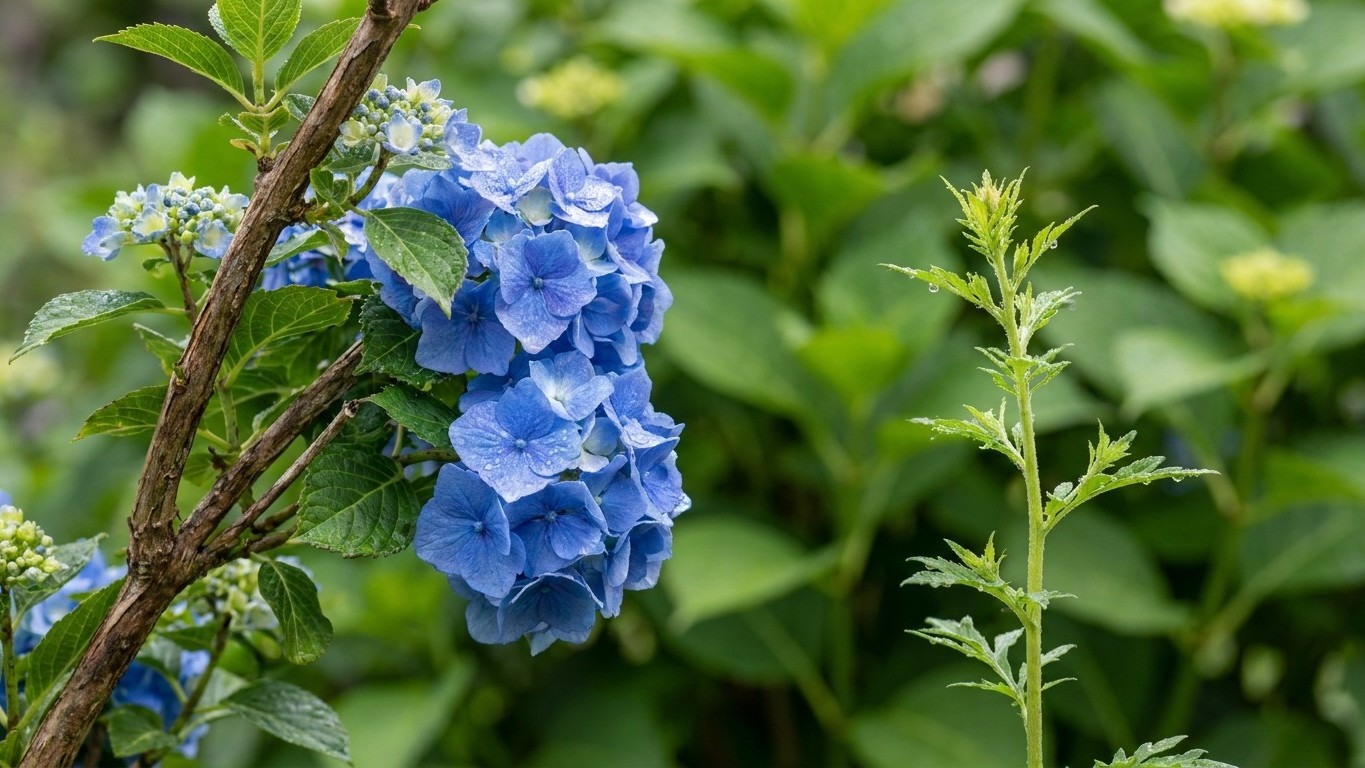

Hydrangeas turn pink in most Delaware gardens because the soil is near neutral or has been limed, and that keeps aluminum out of the plant. Blue needs soil acidic enough, generally a pH around 5.5 or lower, for the roots to take aluminum up. Pink is what a bigleaf hydrangea does by default here. Blue takes a soil test, an amendment, and some patience.
What this comes down to in Delaware
Color changes happen inside the growing season, and at the Wilmington airport reference station the last spring freeze falls April 3 to April 14, with the first fall freeze October 26 to November 7. Within that window, pink wins in most Delaware beds because the aluminum that produces blue sits locked up in soil with a pH above roughly 6.0.
Those dates are the NOAA NCEI 1991-2020 Climate Normals for the Wilmington station, built on the 30 to 70 percent probability band for a 32 F freeze. They describe an airport, not your yard. Suburban and rural gardens usually see the last spring frost one to two weeks later and the first fall frost one to two weeks earlier.
How aluminum decides the color
A bigleaf hydrangea (Hydrangea macrophylla) makes the same pigment whether it blooms pink or blue. What changes the color is whether aluminum reaches the sepals, the petal-like parts of each flower. Soil nearly always contains aluminum. Below a pH of about 5.5 it dissolves and the plant drinks it in, and the flowers go blue. Above about 6.5 it stays bound to soil particles, and the flowers go pink. In between you get purples, mauves, and flower heads that look like two different plants fused together.
Why Delaware beds drift toward pink
Even where native soil runs acidic, gardens rarely stay that way. Lawn lime drifts into adjacent beds. Concrete foundations and mortar leach alkaline compounds into the first couple of feet beside the house, which is exactly where people plant hydrangeas. Some municipal tap water is alkaline, so a hose changes the soil over a season. High-phosphorus fertilizer also pulls aluminum out of play, since phosphorus binds to it. A single bed can collect all four influences without anyone intending it.
Only certain hydrangeas respond. Bigleaf types and some mountain hydrangeas (H. serrata) shift with pH. Smooth hydrangeas and panicle hydrangeas do not, and no amount of sulfur will turn a white one blue.
Working it out for your own garden
The method has three steps: measure, set a target, then count backward from the frost window to schedule the work. It holds up in a cold spring or after a move to a different county.
Test first, then count backward
A soil test comes before any product. The University of Delaware Cooperative Extension can point you to testing options, and a basic pH reading tells you whether you are fixing a half-point or two full points. Sample the soil near the plant’s drip line, not the middle of the lawn.
Ground sulfur works slowly, because soil bacteria have to convert it to acid. As a rule of thumb (my arithmetic, not a published figure), give it six to eight weeks of warm soil before the pH moves. Count backward from the first fall frost: October 26 minus eight weeks lands around the end of August, and November 7 minus six weeks lands in late September. So sulfur goes down from late August through late September at the reference city, a bit earlier if your garden frosts early.
Aluminum sulfate acts faster, which also makes it easier to overdo. It is applied as a drench once leaves have opened. Add one to two weeks to the April 3 to April 14 window for a suburban garden and you get roughly April 10 to April 28 as the earliest sensible start, with a few follow-up drenches through early summer. Follow the label rate. Too much can burn roots, especially in sandy soil.
A worked example, and one that won’t finish
Say your test reads 6.8 beside a brick foundation, and you want blooms on a ‘Nikko Blue’ that has come in pink. You need to drop the pH by more than a full point, to 5.5 or lower. Clay soils resist that kind of shift because they buffer acidity, so expect a purple-ish season before the first true blue. If sulfur goes down in early September, the roots are already working on next year’s flowers by spring, and a spring drench finishes the job. Plan on blue in the second summer, not the first.
Now the plant that won’t finish. ‘Annabelle’, a smooth hydrangea, will stay white to lime-green at pH 4.5 or 7.5 alike. Panicle types like ‘Limelight’ fade to pink in cool fall nights as the flowers age, but that is a maturing process and has nothing to do with soil chemistry. If your pink comes in autumn and your plant is a panicle, there is nothing to correct.
What changes across the state
Delaware is small, but it holds two soil regions and a coastline, and each nudges the color outcome. The USDA Plant Hardiness Zone Map spans 7a to 8a across the state. That system rests on one variable, the average annual extreme minimum temperature. It says nothing about soil, so for color the geology matters more than the zone.
| Area | Soil tendency | Frost timing relative to the reference city | What it means for color |
|---|---|---|---|
| Northern New Castle County (Piedmont edge) | Loamier and clay-bearing, often buffered, with more variation from yard to yard | Close to the reference city, a little cooler inland and on higher ground | Acidifying takes longer in clay, and tests vary widely between neighbors |
| Kent and Sussex Counties (Coastal Plain) | Sandier and fast-draining, naturally more acidic, with less buffering | Usually milder, especially near the bay and ocean | Blue comes easier, but amendments leach out faster and need repeating |
| Beach and bayside towns | Sandy, with salt influence and often alkaline shell or fill material near homes | Warmer winters, later fall frost | Local fill can push pH up even where the region is acidic |
Elevation plays a smaller role here than in mountain states, since Delaware is low and flat. Even so, the slightly higher ground in the north tends to see frost earlier in fall than the bay shore does. That affects how long your amended soil has to work before the plant goes dormant, though the effect on color itself is small compared with soil type.
The mistakes this state punishes
Most failures here come from skipping the test and from treating all the plants in a yard the same way.
- Guessing instead of testing. Adding aluminum sulfate to a bed that is already acidic wastes money and can injure roots. In a bed at 7.2, a light dose does almost nothing. A test avoids both errors.
- Planting right against the foundation. The alkaline halo around concrete and mortar keeps pulling pH upward. Leave a few feet of separation, or plan on retreating that bed every season.
- Feeding with high-phosphorus fertilizer. It makes pink easier and blue harder. Choose a formula low in phosphorus for hydrangeas you want blue.
- Acting on a warm spell. A mild stretch in late March can tempt you to drench early. A freeze inside the April 3 to April 14 window, or later in an inland garden, can still burn new growth, and frozen-back buds mean no flowers to color at all.
- Treating the wrong plants. Spending a season acidifying a panicle or smooth hydrangea is wasted effort.
Frost damage and flowering are linked. Bigleaf types bloom on old wood, so a hard pruning or a late freeze can remove the very buds you were trying to color. The timing advice in When to Prune Hydrangeas in Delaware and the cold-season steps in Protecting Hydrangeas Through a Delaware Winter keep that from happening. Better to have pink flowers than none.
Checking this against your county
The frost dates in this article belong to one reference city. They are a starting point, not an instruction, and the soil under your plants may differ from your neighbor’s. Your county office of the University of Delaware Cooperative Extension can tell you what is typical for your area and help with a soil test. For the broader picture of site, planting, and care, the state guide on growing hydrangeas in Delaware covers what this page leaves out.
Common questions
Can a white hydrangea turn blue?
No. White bigleaf cultivars lack the pigment that aluminum acts on, and smooth and panicle hydrangeas do not respond to soil pH at all. Only pink, blue, and purple bigleaf and mountain hydrangeas can shift.
How long does it take to change the color?
Expect most of a growing season, and in heavy clay sometimes two. Sulfur is slow, aluminum sulfate quicker, and either needs the roots to take up the change while buds are developing. A plant that was pink this summer will rarely be fully blue the next one if the soil started far above pH 6.
Why do I get blue and pink flowers on the same shrub?
The pH around the roots is uneven, often because one side sits near a foundation or a limed lawn. Different roots feed different branches, so you see patchwork color. Treating the whole root zone evenly usually smooths it out over time.
Is it easier to keep blue hydrangeas in pots?
Yes, because you control the mix. An acidic potting blend and rainwater instead of alkaline tap water keep the pH steady. The catch is winter, since roots in a container freeze harder than roots in the ground, so pots need shelter once the first fall frost window of October 26 to November 7 at the reference city approaches. Gardens inland may reach it sooner.