
Yes, melons can be grown in the Northwest Territories, but only with season-extension tricks and realistic expectations. The territory’s frost-free window averages 116 days, days above 90°F are essentially zero, and soil warms late even after the air clears, so success here depends less on which melon you pick and more on how you warm the ground and protect it through a short, cool summer.
When the soil is warm enough in Northwest Territories
Gardeners always ask for a date. At the reference station YELLOWKNIFE A, Environment and Climate Change Canada’s 1981-2010 Climate Normals put the average last spring frost at May 25. That figure is a mean, not a guarantee: in half of the years on record, frost struck after that date. Treat May 25 as the midpoint of a risk window, not a green light, and remember that Yellowknife is one station in a territory where northern and upland districts run weeks colder still.
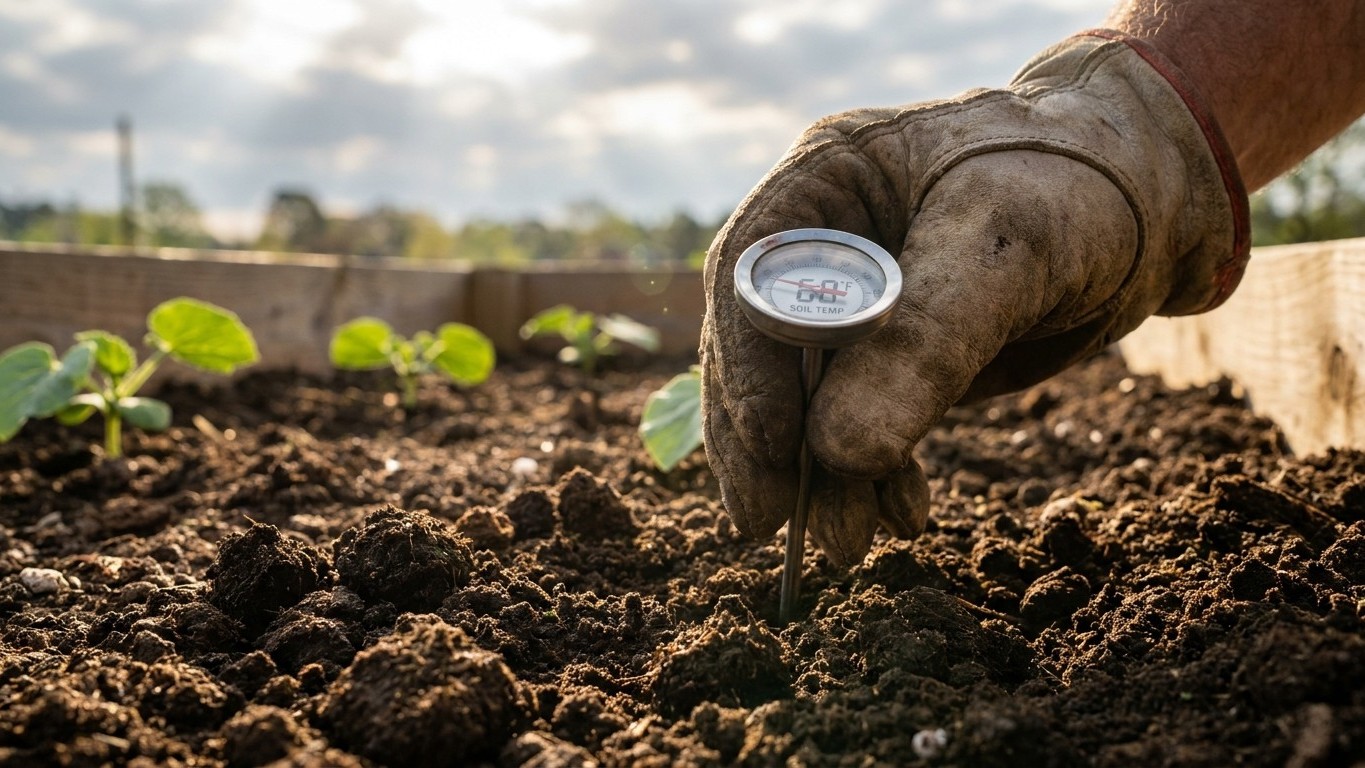
Frost dates matter for melons only as a rough proxy. What actually decides sowing or transplanting is soil temperature, and soil warms slower than air. Even once the risk of a killing frost has passed, bare Northwest Territories soil in late May is still cold to the touch, and melon roots stall in cold ground long before the leaves show any damage. That lag between “frost is over” and “soil is warm enough” is the single biggest reason melon growing here takes deliberate technique rather than a calendar date.
Warming the ground artificially
Because the natural warming curve is so slow, most successful attempts in this territory rely on raising soil temperature by hand: black plastic mulch laid over the bed for a couple of weeks before planting, raised beds that drain and warm faster than flat ground, and low tunnels or cold frames that trap daytime heat around young plants. Starting melons as transplants indoors, then hardening them off and moving them into pre-warmed soil, is the standard workaround for a season this short and a hardiness zone this cold, the Northwest Territories sits at Canadian hardiness zone 1b for the reference city in these figures, a zone drawn from Natural Resources Canada’s seven-variable system and one that has no direct equivalent on the USDA scale used elsewhere on this site.
None of this points to a specific melon variety, and it shouldn’t. The types that actually perform in a given community depend on trial data that only a local extension service holds, and inventing a variety name here would be worse than useless. What’s fixed and verifiable is the soil-warming task itself: get the ground warm before you commit a transplant to it, because in this climate the plant’s tolerance for cold roots, not for cold air, is what fails first.
How long the season lasts here
Subtracting the two mean dates from the Yellowknife record, average last spring frost May 25 and average first fall frost September 18, gives a frost-free window of about 116 days. That’s the number to plan around, and it’s shorter than what most melon-growing regions further south work with.
| Marker | Average date |
|---|---|
| Last spring frost | May 25 |
| First fall frost | September 18 |
| Frost-free window | about 116 days |
A window this length changes the whole strategy. In regions with a longer frost-free season, gardeners can often sow a second round of a fast crop once the first planting finishes, staggering harvests through summer. Here, 116 days on average leaves little slack for that: the first sowing (almost always a transplant, given how late the soil warms) is effectively the only shot at a full melon crop in a given year. That’s also why the root check on transplants matters more in a short-season territory than in a long one, a plant that sulks for two weeks after transplant shock has just burned a meaningful fraction of a 116-day window it can’t get back.
None of this rules out succession sowing altogether. Fast, cool-tolerant crops with short maturity windows can still fit in before or after the melon bed is in use, and readers weighing that kind of staggered planting should look at this site’s succession sowing guide for how to sequence crops within a frost-free season this tight. But for melons specifically, the arithmetic is blunt: one sowing, timed as early as the soil allows, is the realistic plan.
Heat and water in Northwest Territories
Melons are a warm-season crop that ripens on accumulated heat, not just on days elapsed, and the Yellowknife figures make clear how little of that heat is on offer. Days above 90°F average 0.0 at the reference station, essentially none, year after year. That’s not a rounding of a small number; it’s the actual mean, and it means the territory almost never delivers the kind of hot stretch that pushes sugar into a melon fast in its final weeks. In a hot climate, irrigation and a final hot fortnight are what decide fruit size and sweetness. In the Northwest Territories, that lever barely exists, so the type chosen and the soil-warming technique used earlier in the season carry far more of the load than anything done in August.
What a cool, damp summer brings instead
Summer rainfall here averages about 4.3 inches across June, July and August, out of 11.4 inches for the year, with the driest month being June at 1.14 inches, followed by July at 1.61 inches and August at 1.55 inches.
| Month | Average rainfall |
|---|---|
| June | 1.14 in |
| July | 1.61 in |
| August | 1.55 in |
Those totals aren’t heavy by national standards, but paired with almost no days above 90°F, the risk profile flips compared with a hot southern garden. Instead of scorched leaves and a race to keep up with irrigation, the real threats in a Northwest Territories melon patch are mildew on damp foliage, slow ripening that never quite catches up before the September frost, and general disease pressure that builds in cool, humid air that doesn’t dry out quickly. Spacing plants for airflow, keeping foliage as dry as practical when watering, and choosing the warmest, best-drained spot in the garden all matter more here than any watering schedule built around heat stress, because heat stress is rarely the problem this territory presents.
Rain totals this modest still need to be read against the specific plot, not just the regional average. Sandy soil lets an inch of rain through within a day; clay holds onto it for a week and keeps roots wetter than the number alone suggests. A rain gauge on the actual bed, tracked through a season, tells a gardener here more than the territorial mean ever will.
Which melons suit Northwest Territories
Reasoned from the territory’s own numbers rather than from habit, three things point in the same direction. A frost-free window of about 116 days favors the earliest-maturing types available, because anything bred for a long, hot season simply won’t finish before the average September 18 frost arrives. Near-zero days above 90°F means the type also needs to set and ripen fruit without relying on a hot final stretch, which puts a premium on varieties known locally for reliable ripening under cool conditions rather than for maximum size. And a cool, humid summer means disease resistance, especially to the mildews that thrive in damp foliage, becomes a first-line criterion rather than an afterthought.
What this page won’t do is name a specific variety. Recommending a cultivar sight unseen, without trial data for growing conditions this particular, is the kind of advice that falls apart the moment a reader plants it and it fails to perform. The Northwest Territories Department of Industry, Tourism and Investment runs the territorial agriculture service that tracks what actually performs in local trials, and that’s the resource worth consulting directly. Their recommendations are built on plants grown in this exact climate, at this exact latitude, which is more than any generic list can offer.
Refusing to name a variety here isn’t a gap in this page. It’s the accurate answer to a question that genuinely depends on where in the territory a garden sits, what the soil does with rain, and which types the local service has already watched succeed or fail. Everything else on this page, the frost dates, the heat and rainfall figures, the shape of the season, is fixed and verifiable. The variety choice is the one part that has to come from someone watching plants grow in that specific ground.