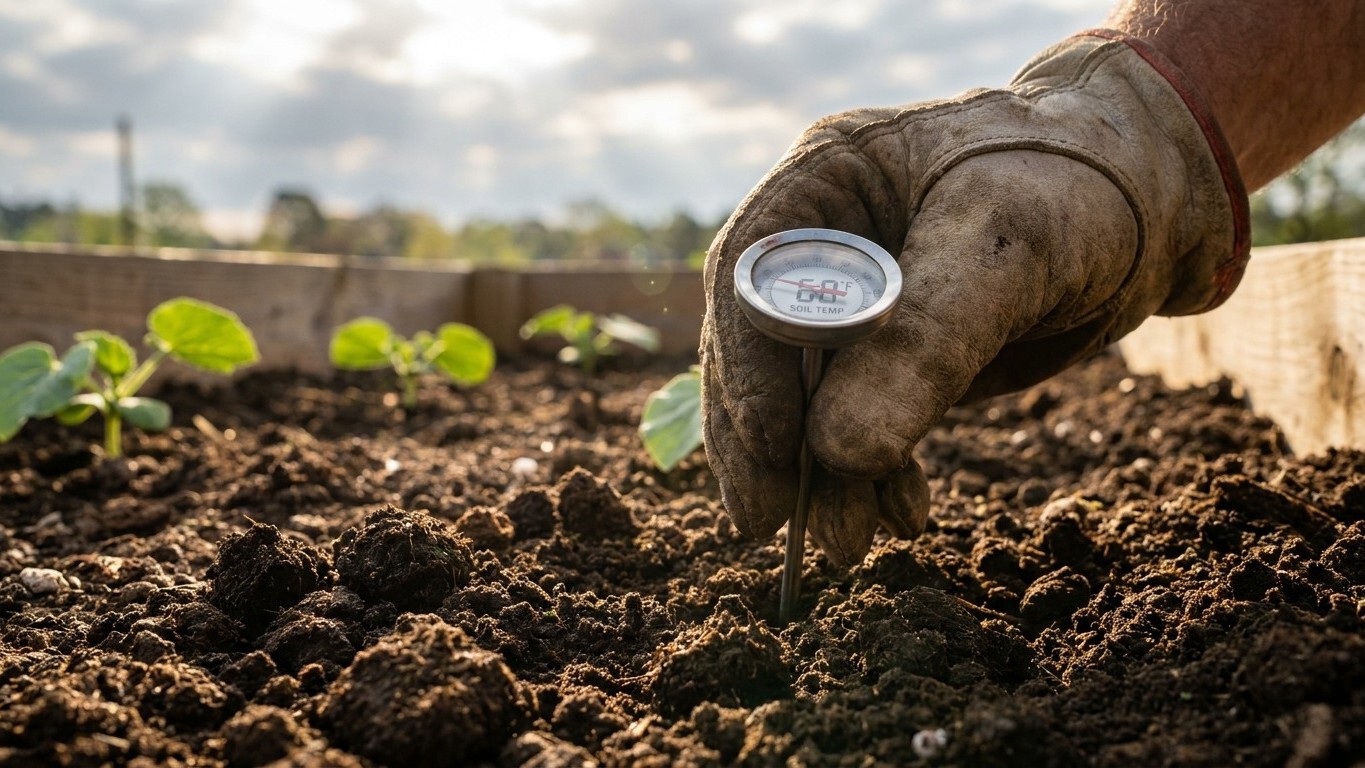

Melon seeds want to go into ground that’s already warm, not just frost-free, and in Tennessee that means waiting until well into spring even after the last freeze risk has passed. The state’s frost dates, its heat load, and its summer rainfall together decide when to plant, how long the season runs, and which type of melon actually has a shot at ripening before fall.
When the soil is warm enough in Tennessee

The reflex is to plant the day after the last frost. With melons, that’s the wrong move. NOAA’s 1991-2020 Climate Normals put the last spring frost for the reference station (USW00013897, near Nashville) somewhere between March 31 and April 12. That’s a probability window, not a promise, built from three decades of freeze data at one weather station. It tells you when the 32°F risk drops off. It does not tell you when the ground stops feeling cold to a melon seed.
Soil temperature lags behind air temperature by weeks, sometimes longer under shade or heavy clay. A frost-free morning in early April can still sit on top of soil barely above 60°F at planting depth, and melon seed germinates poorly, if at all, below that mark. The practical answer is to treat the NOAA window as the earliest the danger of freeze recedes, then give the ground another two to three weeks of uninterrupted sun before direct-seeding or setting out transplants. Gardeners who push earlier usually don’t get a killed crop from frost; they get a stalled one from cold soil, which rots seed and stunts young roots just as effectively.
East Tennessee and the Cumberland Plateau complicate this further. Both regions run cooler and later than the Nashville-area reference station used for these normals, so a date that works in Middle Tennessee can leave a Plateau garden planting into soil that’s still sluggish. Elevation and cold-air drainage matter here as much as latitude. A hollow that collects cold air overnight will lag a nearby ridge by more than the statewide averages suggest.
Black plastic mulch, raised beds, and simply choosing a south-facing slope all speed up soil warming without changing the calendar. These are the tools worth reaching for if the growing window feels tight, rather than gambling on an earlier sowing date. For the actual choice of which melon type to trust to a shorter warm-up, and which local varieties have a track record of surviving Tennessee’s variable springs, the University of Tennessee Extension keeps trial data specific to the state’s counties, and that’s a better source than any general guide can be.
How long the season lasts here
Run the two NOAA windows against each other and Tennessee’s frost-free season lands somewhere between about 199 and 222 days, depending on which end of each range you use. Take the latest spring frost date (April 12) against the earliest fall frost date (October 28) for the conservative estimate: 199 days. Take the earliest spring date (March 31) against the latest fall date (November 8) for the generous one: 222 days. Either way, that’s roughly six and a half to seven months of frost-free growing, which puts Tennessee comfortably in the range where melons have room to mature, but not so long that timing stops mattering.
That length matters most in what it allows beyond the first planting. A season stretching past 200 days gives a gardener the option of a second sowing, staggered a few weeks after the first, so that ripe melons don’t all arrive in the same ten-day stretch in late July. A shorter effective window, say if a garden sits in one of the cooler Cumberland Plateau pockets and loses two or three weeks off both ends, turns the first sowing into the only realistic one. In that case, whether to start seed indoors and transplant, rather than direct-seed, becomes a real decision rather than a preference. Melons resent root disturbance, and a poorly hardened transplant can lose more time to transplant shock than it gained by starting early. A tight season makes that tradeoff sharper: every week matters more when there isn’t a second chance to resow.
For gardeners working with the fuller end of the window, staggering plantings two to three weeks apart is the standard way to spread harvest and hedge against a bad stretch of weather knocking out one sowing. The mechanics of that timing, and how to judge whether a given territory’s season supports it, are covered in the succession sowing guide on this site.
Heat and water in Tennessee

Melons care less about how many individual days feel hot and more about the total warmth that accumulates over the season. Still, the day count is the best proxy available, and Tennessee’s reference station (Nashville) averages 40.0 days a year at or above 90°F, per NOAA’s 1991-2020 Climate Normals. That’s a moderate heat load, not a scorching one. It puts Tennessee in a middle position: not the northern territories where cool-season crops dominate and melons struggle to size up, but not the Deep South either, where 90°F days routinely stack up past 60 or 70.
At 40 days, heat isn’t the limiting factor it would be further north, but it’s also not generous enough to ignore. Black plastic mulch and dark-colored row covers that trap warmth around the root zone do real work here, nudging the effective heat accumulation upward without waiting on the calendar. This is where the choice of melon type and the choice of soil-warming technique matter more than exactly which week the seed goes in.
Rainfall tells a different part of the story. Summer totals about 12.3 inches across June, July, and August combined, out of 50.5 inches for the year. Broken down by month, the pattern is fairly even but tapers as summer goes on:
| Month | Average Rainfall |
|---|---|
| June | 4.36 in |
| July | 4.16 in |
| August | 3.79 in |
August, the driest of the three, lands right when many melon plantings are sizing fruit or finishing ripening, which is exactly the stretch where water stress hits hardest. That’s not drought-territory rainfall, but it’s not abundant either, and it rarely falls evenly. A single thunderstorm dumping an inch in an afternoon mostly runs off a clay soil rather than soaking down to the root zone, so the monthly total can look adequate on paper while the plant still goes thirsty between storms. Supplemental irrigation, even just a soaker hose on a timer through the driest weeks of August, is what decides fruit size in most Tennessee gardens, and the final two weeks before harvest are what decide sugar content. Skimping on water early costs size; skimping late costs flavor.
Humidity that comes with this rainfall pattern also feeds foliar disease, particularly in a summer where storms roll through every few days without drying out fully between them. That’s a bigger practical threat in Tennessee’s climate than either heat or drought, and it shapes which melon type makes sense here more than the temperature numbers do.
Which melons suit Tennessee
None of this points to a single variety. Reasoning by type is what the numbers above actually support, and reasoning by cultivar without local trial data is a guess dressed up as advice.
A frost-free season of roughly 200 to 222 days is generous enough that the earliest-maturing types aren’t a necessity the way they’d be in a shorter northern window, but a gardener working the cooler end of that range, especially on the Cumberland Plateau, gains a real margin of safety by favoring quicker-maturing types over long-season ones. Forty days a year above 90°F is moderate heat, which means melon types bred for airflow and light shade at the root, rather than for raw heat tolerance, tend to perform better here than varieties selected for desert-hot climates. And the humidity that comes with 12.3 inches of uneven summer rain, concentrated in thunderstorm bursts rather than steady soaking, makes disease resistance, particularly to the fungal and bacterial issues that show up in wet, warm foliage, the first thing worth checking before anything else on a seed packet.
That’s the honest limit of what a statewide page can tell a gardener. The varieties that have actually held up against Tennessee’s specific disease pressure and its variable spring soil temperatures are documented in University of Tennessee Extension trial reports, county by county, and that’s the resource worth checking before buying seed. Extension programs run these trials precisely because a variety that thrives in a research plot outside Knoxville can behave differently in a garden in Memphis or on the Plateau, and no general guide, including this one, has that granularity. The Tennessee Extension office nearest a given county is the right next call, not a seed catalog description written for a national audience.