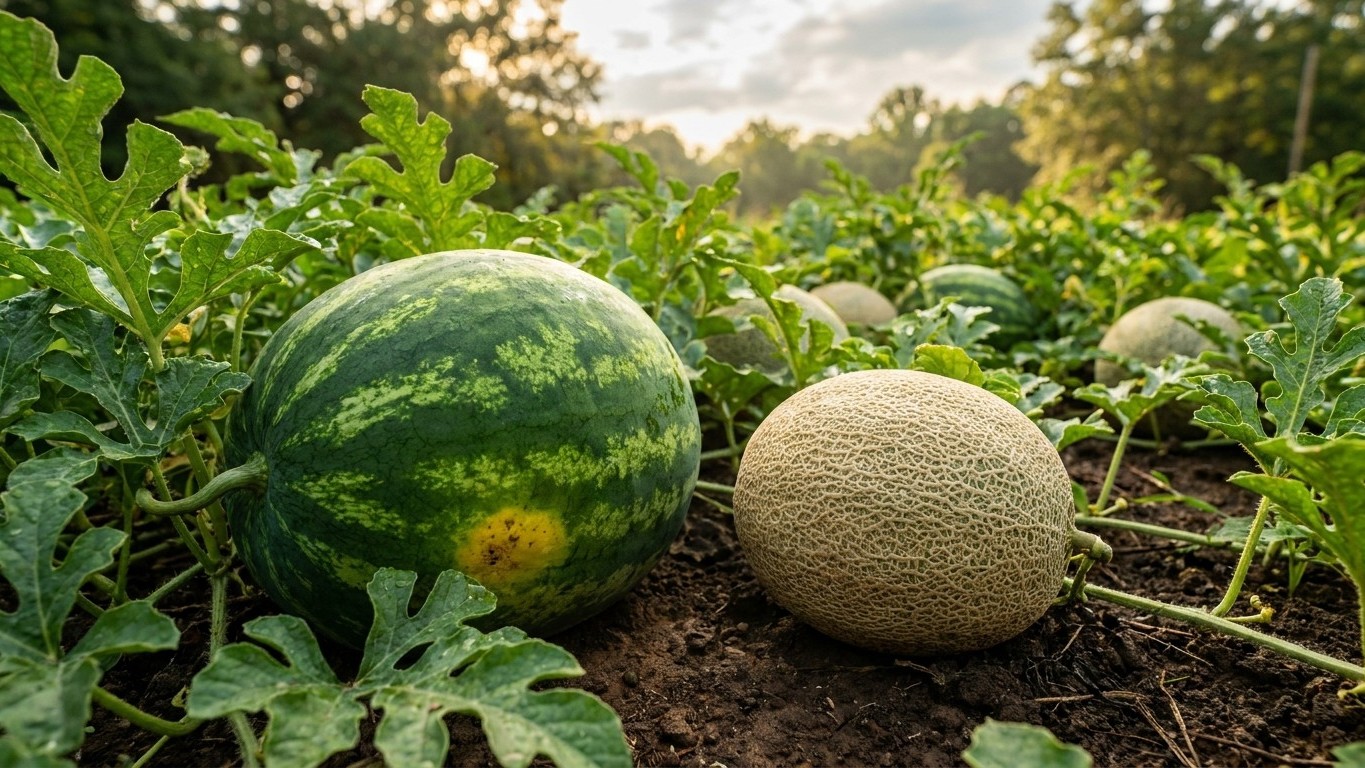

Arkansas gardeners get one advantage most Southern states don’t: enough heat and enough season length to grow almost any melon type, provided the variety can handle humidity. Watermelon and cantaloupe are the safest bets here. Honeydew and other thin-skinned dessert melons need a drier climate than this state offers.
The short answer for Arkansas
Start with the heat load. The reference station near Little Rock averages 69.2 days a year at 90F or hotter. That’s more than two months of sustained heat, and it’s the number that should drive every variety choice. Melons bred for hot climates, watermelon above all, thrive in that kind of summer. Melons bred for milder, drier growing regions, like Charentais or Galia types, tend to stall or scald under it.
Frost dates give Arkansas a workable window too. The 32F last-spring-frost date runs from March 12 to March 28, and first fall frost arrives between November 7 and November 20. That’s a frost-free stretch well past 200 days in most years, which is more than enough time for even a 100-day watermelon variety planted after the soil has warmed. The tighter 36F light-frost window at Little Rock, April 3 to October 31, matters more for tender seedlings set out too early, since a light frost can still knock back young melon plants even when a hard freeze isn’t in the forecast.
Humidity is the variable that separates the melons that succeed here from the ones that rot on the vine. Summer rainfall averages around 10 inches across June, July, and August, arriving mostly as thunderstorms rather than steady soaking rain. Combined with the heat, that keeps foliage damp long enough for fungal disease to take hold, which is why disease resistance matters as much as flavor when picking a variety in this state.
| Melon type | Typical days to maturity | Heat tolerance | Humidity tolerance | Arkansas fit |
|---|---|---|---|---|
| Watermelon | 80-100 | High | Moderate to good in resistant cultivars | Strong |
| Cantaloupe / muskmelon | 75-90 | High | Moderate, needs airflow and resistant lines | Strong |
| Honeydew | 85-100 | Moderate | Poor, prone to mildew | Weak |
| Charentais / Galia types | 75-90 | Moderate | Poor, needs dry finish | Weak |
What will not work here

Melons bred for arid or Mediterranean growing regions are the clearest failure case in Arkansas. Charentais melons, true Galia types, and most honeydew varieties depend on low humidity at the end of the season to concentrate sugar and avoid rot. Arkansas doesn’t deliver that. With roughly 10 inches of rain falling across the three summer months and 69.2 days a year pushing past 90F, the air stays heavy with moisture even between storms, which is exactly the condition that lets powdery mildew, downy mildew, and fusarium wilt spread through a melon patch.
Watering on a weekly schedule fails for a similar reason. Do the math on the monthly rainfall figures, June at 3.55 inches, July at 3.33, August at 3.16, and it works out to less than an inch a week on average. But that rain doesn’t arrive evenly. It comes in thunderstorm bursts, then nothing for stretches during the hottest days of the year. A melon vine that gets soaked, then bone-dry, then soaked again is a vine headed for blossom end scarring and split fruit. Melons want consistent soil moisture, not a boom-and-bust cycle, and relying on the sky to provide it in Arkansas is not a plan.
Tight spacing between plants is another mistake that shows up more in a humid state than a dry one. Vines packed close together trap moisture at leaf level after rain or heavy dew, and that damp canopy is where fungal disease gets its start. Wider rows and good airflow matter more here than in a low-humidity climate, where the same spacing might never cause a problem.
Finally, pushing a 100-day variety in by direct-seeding too late in a cool spring, then expecting it to ripen before a wet, cooling fall sets in, is a bet against the calendar. The frost-free window is generous in Arkansas, but a late start still runs the fruit-finishing stage into the wetter, cooler weeks of October, right when disease pressure is highest.
What changes across Arkansas
Arkansas sits across USDA hardiness zones 6b to 8a, and that’s a wide enough spread that there’s no single planting answer for the whole state. This is the average annual extreme minimum temperature, one number, and it separates the cooler highland areas from the warmer lowland ones by a real margin.
A gardener in the cooler end of that range, generally the higher elevations in the northern part of the state, is working with a shorter effective season than the state-wide frost dates suggest. For that reader, shorter-maturity varieties, in the 75 to 85 day range, are the safer choice, and starting seedlings indoors three to four weeks before the last expected frost buys back time that a direct-seeded planting would lose.
At the warmer end of the range, generally the southern and Delta lowlands, the season runs longer and the soil warms earlier in spring. Gardeners there have more room to grow a full 90 to 100 day watermelon variety and can often direct-seed rather than transplant, since the ground reaches melon-friendly warmth sooner.
Neither end of that range is right or wrong for the state as a whole. The point is that a single date or a single variety recommendation for “Arkansas” is going to undersell one end of the state and oversell the other. Checking exactly where a property falls on the USDA hardiness zone map is the only way to know which half of this advice applies.
Where to check this for your own county
Everything above is a state-level picture, built from a single reference station’s climate normals. It’s useful for narrowing down melon type and general timing, but it isn’t a substitute for what the University of Arkansas Division of Agriculture’s Cooperative Extension Service publishes for individual counties, available at uaex.uada.edu.
Two things are worth looking for there specifically. First, the county-level planting calendar, which adjusts the state’s general frost window to local conditions that a single reference station can’t capture, things like river-bottom cold pockets or higher terrain that lags a few days behind the rest of the county. Second, any variety trial results the extension service has published for melons grown in that county or nearby demonstration plots. Extension trials test how specific cultivars actually perform against local disease pressure and soil types, which is exactly the kind of ground-truth data a state-wide climate summary can’t provide.
A county recommendation will always outrank a state one, for the simple reason that it’s built on conditions closer to an actual garden. Statewide averages are the level at which a “best varieties for Arkansas” question can be answered at all. But the fine-tuning, the extra week of frost risk in a low-lying county or the melon variety that a local extension agent has seen outperform others in the same soil, only shows up at the county level.
Checking this against your own garden
None of the dates or averages above account for what’s happening in one particular yard, and that’s where a gardener’s own observation ends up outranking every figure. Three signs are worth tracking by hand, no equipment needed.
Soil warmth by feel is the first. Melon seed sits and rots in cold, damp soil, so before direct-seeding, press a hand into the planting bed in the morning. Soil that still feels chilly and heavy signals a microclimate running behind the regional average, whether from shade, poor drainage, or low ground that holds cold air. Soil that already feels warm through the day is a sign it’s safe to move ahead of the general calendar.
The first flush of male flowers is the second marker. Melon plants send out male blooms before the female flowers that actually set fruit, and the timing of that first flush shows how far along a particular plant is compared to a typical season. A garden running male flowers noticeably earlier than expected is likely sitting in a warmer-than-average pocket.
The appearance of first true leaves, the leaves that emerge after the initial rounded cotyledons, is the third. Watching how quickly true leaves show up after germination gives a rough read on how much heat that specific bed is accumulating, which is the same information the days-above-90F figure captures at a regional scale, just measured in one’s own soil instead of at a weather station miles away.