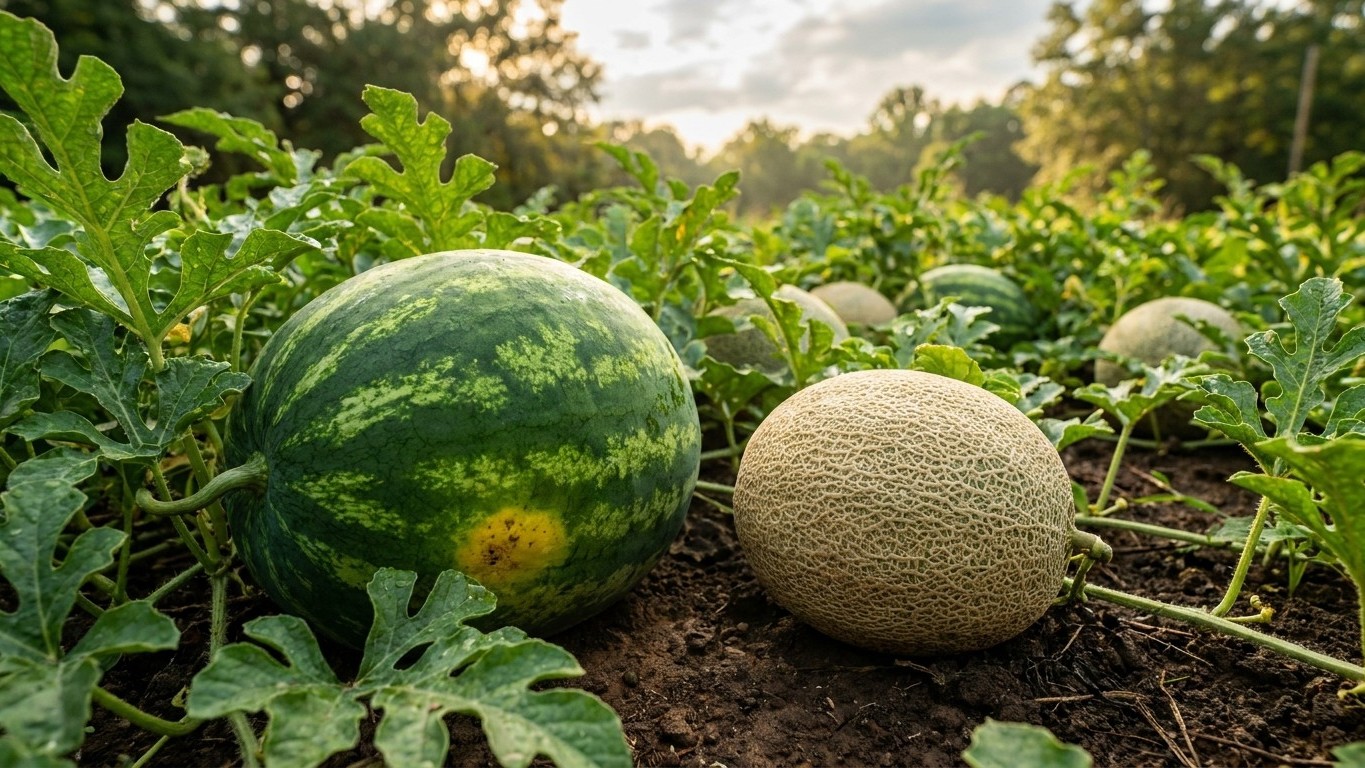

Short-season melons win in Connecticut. Cantaloupes and muskmelons rated for 70 to 85 days, along with icebox-type watermelons, mature reliably before fall frost and don’t depend on the sustained blast-furnace heat this state rarely delivers. Full-season honeydews, Crenshaws, and canary melons are a gamble most years.
The short answer for Connecticut
Two numbers decide which melon types belong in a Connecticut garden, and neither one is the frost date most people fixate on first. The first is the frost-free window itself: last spring frost falls between April 2 and April 12, first fall frost between October 28 and November 10. Stack the most conservative pairing (April 12 to October 28) and you get a season of roughly 199 days. That’s generous on paper. Most melons, even long-season types, finish inside that window if nothing else got in the way.
The second number is the one that actually narrows the field: 6.2 days a year, on average, reach 90°F or hotter. That’s the heat-load figure for the reference station, and it’s low. Melons don’t just need frost-free days, they need sustained heat to push sugar into the fruit and ripen the flesh evenly. A vine that technically survives to maturity in a cool, cloudy August still produces pale, watery fruit if the plant never got enough hot days to work with. Connecticut’s summers are warm, not scorching, and that’s the detail a seed catalog written for Georgia or Texas growers won’t tell you.
That combination, plenty of calendar days but modest heat, points toward one category: early and mid-season varieties bred for shorter, cooler summers rather than desert or Deep South heat. Think cantaloupe and muskmelon types rated 70 to 85 days to maturity, and icebox-style watermelons in the 70 to 80 day range. These varieties were selected specifically because they set fruit and ripen without needing week after week above 90°F. They also give a built-in cushion: if a cool, rainy stretch in July or August delays things by a week or two, an 80-day melon still has room to finish before the October frost window opens. A 100-day melon doesn’t have that margin.
This isn’t a case for babying tender plants under row cover all summer, either. It’s a case for matching the variety’s heat requirement to what the region actually produces most years, which is a moderate summer with brief hot spells rather than a prolonged heat wave. Growers who’ve had good luck with Connecticut melons tend to describe the same pattern: smaller-fruited, faster-maturing types outperform the big, slow ones, year after year, regardless of how carefully the slow ones are babied.
What will not work here
Long-season melons are the clearest failure point. Canary melons, Crenshaw types, and some of the specialty Galia and Asian melon hybrids are commonly rated 90 to 110 days to maturity, sometimes more. Even using the generous end of the frost window, April 2 to November 10, that’s about 222 days of frost-free calendar, which sounds like enough. But melons don’t count from the frost date. They count from the day soil is warm enough to germinate or transplant without stalling, and that’s typically two to three weeks after last frost, not the same day. Push a 100-day melon back to early May and it’s finishing in mid-August at best, or creeping toward the first fall frost with no margin if a cool patch slows it down. In the inland parts of the state, where frost arrives earlier than the coastal reference station, that margin disappears entirely.
Heat-dependent flavor is the second failure, and it’s sneakier because the plant doesn’t show obvious distress. With only 6.2 days a year averaging 90°F or above, a variety bred for consistent triple-digit desert heat, or for the long hot summers of the mid-Atlantic and further south, will often size up and even change color on schedule. What it won’t do is develop full sugar content. The fruit looks ready and tastes flat. This is why a neighbor’s glowing review of a Southern-bred melon variety doesn’t always translate here. The plant survived. It just didn’t get the heat units it was bred to expect.
Watering habits built for drier climates also stumble here. Summer rainfall averages about 11.1 inches across June, July, and August, with July the driest month at 3.32 inches. That’s not drought territory, but Connecticut summers are humid, and that humidity combined with close plant spacing is a reliable setup for powdery and downy mildew on melon foliage. A spacing plan copied from a seed packet written for a drier Western state, where airflow problems are rare, often runs melons too close together for New England humidity. Wider spacing and pruning for airflow matter more here than the packet suggests.
What changes across Connecticut
Connecticut isn’t one growing zone, it’s a range: USDA Hardiness Zone 6a to 7b, under the USDA Plant Hardiness Zone Map. That’s a real spread, built on average annual extreme minimum winter temperature, and it matters for melons mainly through what it implies about the surrounding season, not winter survival, since melons are annuals killed by any frost regardless of zone number.
The frost dates cited above come from Bridgeport, a Long Island Sound coastal station and the mildest reference point in the state. Coastal Connecticut, warmed by the Sound, sees its last spring frost and first fall frost land closer to the late-April/early-November end of the ranges given. Inland Connecticut, and especially the northwest hills and higher elevations, behaves differently: spring frost lingers later, fall frost arrives earlier, and the effective growing season for melons shrinks accordingly, sometimes by two to three weeks compared to the shoreline.
That gap is exactly why there’s no single melon calendar that fits the whole state. A gardener thirty miles from the shore isn’t gardening in the same frost window as a gardener in Litchfield County or up along the Massachusetts border. The safe move is to treat the coastal dates as the optimistic end of the range and assume less margin the farther inland or higher in elevation the garden sits. This page can’t tell an individual reader which zone applies to their yard. That’s a job for the USDA’s interactive hardiness zone map, which resolves down to specific ZIP codes rather than a statewide band.
Practically, that means inland and higher-elevation growers should lean toward the shorter end of the “short-season” recommendation above, not the middle. If 75-day cantaloupes work well on the coast, an inland grower is better served picking something closer to 68 to 72 days, simply to preserve the same safety margin against an earlier fall frost.
Where to check this for your own county
Everything above is a statewide read, built from one reference station and a statewide hardiness range. It’s useful for narrowing melon types, but it isn’t a substitute for county-level guidance, and there’s a specific place to get that: UConn Extension. It is the state’s land-grant university extension service, and it publishes planting guidance built from local trial data rather than a single coastal weather station.
Two things are worth looking for once there. First, a local or regional planting calendar, which will reflect the frost timing actually experienced in that part of the state rather than the Bridgeport-based ranges used here. Second, variety trial results or recommendation lists specific to Connecticut growing conditions, which show which melon cultivars have actually performed well in university test plots or through county-level demonstration gardens, rather than relying on catalog descriptions written for a national audience.
A county-level recommendation will always beat a state-level one, for a simple reason: it’s built from data closer to the actual garden. Statewide averages and a single reference station’s climate normals show the broad pattern (short heat load, humid summers, a real inland/coastal split) but can’t account for a specific valley, slope, or soil type.
Checking this against your own garden
None of the numbers above beat what’s happening in the actual garden bed, and melons give three clear, low-tech signals worth tracking by hand and eye rather than by calendar.
Soil warmth by feel is the first. Melon seed sits and rots in cold soil regardless of what the frost date says. Pushing a bare hand into the top few inches of soil in mid-morning and feeling real warmth, not just “not cold,” is a better cue for direct-seeding or transplanting than counting days from last frost. A garden that runs cooler than the regional average, shaded, low-lying, or heavy clay, needs to wait past the general recommendation no matter what the extension calendar says for the county overall.
The first flush of male flowers is the second signal. Melon vines produce male flowers before female ones, sometimes by a week or two, and a garden throwing lots of male blossoms with no female flowers yet is still in a vegetative growth phase, not a fruiting one. That timing shifts year to year with how warm the season has actually run, and it’s a far better predictor of harvest timing than counting backward from a variety’s “days to maturity” number, which assumes ideal conditions that don’t always show up.
The first true leaves, the ones that appear after the initial seed leaves and actually look like miniature melon foliage, mark the point where the plant has shifted from surviving on seed reserves to running on its own root system. A garden where true leaves show up quickly and vigorously is running warmer and richer than average; a slow, stunted emergence of true leaves is an early warning that the bed is cooler, wetter, or less fertile than the general county recommendation assumes, and that the melon timeline in that specific spot will likely run behind the rest of the neighborhood.