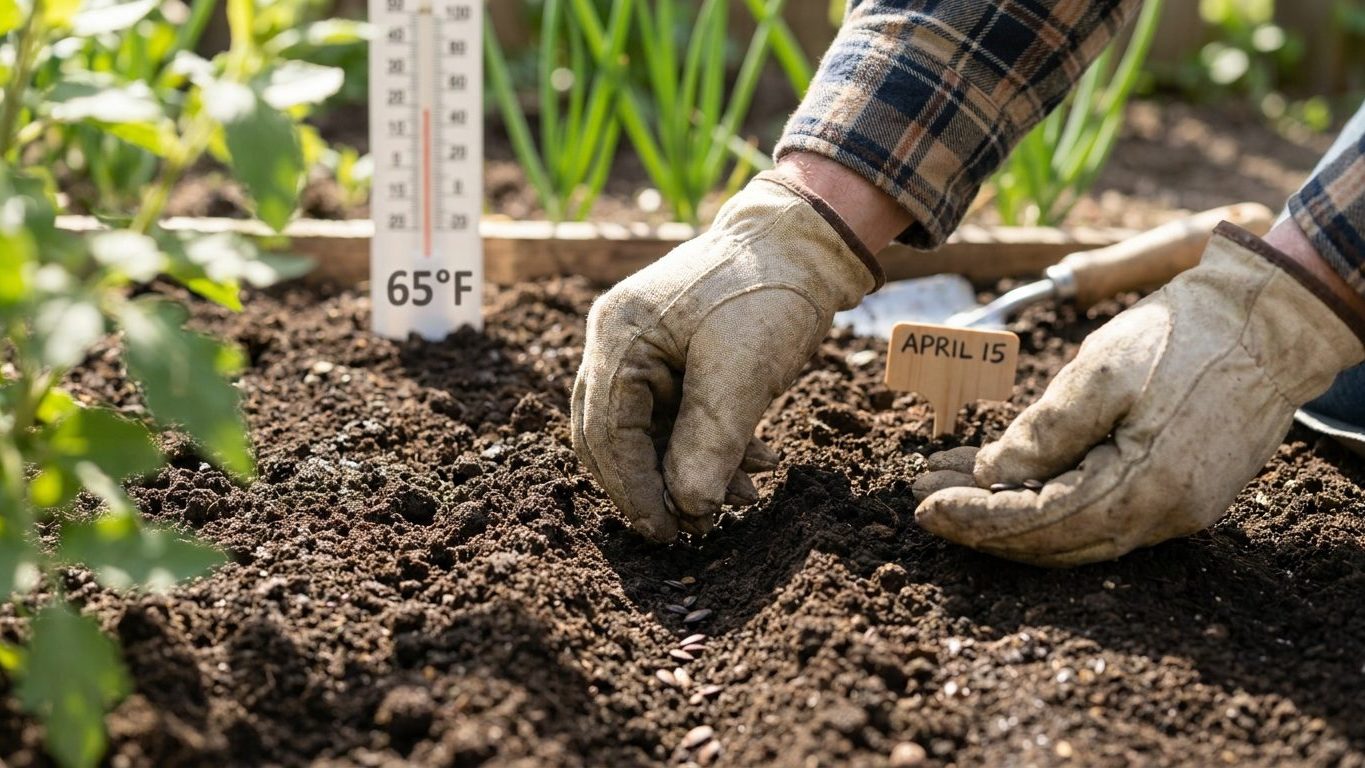

Melon seed goes into Connecticut ground once the soil itself is warm, not simply once the calendar says frost has passed. At the coastal reference station, that means waiting until well after the April 2 to April 12 frost window closes, with harvest racing the October 28 to November 10 fall frost. Inland gardens get less room on both ends.
The short answer for Connecticut
Start from the numbers that actually exist for this state. NOAA’s 1991-2020 Climate Normals put the last spring frost at Bridgeport (station USW00094702, the coastal reference point) between April 2 and April 12, and the first fall frost between October 28 and November 10. Those dates aren’t a guarantee of safety, they mark the window where the probability of a 32°F freeze sits between 30% and 70%. In plain terms: even at the late end, April 12, there’s still a real chance of frost after that date, and even at the early end of fall, October 28, there’s a real chance frost hasn’t hit yet. Treat both as a probability band, not a switch that flips from unsafe to safe.
Do the subtraction and the frost-free stretch at this reference station runs from roughly 199 days (April 12 to October 28) to about 222 days (April 2 to November 10). That’s the outer envelope for any warm-season crop grown here, melons included.
But melon seed doesn’t germinate reliably in soil that’s merely frost-free. It wants soil that’s genuinely warm to the touch, which in most Connecticut springs arrives weeks after the last frost date, not the same week. That’s why growers here commonly hold off on direct seeding until late May into early June, once overnight lows have settled well above freezing and the ground has had a real stretch of sun. Transplants started indoors and hardened off can go into the garden a little sooner, giving the plant a head start before the truly warm nights arrive, but they still shouldn’t sit in cold soil waiting for it to catch up.
On the back end, melons need every one of those frost-free days you can get. Vines that are still setting or ripening fruit when the first hard frost lands simply stop, and unripe melons don’t finish indoors the way tomatoes sometimes will. The practical window for this state, then, isn’t the full 199-to-222-day span on paper. It’s that span minus the weeks lost waiting for soil to warm in spring, which is the single biggest variable a Connecticut grower controls.
What will not work here

The slowest-maturing melon varieties are the first casualties of a Connecticut season. A frost-free window capped around 199 days at the coldest edge of the coastal reference, and shorter inland, leaves no slack for a vine that needs the entire growing season plus a cushion. Add the time lost waiting for soil to warm past the April frost dates before seed even goes in the ground, and a variety bred for a Deep South or Mid-Atlantic season is gambling on a fall frost that, per the data, has close to even odds of arriving before November 10 even at the mildest station in the state.
Heat load is the second trap. The Bridgeport reference station averages just 6.2 days a year at or above 90°F. Melons are heat-loving plants, and that’s a modest heat budget compared to the regions where many long-season varieties were developed. A grower who plants a variety selected for hot, dry Southern summers is asking Connecticut’s cooler, shorter run of true heat to do work it isn’t built for. Sugar development and vine vigor both slow when the season simply doesn’t deliver enough hot days, regardless of how many frost-free days sit on the calendar.
Watering on autopilot fails in July
Summer rainfall here averages about 11.1 inches across June, July and August, but it isn’t spread evenly. July, the month when melon vines are usually sizing fruit and demanding the most water, is the driest of the three at just 3.32 inches, compared to 3.77 in June and 3.98 in August. A grower who waters on a fixed weekly schedule, assuming the “average” summer rainfall will fill in the gaps, is very likely to hit a dry stretch in exactly the month the plant can least afford it. Combine a dry July with any run of 90°F days and a once-a-week watering habit stops being adequate almost immediately.
Tight spacing is the third failure point, though it cuts the opposite direction from what many gardeners expect. Connecticut summers aren’t the driest in the country, and the humidity that comes with an 11-inch-plus summer rainfall total sits in the leaves longer when vines are crowded. Powdery mildew and other fungal issues move fast through melon foliage that doesn’t get airflow, and a planting plan copied from a drier, more open climate will underestimate how much space and air circulation Connecticut vines actually need.
What changes across Connecticut
Connecticut is not one growing season wearing different hats. The USDA Plant Hardiness Zone Map places the state across zones 6a to 7b, a spread built entirely on average annual extreme minimum winter temperature. That’s a winter-cold measure, not a frost-date measure, but the two track together closely enough to matter: the mildest zones sit along Long Island Sound, where the Bridgeport reference station’s frost dates apply most directly, and the coldest zones sit inland and at higher elevation in the northwest hills and the northeastern uplands.
A gardener in the milder coastal zones is working with something close to the April 2-April 12 spring frost window and the October 28-November 10 fall window quoted above. A gardener in the colder inland or higher-elevation zones should expect the same general shape of the season but shifted: last frost arriving later than the coastal date, first fall frost arriving earlier. That combination shortens the usable frost-free window from both ends at once, which for a crop already living close to the edge of what the season allows is the single most important local adjustment to make.
There’s no single number that covers the whole state honestly. A planting date good for the shoreline can be two, three, or more weeks premature for a hillside garden thirty miles inland. Rather than guess which end of the 6a-7b range applies to a specific address, check the USDA hardiness zone map directly for the property in question, then treat the coastal frost dates in this article as the mild end of the state’s range and adjust later in spring, earlier in fall, the further inland and higher up the garden sits.
Where to check this for your own county
Connecticut as a whole is described by one coastal reference station, because that’s what NOAA’s Climate Normals provide at the state level. A county-level recommendation will almost always beat it, because it accounts for the microclimate a state-wide figure has to average away.
The University of Connecticut’s Cooperative Extension System is the land-grant authority for this work. Two things are worth pulling from that resource specifically. First, a local planting calendar, if the county office publishes one, will reflect the actual frost pattern of that county rather than the coastal Bridgeport station used here, which matters most for anyone gardening inland or at elevation, as covered in the section above. Second, look for any variety trial results or extension bulletins covering melons specifically. Extension offices frequently test which cantaloupe, watermelon or specialty melon varieties actually finish reliably within the local frost-free window, which turns the general caution in this article, that slow varieties are risky here, into a concrete list of which ones have worked in that exact county.
Treat the state-level figures in this article as a starting frame, not a final answer. Cooperative Extension exists precisely to narrow that frame down to a specific county, and often down to specific soil types and elevations within it. A phone call or visit to the local office, or a search of their published fact sheets, is the next real step for anyone planting melons on a particular piece of Connecticut ground.
Checking this against your own garden
Every frost date and rainfall average in this article describes a reference station, not a backyard. The garden itself will always give better information than the calendar, and none of it requires equipment beyond a gardener’s own hands and eyes.
Soil warmth comes first. Melon seed sitting in cold soil doesn’t just grow slowly, it often rots before it germinates. Press a hand into the planting bed a few inches down in mid-morning, after the surface has had a chance to warm. Soil that still feels cool or damp-cold, even weeks after the last frost date has passed, is telling the gardener the microclimate is running behind the regional average, whether from shade, heavy clay, or a low spot that holds cold air.
The first flush of male flowers is the second signal. Melon vines produce male blossoms before the female flowers that actually set fruit, and a strong early show of male flowers means the plant has moved past its establishment phase and is building toward fruiting. If male flowers appear but linger for a long stretch with no females following, that’s often a heat or stress signal worth watching rather than assuming the fruit set will simply arrive on schedule.
Third, watch the true leaves, not the seed leaves that appear first. Once a melon seedling pushes out its first set of true leaves, rough-edged and clearly shaped like the mature plant’s foliage, it has committed to real growth. A seedling stalled at the seed-leaf stage for an unusually long time is a direct, on-the-ground sign that the local soil and air temperature haven’t caught up to whatever the regional frost date implied. That observation, made in the actual bed, overrides any regional frost date.
Some gardeners also time melons by the Moon: when to plant watermelon and cantaloupe by the moon, as almanac tradition rather than fact.