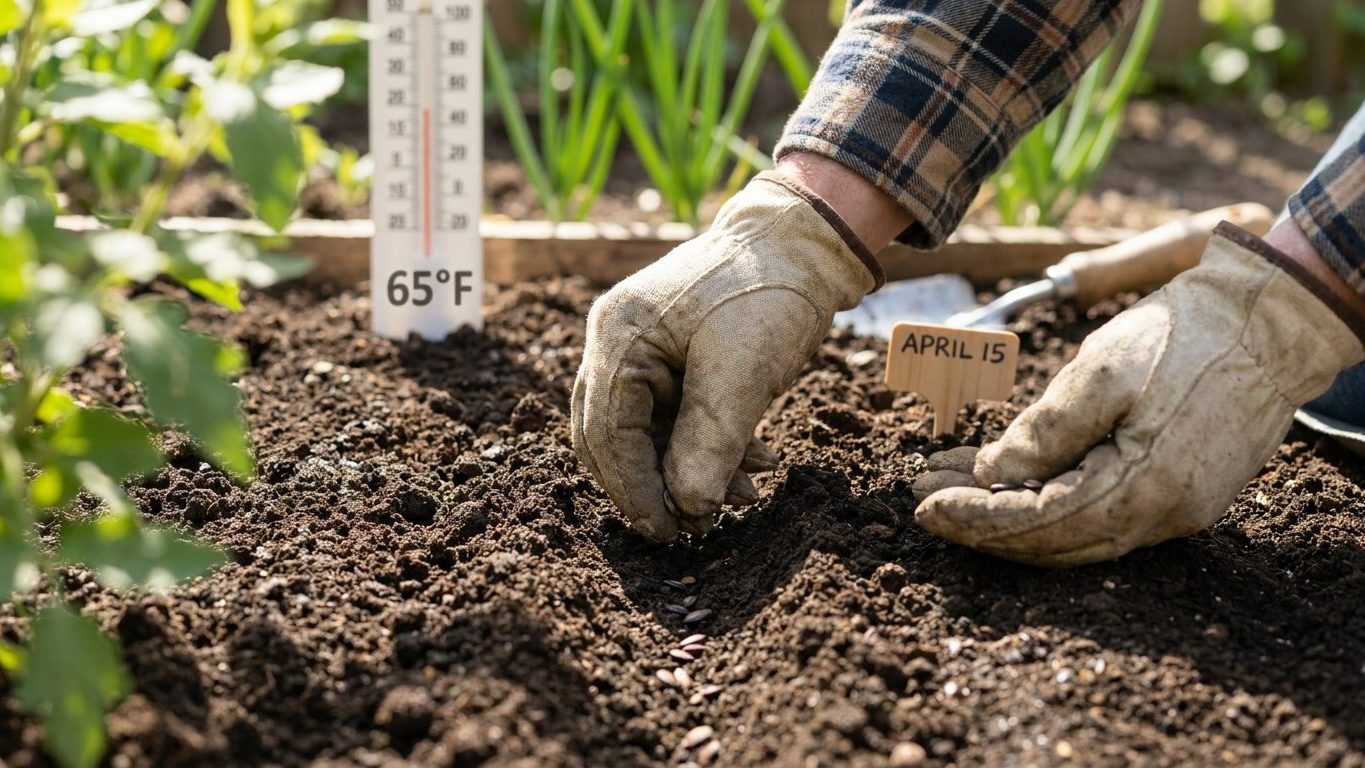

For north Florida, melon seed goes into warm soil after the last frost risk fades, roughly mid-February to early March, and vines need to finish fruiting before the first fall frost arrives, late November to mid-December. That’s close to nine months on paper. But this window describes the Jacksonville area only. Farther south, where frost turns rare or disappears, the calendar reverses: melons grow through winter, and summer becomes the season to dodge.
The short answer for Florida
Those two frost dates, February 16 to March 7 for the last spring freeze and November 26 to December 13 for the first fall freeze, come from NOAA’s 1991-2020 Climate Normals at station USW00013889, the Jacksonville reference site. They aren’t a guarantee. They mark the window in which a 32°F freeze has between a 30% and 70% chance of occurring, which in plain terms means the weeks when frost is closer to a coin flip than a certainty. Plant melon seed before that window closes and a late freeze can still kill young vines outright, since melons carry zero frost tolerance at any growth stage.
That leaves north Florida with a growing season stretching from early March to late November on paper, well over 250 days. Few growers use anywhere near that whole span for one planting. Melon seed needs soil consistently above 65°F to germinate reliably, which around Jacksonville usually means waiting two to three weeks past the last-frost date rather than rushing in the moment freeze odds drop below 50%. Push the date earlier, and cold, wet soil rots seed before it sprouts.
The other number shaping the calendar is 73.2, the average number of days a year the reference station reaches 90°F or hotter. That heat concentrates from June through September, so a planting made in early March has roughly ten to twelve weeks to flower and set fruit before daytime highs start cutting into pollen viability and stressing the vines. A grower who waits until May to plant, instead of March or April, is aiming the plant’s most fragile stage directly at the hottest, most humid stretch of the year.
None of this applies once frost turns rare or disappears, which is the case through most of central and south Florida. There, there’s no spring frost date to plant around, and the whole logic flips: growers there plant in fall and winter and treat summer as the stretch to avoid rather than the target.
What will not work here

A long-season melon variety bred for cooler climates, one needing 100 days or more from seed to harvest under mild conditions throughout, runs into trouble here even though the frost-free window looks generous on paper. Plant it in March around Jacksonville and it spends its final ripening weeks in June and July, right as the reference station logs its heaviest run of 90°F-plus days. Heat that intense can stall fruit sizing and knock sugar development off track, even when the plant itself survives to harvest.
Watering on a fixed weekly schedule, a habit that works fine in a drier climate, fails here for a different reason. Summer rainfall averages about 21.2 inches across June, July and August, which sounds generous. But it rarely arrives as a steady soak. July, the driest of the three summer months at 6.77 inches, still tends to deliver that total in a handful of afternoon thunderstorms rather than gentle, evenly spaced rain. Water runs off before it soaks past the top few inches, especially on Florida’s sandy ground, so a melon patch watered once a week can be bone-dry by day four while the monthly rain gauge shows a wet month.
Tight spacing, the kind that saves room in a small backyard bed, backfires in Florida’s combination of heat and summer humidity. Melon foliage packed close together holds moisture on the leaf surface longer after every thunderstorm or heavy morning dew, and that’s exactly the condition powdery mildew and downy mildew need to spread. Wider spacing than a seed packet written for a drier region recommends, with real air movement between vines, is less a preference than a requirement once the humid months set in.
Treating the frost dates as the whole answer also will not work. They describe one station near Jacksonville. A garden thirty miles inland, at a different elevation, or in a low spot where cold air pools can see frost several days earlier in fall or later in spring than the airport does.
What changes across Florida
Florida’s USDA Hardiness Zone range runs from 8b to 11b, based on the Plant Hardiness Zone Map’s single measurement, the average annual extreme minimum temperature. A span that wide, four and a half zones, means there is no single planting date that covers the whole state, and the frost dates used above describe only the northern end of that range.
| Rough zone band | Frost pattern | Melon calendar logic |
|---|---|---|
| 8b-9a (north) | Frost most winters, near-annual | Conventional spring-to-fall: plant after last frost, finish before first fall freeze |
| 9b-10a (central) | Occasional freezes, skips some years | Transitional; spring planting still common but summer heat stress grows |
| 10b-11b (south) | Frost rare or absent | Calendar inverts: plant fall through winter, avoid summer |
In the northern tier, the planting calendar looks like a conventional spring-to-fall garden. Move into the central band and freezes become occasional rather than annual, arriving some years and skipping others. By the time the zone reaches the far south, frost is rare enough that some seasons see none at all, and the entire idea of a “last frost date” stops being useful.
A calendar built on Jacksonville’s frost dates would push a central or south Florida gardener to wait for a freeze risk that barely exists, then plant straight into the harshest heat of the year instead. Exactly where the shift happens, and which band applies to a specific yard, depends on zone boundaries that follow minimum winter temperature rather than county lines and can shift within a few miles near the coast or with a change in elevation. Checking the USDA Plant Hardiness Zone Map directly is the way to settle that, rather than guessing from a regional description.
Where to check this for your own county
The University of Florida’s IFAS Extension network breaks that down to the county level, and a county recommendation should always outrank a state-level one.
Two things are worth looking for once there. First, the local planting calendar for the specific county, built on that county’s own frost records rather than a single reference station near Jacksonville. A county in the panhandle, on the peninsula, or along the coast can see meaningfully different frost timing even within the same broad hardiness zone, and the county office tracks that directly rather than relying on a statewide average. Second, look for the melon varieties that county’s extension agents have actually trialled on local soil. Trial results shift with disease pressure, soil texture and rainfall pattern, so a variety that does well in the sandy, humid conditions near Jacksonville can perform differently in the heavier soils found elsewhere in the state.
County extension offices also field direct questions a static page cannot answer: whether a particular spring has run warm or cold so far, whether growers nearby are reporting disease pressure that season, and whether the planting window is running early or late against the long-term normal. That current, hyperlocal layer is exactly what a state-level page like this one is missing, and exactly what the county office exists to provide.
Checking this against your own garden
Every date here is a normal built from thirty years of station data, not a forecast for one specific yard this spring. Three direct observations, made right in the bed, settle the question better than any calendar.
Soil warmth by feel is the first and most reliable check. Push a finger or a hand trowel a couple of inches into the planting bed in mid-morning. Soil that feels cool to the touch, closer to a refrigerated drink than to bathwater, is still too cold for melon seed to germinate reliably, whatever the calendar date says. Soil that feels closer to room temperature, and slightly moist rather than soggy, is the signal that actually matters.
The first flush of male flowers is the second marker worth tracking, less for what it means botanically than for what its timing reveals. Melon vines send out male blossoms well before the female ones, recognizable by a small swelling at the base, appear. A first flush that shows up earlier than the previous year, or earlier than a neighbor’s garden, points to a spot running warmer than the regional average, whether from more sun exposure, better drainage, or shelter from wind. A late flush points the other way, toward a cooler or more exposed microclimate than the calendar assumes.
The first true leaves are the third check. Seedlings emerge with two rounded seed leaves, but the jagged, lobed leaves that follow confirm the plant has moved past the fragile germination stage into active growth. A quick appearance of true leaves after emergence points to near-ideal conditions; a long stall between seed leaves and true leaves usually means the soil or air is running cooler than the plant wants, regardless of what the frost-date average suggests that week.
Some gardeners also time melons by the Moon: when to plant watermelon and cantaloupe by the moon, as almanac tradition rather than fact.