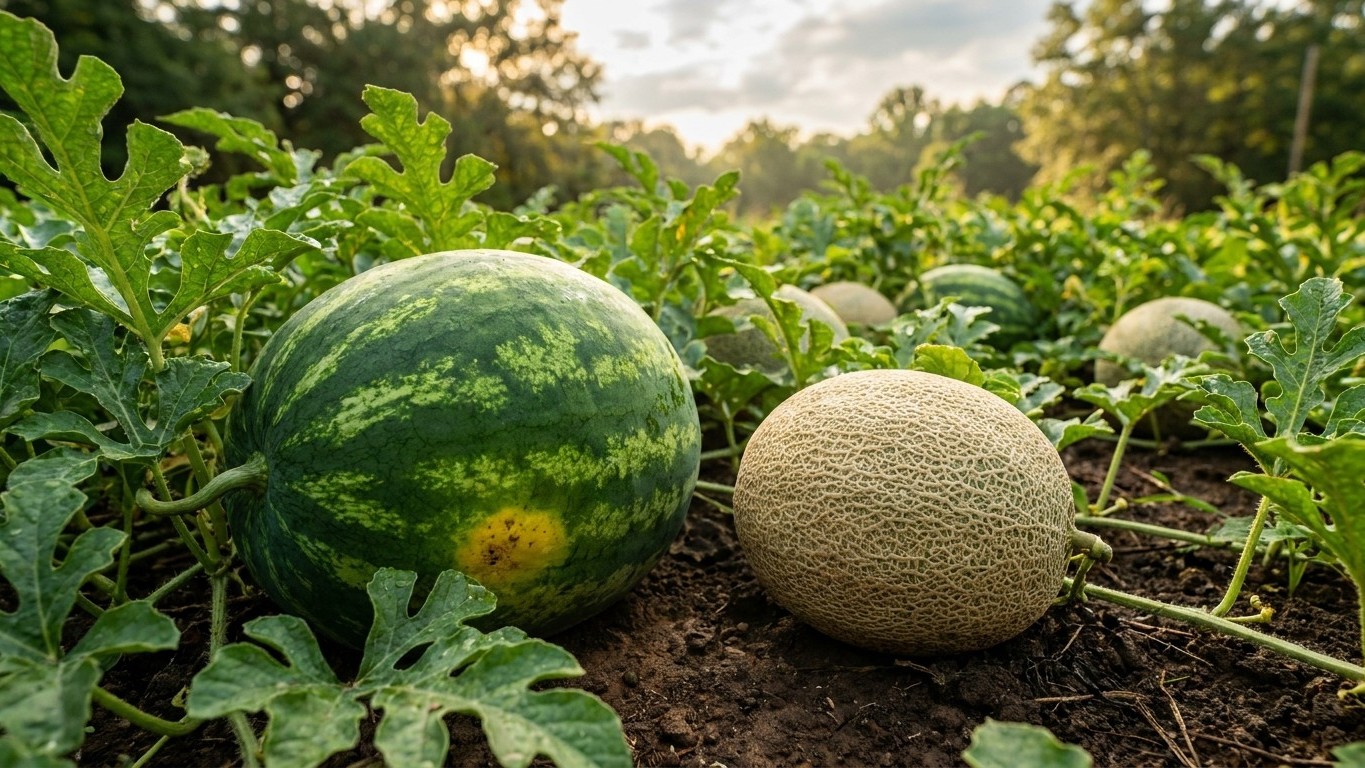

Short-season melons win in Iowa. Cantaloupe and compact watermelon varieties that ripen in 70 to 85 days fit the state’s frost-to-frost window with room to spare, while honeydew, casaba, and other 100-day-plus types are gambling against a calendar that doesn’t always cooperate. The heat is there most summers; the season length is the real constraint.
The short answer for Iowa
Start with the two dates that set the boundaries: the last spring freeze at the reference station runs April 12 to April 24, and the first fall freeze runs October 14 to October 25. Stack the optimistic ends together and Iowa’s frost-free window can stretch to 196 days. Stack the cautious ends and it shrinks to 173 days. That’s already a wide spread before accounting for the extension caution that county-level records (1950-2021) run about four days later in spring and ten days earlier in fall than the airport data above. Applied honestly, a realistic working season for most Iowa counties sits closer to 159 to 182 days, not the airport’s 196.
That range is the whole decision. A melon rated at 75 to 85 days to maturity fits inside 159 days with a comfortable buffer for a cool week in June or an early cold snap in September. A melon rated at 100 days or more is trying to fit into a season that, at the pessimistic end, barely gives it room to germinate, flower, set fruit, and ripen before the first freeze arrives.
Heat load backs this up. Des Moines averages 18.4 days a year at or above 90°F, enough warmth to push a short-season cantaloupe or icebox watermelon through its ripening window quickly, but not the sustained, weeks-long heat that a slow honeydew or a large full-size watermelon needs to finish sweet.
| Melon type | Typical days to maturity | Fit for Iowa’s realistic season |
|---|---|---|
| Short-season cantaloupe/muskmelon | 75-85 days | Comfortable fit statewide |
| Compact or icebox watermelon | 70-80 days | Comfortable fit statewide |
| Full-size watermelon | 85-100 days | Workable only with transplants, black plastic mulch, and the optimistic end of the season |
| Honeydew and late muskmelon | 90-100+ days | Marginal even in a good year |
| Casaba, winter melon, long-season specialty types | 100-120+ days | Not a realistic match for this season length |
The practical move for most gardeners here is to start short-season cantaloupe and compact watermelon from transplants rather than direct seed, which buys back ten to fourteen days that a direct-seeded crop would spend just germinating in cool spring soil.
What will not work here

Long-season melons are the clearest failure point. A 100-day honeydew planted at the pessimistic end of Iowa’s realistic window, 159 days, has already used more than 60 percent of the entire frost-free period just reaching maturity, with no cushion for a cloudy stretch in August or a slow-to-warm spring. Push that same melon into a county running on the shorter end of the calendar and it simply won’t finish before the October freeze arrives. This isn’t a soil or skill problem; it’s arithmetic.
Watering on a fixed weekly schedule is the second common failure, and the rainfall numbers explain why. Iowa summers bring about 13.2 inches of rain across June, July, and August, but that total isn’t spread evenly. July, the month when melon vines are usually setting and sizing fruit, averages just 3.82 inches, the driest of the three summer months. Combine that dry stretch with 18.4 days a year at or above 90°F, and the evaporation demand in a hot, dry July regularly outpaces what a once-a-week soaking can replace, particularly on sandy or well-drained soil where the same inch of rain moves through the root zone in a day rather than lingering for a week. A melon that gets watered on a calendar instead of by soil feel is likely to drop blossoms or stall fruit sizing right when it matters most.
Tight spacing is the third failure, and it runs the opposite direction of the drought problem. Summer rain in Iowa often arrives as thunderstorms rather than steady drizzle, which means foliage gets soaked all at once and then stays damp in a dense canopy longer than in a well-spaced planting. Vines set close together trap that humidity around the leaves, which is exactly the condition that favors powdery mildew and other foliar disease on melon plants. A vine spaced for airflow dries out within a few hours of a storm; one crowded against its neighbors can stay wet well into the next afternoon, weakening the plant right as it’s trying to ripen fruit against the clock described above.
What changes across Iowa
Iowa isn’t one climate wearing one label. The USDA Plant Hardiness Zone Map places the state across zone 4b in the north to zone 6a in the south, a spread built on a single measure, the average annual extreme minimum winter temperature. That’s a winter-cold statistic, not a summer-growing-season statistic, but it’s a useful proxy for how much the state’s growing conditions shift from border to border.
A gardener working land closer to the 4b end of that range is dealing with a location where the cold snaps deeper and, generally, where the frost-free window trends toward the shorter, more conservative side of the 159-to-182-day realistic range discussed above. That argues for leaning hard on the fastest cantaloupe and icebox watermelon types, starting from transplants rather than seed, and using black plastic mulch or row cover early in the season to bank a few extra degrees of soil warmth. A gardener closer to the 6a end has more room to experiment, potentially trying a full-size watermelon or a slower cantaloupe variety, since the season on that end of the state runs longer and the frost dates arrive later in fall.
There’s no single answer that covers both ends of a zone spread that wide. The right move is checking the USDA Plant Hardiness Zone Map for the specific location in question rather than assuming a state-level average applies evenly from the Minnesota border to the Missouri line.
Where to check this for your own county
Iowa State University Extension and Outreach is the authority for anything more specific than what this page can responsibly say. Their site is worth treating as the next stop rather than an optional extra, because a county-level recommendation is built on data this state-wide page simply doesn’t have.
Two things are worth looking for specifically once there. First, the local planting calendar for the county in question, which will reflect the extension’s own frost-date records rather than the airport-based normals cited above, correcting for that four-days-later-spring, ten-days-earlier-fall gap already flagged in these figures. Second, any variety trial results published for melons grown in that county or region, since Iowa State’s horticulture programs periodically test cantaloupe and watermelon cultivars under actual Iowa field conditions rather than the generalized days-to-maturity ratings on a seed packet.
A county recommendation beats a state one every time, because it accounts for local soil, local microclimate, and local frost history in a way that a statewide range, built from one or two reference stations, cannot. This page has given the reasoning and the boundaries; the extension office has the number for the specific piece of ground being planted.
Checking this against your own garden
Every date and range above is a starting estimate, and the garden itself is the final word. Three observations, checked by hand rather than instrument, tell more about a specific plot than any regional average.
- Soil warmth by feel: melon seed germinates poorly in cold soil. If the soil still feels cool and heavy to the touch in mid-May rather than warm and crumbly, that plot is running behind the regional average and a transplant will outperform direct seeding.
- The first flush of male flowers: melon vines produce male flowers before female ones. Their early appearance signals the plant has settled in and is building toward fruit set; a long delay past when neighboring gardens are flowering points to a cooler or shadier microclimate on that specific site.
- The first true leaves: the speed at which true leaves follow the seedling’s initial pair is a rough read on how much heat the plant is actually receiving at soil level, which can run warmer or cooler than the air temperature depending on mulch, slope, and sun exposure.
None of these require a thermometer or a soil probe, just a few minutes of attention during the weeks when the crop is deciding how the rest of its season will go.