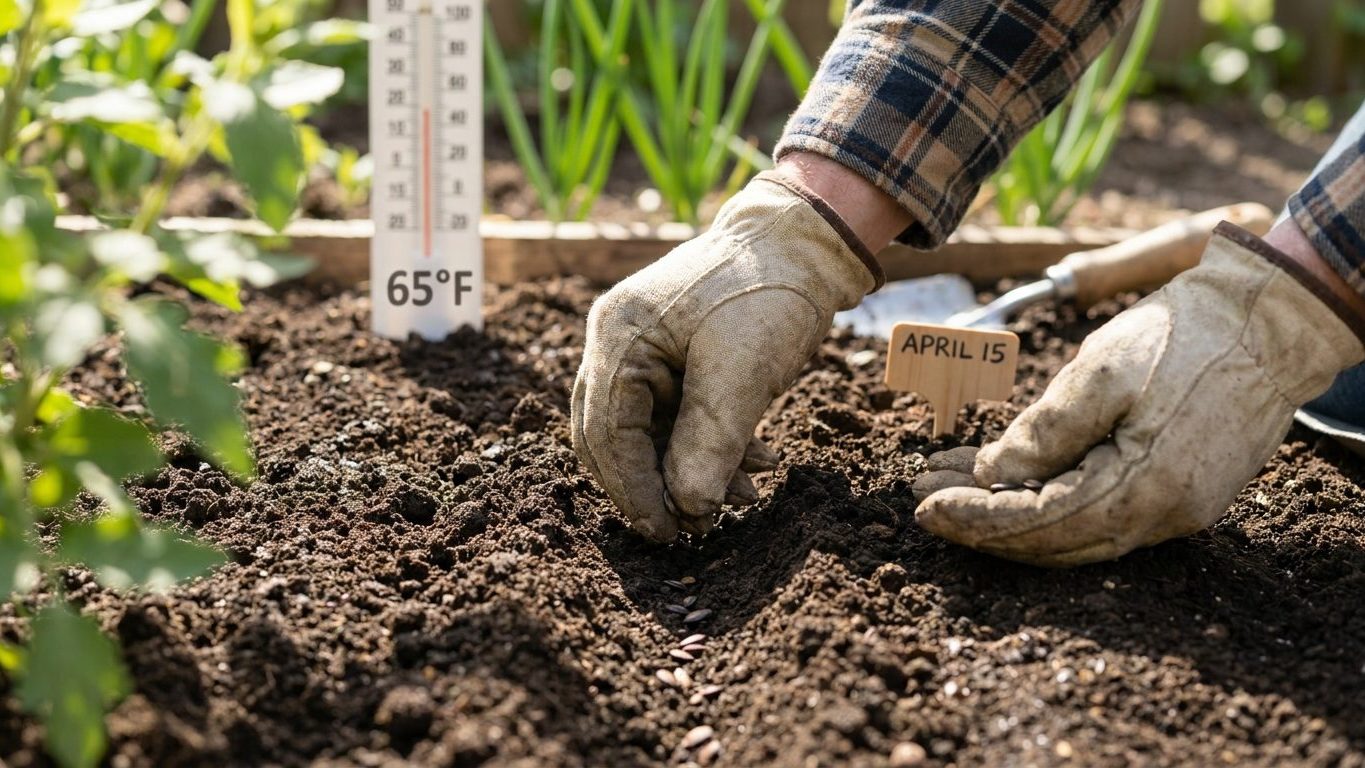

Melon planting in Iowa hinges on the soil warming past 65°F, which typically lines up with the state’s last spring frost window of April 12 to April 24. Transplants go in after that window closes; direct-seeded melons wait another week or two until the soil itself has caught up, not just the air.
The short answer for Iowa
Iowa’s last spring frost falls somewhere between April 12 and April 24, based on NOAA’s 1991-2020 climate normals for the reference station used here. That’s not a guarantee, it’s a probability band: NOAA defines this window as the 30% to 70% chance of a 32°F freeze occurring after that date. In plain terms, planting on April 12 still carries roughly a 70% chance of frost showing up afterward, while April 24 cuts that risk down closer to 30%. Neither date is “safe.” Both are odds.
For melon transplants, the practical move is to wait until the tail end of that window, late April, and then watch the ten-day forecast before setting plants out. Melons are frost-killed outright at 32°F and stunted by anything below the low 50s, so a transplant that survives a light frost rarely thrives afterward even if it lives.
Direct seeding pushes the calendar later still. Melon seed germinates poorly in soil below 65°F, and cold, wet soil in early spring invites seed rot before a sprout ever appears. Most Iowa gardeners direct-seeding melons wait until early-to-mid May, roughly two to three weeks past the last-frost midpoint, to give the soil time to catch up to the air temperature.
On the other end of the season, Iowa’s first fall frost arrives between October 14 and October 25, again per the same NOAA normals. Counting backward from the earlier end of that range, October 14, and subtracting the 65 to 100 days most melon varieties need to mature, the working seed-start date for direct sowing lands in early May at the latest for anything but the fastest-maturing types.
One caution matters here: Iowa State Extension’s own county-level data, drawn from 1950-2021 records, runs about 4 days later in spring and 10 days earlier in fall than the airport-station normals cited above. That means the airport numbers are the optimistic end of the range. A grower planning around the earliest possible frost-free date should mentally shift the spring date about 4 days later and the fall date about 10 days earlier before committing seed to soil.
What will not work here
Run the numbers and Iowa’s growing season is tighter than it first looks. Using the optimistic airport dates, April 12 to October 25 gives about 196 days frost-to-frost. Shift to the Extension-adjusted figures, April 16 to October 15, and that shrinks to roughly 182 days. Either way, that’s the outer ceiling, not the usable window for melons, since nobody plants melon seed the day frost lifts or leaves it in the ground the day frost returns.
Subtract the two to three weeks needed for soil to warm past 65°F in spring, and the four to six weeks a melon needs to ripen fully before a killing frost, and the real planting-to-harvest runway in Iowa runs closer to 100 to 130 days depending on where in the state a garden sits. That number rules out the slowest-maturing melon types outright. A variety needing 100+ days from transplant, not seed, is gambling against an October frost that could show up as early as the 14th in a cool year.
Heat load is moderate, not tropical
Des Moines averages 18.4 days a year at or above 90°F. That’s enough heat to ripen a melon properly, melons need sustained warmth to convert starches to sugar, but it’s nowhere near the heat load of a Southern Plains or Deep South garden. Melon varieties bred for extreme heat tolerance are wasted here; the limiting factor in Iowa isn’t scorching afternoons, it’s whether enough warm days accumulate before frost, not how hot any single day gets.
Rainfall pattern punishes tight spacing
Summer rainfall averages about 13.2 inches across June, July and August, with July running driest at 3.82 inches and June wettest at 5.26 inches. That’s not a drought pattern, but it’s also not evenly spread; a wet June followed by a drier July means a garden that looked fine in early summer can stress a melon crop right as fruit starts sizing. Combined with humidity from that June rainfall, melons planted at tight spacing or with foliage kept damp are set up for powdery mildew and other fungal issues later in the season. Weekly watering schedules that ignore the June-to-July shift will either drown roots early or starve fruit late.
What changes across Iowa
Iowa isn’t one growing zone, it’s a range. The USDA Plant Hardiness Zone Map, built on 1991-2020 average annual extreme minimum temperatures, places the state between zones 4b and 6a. That’s a meaningful spread within one state’s borders, and it matters more for melons than the zone number itself suggests, since hardiness zones measure winter cold, not the length of a frost-free growing season, but the two tend to track together across Iowa’s north-south length.
A gardener in the state’s northern reaches, closer to zone 4b, is working with a shorter frost-free season than one farther south near zone 6a. In practice, that means the northern end of the state should lean toward the earlier end of any maturity-day estimate and treat the fall-frost date as arriving closer to mid-October rather than late October. Southern Iowa gardens, by contrast, have more room to experiment with a slower-maturing variety or a second succession planting.
There’s no single planting date that fits both ends of that range accurately, and the frost normals cited earlier come from one reference station, not a statewide average. A garden 150 miles north or south of that station, or one sitting in a river-bottom cold pocket versus a south-facing slope, can see meaningfully different frost timing even within the same county.
The USDA’s Plant Hardiness Zone Map lets a reader enter their ZIP code and get a specific zone assignment, which is the right next step before adjusting anything to a home garden.
Where to check this for your own county
Everything above is a state-level normal, built from one reference station’s climate data. That’s useful for understanding the pattern, but it’s not a substitute for county-specific guidance, and Iowa State University Extension exists precisely to fill that gap. Their site, extension.iastate.edu, publishes planting calendars and variety trial results built from local data rather than a single airport station’s 30-year average.
Two things are worth searching for specifically once there. First, the county-level planting calendar, which will reflect the Extension’s own frost-date figures rather than the NOAA airport normals, figures that, as noted, tend to run about 4 days later in spring and 10 days earlier in fall. Second, look for melon variety trial data specific to Iowa growing conditions; Extension offices regularly test which varieties actually finish ripening reliably before first frost in local trial plots, which is more useful than any general maturity-day rating printed on a seed packet.
A county recommendation will always outperform a state one for the simple reason that it’s built from data closer to an actual garden. County Extension data narrows that down to conditions much closer to a specific plot of land, and it’s free, publicly available, and updated more often than a national climate normal dataset that only refreshes once a decade.
Some gardeners also time melons by the Moon: when to plant watermelon and cantaloupe by the moon, as almanac tradition rather than fact.
Checking this against your own garden
None of the dates above beat what a garden is actually doing in a given spring. Three signs, checked by hand and eye, tell a grower more than any calendar date.
- Soil warmth by feel: Push a finger a few inches into the planting bed in mid-morning. If it still feels cold and damp rather than merely cool, the soil hasn’t reached the 65°F melon seed needs to germinate reliably, regardless of what the calendar says.
- The first flush of male flowers: Melon plants produce male flowers before female ones, usually by two to three weeks. Their appearance signals the plant has settled into active growth; if they show up unusually early or late compared to a typical year, that’s a sign the local microclimate is running warmer or cooler than the regional normal.
- The first true leaves: The seed leaves (cotyledons) that emerge first aren’t the plant’s real leaves. Watching for the first set of true, lobed melon leaves confirms the seedling has moved past its most vulnerable stage and is drawing on its own root system rather than stored seed energy.
A garden tucked against a south-facing wall, or one sitting in a low spot where cold air pools overnight, can run a week or more off the reference-station dates in either direction. Watching the plant itself, rather than trusting the calendar alone, catches that difference before it costs a season’s harvest.