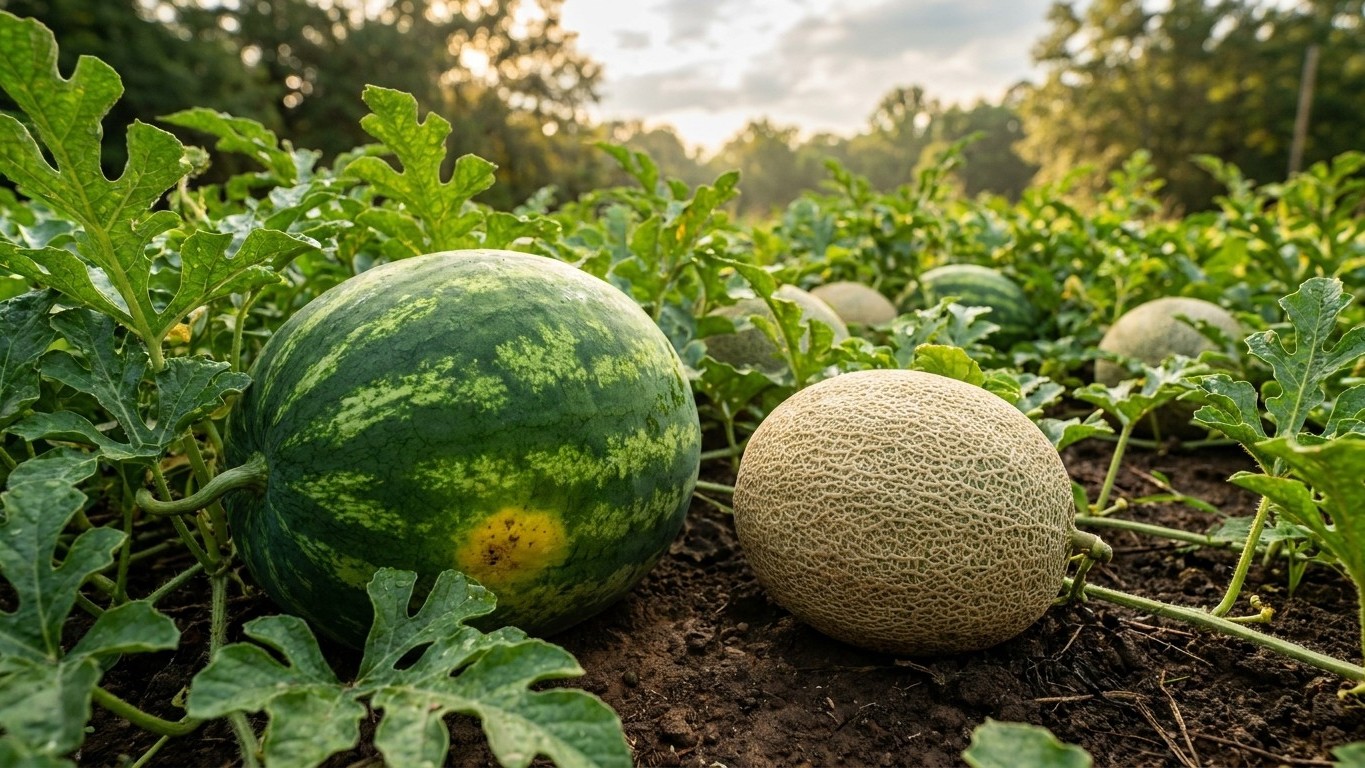

Kansas gardeners get one real advantage with melons: a long, hot frost-free stretch that favors cantaloupe and most watermelon types over slow-finishing honeydew or Crenshaw varieties. The heat load that comes with that season means water management, not cold, decides most failures here.
The short answer for Kansas
At the reference station used for these figures, the frost-free window runs from around April 4 to April 18 (last spring frost) through October 23 to November 2 (first fall frost). That’s roughly 198 to 202 days without freezing air, measured at the airport station itself. Stack that against 57.6 days a year that hit 90F or higher, and you get a growing season that’s both long and genuinely hot, exactly the combination that suits muskmelon and cantaloupe types maturing in 75 to 85 days, and most watermelon types in the 80 to 90 day range, including icebox varieties that finish faster still.
That’s the answer by type, not by brand name: pick from the mid-season cantaloupe and watermelon categories first, because they fit comfortably inside the reference-city window with margin to spare even in a cooler-than-average year. Honeydew and other 90-to-100-plus day melons sit at the edge of what this season reliably supports, and they lose that margin fast the moment a garden’s actual frost dates run later in spring or earlier in fall than the airport’s, which the caution attached to these normals says happens routinely in suburban and rural yards, often by one to two weeks.
Water matters as much as heat here. Summer rainfall averages about 13.2 inches across June, July and August, with July the driest month at 3.98 inches. That’s not a drought, but it’s also not enough to carry a heavy-fruiting melon crop through 57.6 annual days of 90-plus heat without supplemental watering. So the practical answer for Kansas is: choose mid-season cantaloupe or watermelon types, plan on irrigating through July, and treat anything past 90 days to maturity as a variety that needs a head start indoors or a warmer microclimate to pull off reliably.
What it can tell you is the type and timing that this state’s own season length and heat load support, which is the mid-season, heat-tolerant end of the melon lineup.
What will not work here
The clearest failure mode in Kansas is planting a melon that needs more days than the season reliably gives it. A 100-day honeydew sown right at the reference station’s last-frost date of April 18 would mature around July 27 in a best-case reading of the numbers, but that’s the airport’s date, not a home garden’s. If your yard runs a week or two behind that (which the NOAA caution says is common in suburban and rural settings), you’re pushing that same melon toward mid-August, still fine on paper, but with zero buffer left if a cool stretch slows fruit set in June or a wet spell delays pollination. Long-season melons don’t fail dramatically in Kansas; they just run out of slack, and slack is exactly what this state’s variable local frost timing doesn’t guarantee.
The second failure mode is watering on a schedule instead of watering to the heat. With 57.6 days a year at or above 90F and only 3.98 inches of rain in an average July, a melon that gets watered once a week on a fixed calendar will be underwatered during the hottest stretches and adequately watered during the mild ones, which is backwards. Melon roots that dry out during fruit sizing produce cracked or misshapen fruit, and thin-skinned varieties bred for milder, wetter climates show this fastest. Varieties marketed for humid Southeastern or Pacific Northwest gardens, where rain arrives steadily through summer, are a poor match for a Kansas July that can go stretches without meaningful rainfall between thunderstorms.
Early planting into cold soil is the third trap. Kansas’s frost-free window looks generous on the calendar, but melon seed germinates poorly below roughly 60F soil temperature, and soil that cold in early April (even after the average last frost) will simply sit and rot seed rather than speed things up. Gardeners who plant at the very start of the reference window without checking their own soil temperature aren’t gaining season length, they’re losing seed to cold, wet ground. The fix isn’t a different variety; it’s a later, warmer-soil start that still leaves enough of the 198-to-202-day window to finish a mid-season type.
What changes across Kansas
Kansas spans USDA Hardiness Zones 5b through 7a, which is a wide spread for one state and not a detail to gloss over. Zone 5b, typically found in the northern and higher-elevation parts of the state, carries colder average extreme minimum winter temperatures than zone 7a, which shows up more in the state’s southern and eastern sections. That range matters less for melon planting dates directly (hardiness zone measures winter cold, not frost-free season length) but it’s a proxy for a real pattern: the northern and higher-elevation parts of Kansas tend to warm later in spring and cool earlier in fall than the southern and eastern parts, which pushes the whole frost-free window earlier to close and later to open the farther north or higher you garden.
There is no single planting date for “Kansas.” A gardener in the state’s southern tier is likely working with a longer effective season than the reference-station figures already suggest, while a gardener at higher elevation or farther north should expect the opposite: a later usable start in spring and an earlier cutoff in fall, tightening the margin for anything beyond a mid-season melon. Neither of those adjustments can be made accurately from a state-level page.
The right move is to check the USDA Plant Hardiness Zone Map for the specific zone at your own address, not guess it from a regional description. That single lookup, combined with your county extension’s local calendar, does more to refine a melon planting decision than any state average can.
Where to check this for your own county
K-State Research and Extension is the state’s land-grant extension service and the right next step. A state-level article can describe the season length and heat load that shape a melon decision across Kansas broadly, but it cannot tell you what actually performed well in your county’s soil, in your county’s microclimate, over multiple seasons. That’s the gap county extension offices are built to fill.
Two things are worth pulling up specifically once you’re there: the local planting calendar for vegetable crops, which will reflect your county’s own frost data rather than a single reference station, and any variety trial results or recommended-variety lists compiled for melons or cucurbits in your region of the state. K-State’s extension network runs county offices across Kansas, and those offices often publish or can point to trial data on which specific cantaloupe, watermelon, or specialty melon varieties actually produced well locally, something no statewide summary can responsibly claim.
A county recommendation beats a state one every time, for a simple reason: it’s built on data closer to your actual soil, elevation, and local weather pattern rather than a single airport station averaged over thirty years. The state-level part is the season length, heat load, and rainfall pattern that shape a Kansas-wide answer. The county-level refinement, the part that names specific varieties with a track record in your specific ground, is what your local extension office is for.
Checking this against your own garden
Every date and average is a starting estimate, not a rule, and your own garden will tell you more than any calendar once you know what to watch. Three signs are worth checking by hand before you commit seed or transplants to the ground.
Soil warmth by feel is the first and most direct check. Cold, damp soil that feels cool to the wrist an inch or two down means melon seed will sit rather than sprout, regardless of what the calendar says about frost risk being past. Wait for soil that feels warm through most of the day before planting, not just air temperature that happens to be frost-free.
The first flush of male flowers tells you the plant has shifted into reproductive growth, but it’s not the signal to expect fruit yet. Melons produce male flowers before female ones, sometimes by a week or two, and a garden that shows male flowers early but no females for a while isn’t behind schedule, it’s following normal sequence. It’s the second, later flush that carries female flowers with the small swollen ovary behind the petals, and that’s the flush that actually predicts fruit set.
First true leaves, the ones that appear after the initial rounded seed leaves and actually look like melon foliage, mark the point where a transplant is established enough to handle a bit of stress. A garden where true leaves show up quickly after germination is running warmer and faster than the state average; one where they’re slow to appear is running cooler, and that’s useful information for deciding how much buffer to leave before your local first fall frost.