
The short answer: wait until mid-to-late April, after the last frost risk has passed at the reference station, and only sow once the soil itself has warmed, not just the calendar. Kansas gardeners deal with hot, sometimes dry summers and a growing window long enough for one solid melon crop, occasionally two if timed carefully.
When the soil is warm enough in Kansas

NOAA’s 1991-2020 Climate Normals put the last spring frost for the reference station (USW00003928) somewhere between April 4 and April 18, based on the 30-70% probability band for a 32F freeze. That’s a real window, not a single magic date, and it means a gardener who plants on April 5 is playing better odds than someone who assumes the season starts the moment the calendar flips to spring.
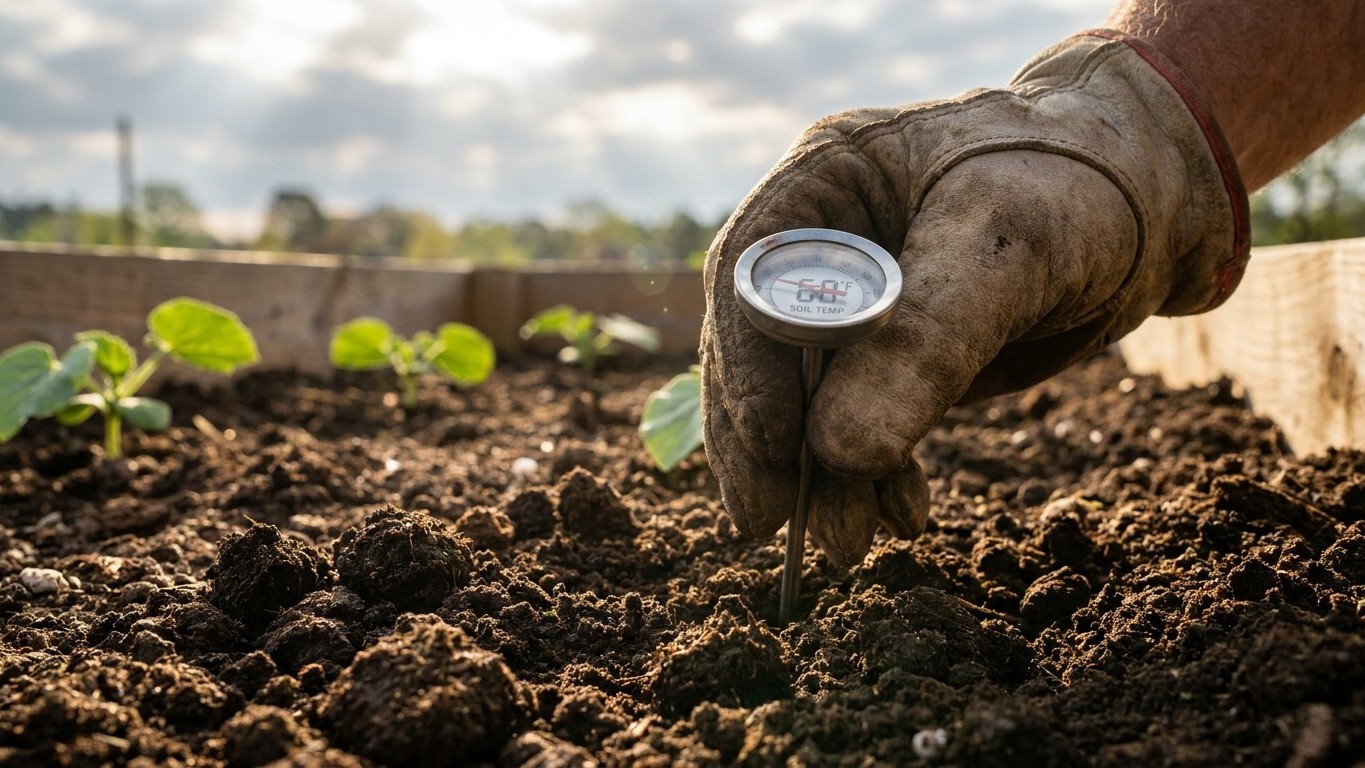
Frost is only a proxy, though. What actually decides when melon seed germinates and roots take hold is soil temperature, and soil lags behind air. A morning with no frost risk can still sit on soil in the low 60s, which is too cool for melon roots to do much beyond sulk. The practical move is to treat that April window as the earliest possible starting line, then confirm with a soil thermometer pushed a few inches down before committing seed or transplants to the ground. Black plastic mulch, laid a week or two ahead, speeds that warming along and is worth the extra step in a state where spring can swing from balmy to raw in 48 hours.
Remember that the April 4 to April 18 range comes from an airport weather station, and airport stations tend to run warmer than the surrounding countryside because of pavement and open exposure. Suburban yards and rural gardens across Kansas typically see their last frost land later than the station’s figure, sometimes by a week or two, and gardens at higher elevation later still. Treat the station date as a starting reference, then check the actual pattern for your county before setting a firm planting day.
Kansas sits across USDA Hardiness Zones 5b to 7a, a wide range built entirely on average annual extreme minimum winter temperature. It says nothing about frost timing or summer heat, which is why it matters less for melon planting than the frost data above, but it does explain why a grower in the southern part of the state can often push planting earlier than someone near the Nebraska line.
For melons specifically, most growers hold off past the earliest safe frost date anyway, because these are warm-season plants that stall rather than thrive in marginal soil temperatures. The better rule is patience: let the soil catch up to the season, not the other way around.
How long the season lasts here
Put the two frost dates together and Kansas offers a frost-free window running from roughly April 4-18 in spring to October 23-November 2 in fall, based on the same 1991-2020 Normals for the reference station. Depending on which end of each range you use, that works out to somewhere between about 188 and 212 frost-free days. Even the shorter end of that math is a genuinely long season by national standards, and it changes what’s realistic to plant.
A window that long gives a melon grower room to make a real decision rather than a forced one. With close to 200 days or more between frosts, there’s enough runway for a single planting to mature comfortably with weeks to spare, and in many years enough slack to consider a second, later sowing of a fast-maturing type as a hedge against a rough first round, or simply to stretch the harvest later into the year. That second option isn’t guaranteed and depends on how the summer heat and rainfall play out, covered next, but the calendar itself doesn’t rule it out the way it would in a state with a six-week shorter season.
The length of the window also affects whether starting melon seed indoors is worth the trouble. In a short-season territory, transplanting is often the only way to get a crop to finish before fall frost arrives. In Kansas, with frost-free stretches pushing past six months at the generous end, direct-sown seed has a realistic path to full maturity without needing a head start indoors, though transplants can still be useful for getting an early jump or filling in after a rough spring. Either way, always check the transplant’s root system before setting it out; melons dislike root disturbance, and a plant that’s been root-bound too long in its tray often stalls for a week or more after transplant, eating into the very cushion the long season provides.
Gardeners looking to make the most of that window, particularly the option of a second sowing, should look at the site’s succession sowing guide for the timing math specific to melons.
Heat and water in Kansas

The reference station near Wichita logs an average of 57.6 days a year at or above 90F, per the 1991-2020 Climate Normals. That’s a substantial heat load, not a handful of hot afternoons, and it puts Kansas firmly in the category of states where summer warmth is rarely the limiting factor for melons. What melons actually need is accumulated warmth over the season, and with nearly two months’ worth of days pushing past 90F, there’s plenty of it to work with. The planting date question above matters more here than any worry about the vines not getting hot enough to ripen fruit.
Rainfall is the other half of the equation, and it tells a less generous story. Summer rain across June, July and August averages about 13.2 inches at the same station, out of roughly 34.3 inches for the whole year. Broken down by month, June brings about 4.93 inches, July drops to 3.98 (the driest of the three), and August rebounds slightly to 4.3. July’s dip lands right in the middle of the period when melon vines are setting and sizing fruit, which is exactly when a shortfall does the most damage.
Those numbers never tell the full story on their own. Nearly 58 days a year above 90F means evaporation is working hard against whatever rain does fall, and a single thunderstorm in a dry July mostly runs off a compacted or clay surface rather than soaking down to where melon roots sit. On sandy ground, the opposite problem shows up: water passes through fast and needs replacing sooner. Either way, the honest conclusion is that Kansas summers put irrigation in charge of fruit size, and the final two or three weeks before harvest, when growers typically cut back water to concentrate sugars, become the stretch that decides flavor. A rain gauge on the actual plot, not the regional average, is what tells a grower whether that final dry-down is happening naturally or needs help.
None of this describes a cool, damp-summer problem. Kansas isn’t a territory where mildew and slow ripening from excess moisture are the main risk; it’s a territory where heat and dry stretches, especially through July, are what a grower needs to plan around.
Which melons suit Kansas
Given a heat load like this and a long, mostly generous season, the deciding factor for melon type in Kansas is less about maturity speed and more about handling sustained heat and uneven summer rain. Types that tolerate heat stress well and that respond to consistent irrigation tend to do better here than those bred primarily for short, cool seasons. Airflow around the vines and some attention to root-zone moisture (via mulch or drip irrigation) matter more in a Kansas July than they would somewhere with a milder summer.
Disease pressure is a secondary but real consideration. Warm nights combined with irrigation or occasional heavy rain can create the humidity spikes that favor powdery mildew and other foliar diseases, even in a generally dry state. That makes disease resistance a reasonable second criterion when comparing melon types for this territory, right behind heat tolerance.
Variety trials run by Kansas State University’s extension program test performance against the state’s actual conditions, soil types, disease pressure, and local pest populations, in a way no general guide can replicate. A cultivar that performs well in one part of the state can underperform in another simply because of soil texture or microclimate differences the trials are built to catch.
The Kansas State Research and Extension service, reachable at ksre.k-state.edu, publishes updated variety recommendations by county and season. That’s the resource worth checking before buying seed, because it reflects what’s actually been trialled and proven under Kansas heat and rainfall patterns rather than a general national recommendation. Choosing by type first (heat-tolerant, disease-resistant, suited to the length of window discussed above) and then confirming the specific variety through that extension resource is the sequence that holds up across the state’s varied conditions, from its drier western counties to the somewhat wetter east.