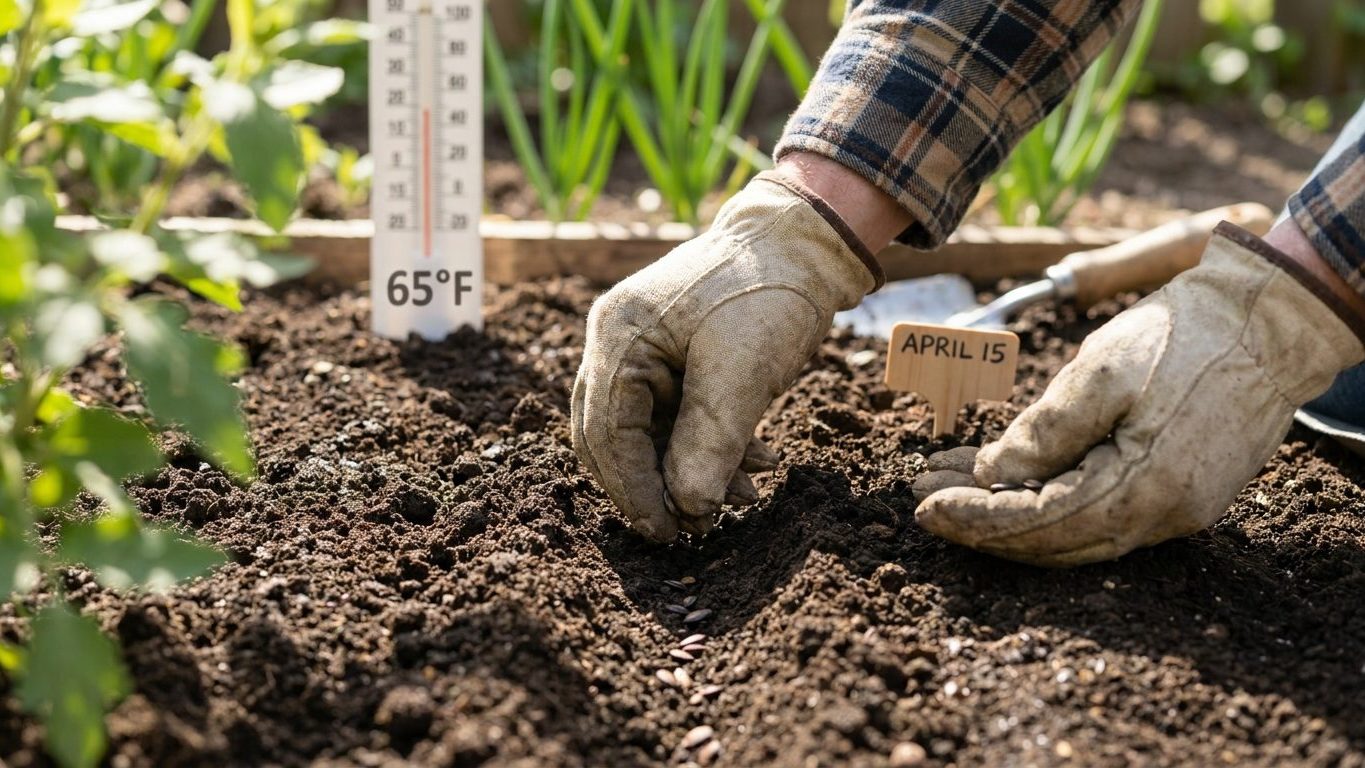

Kansas gardeners get one real window: sow melon seeds or set out transplants after the last spring frost risk passes, roughly mid-to-late April at the Wichita reference station, and count backward from an October frost that can arrive as early as October 23. Everything else on this page explains why that window shrinks or shifts depending on where in Kansas you actually garden.
The short answer for Kansas
At the Wichita reference station, the last spring frost falls somewhere between April 4 and April 18, and the first fall frost lands between October 23 and November 2. Those aren’t fixed calendar dates. They come from NOAA’s 1991-2020 Climate Normals and mark the window where a 32°F freeze has a 30 to 70 percent chance of happening. In plain terms: April 4 is early enough that a freeze is still fairly likely, and April 18 is late enough that the odds have flipped toward safe. Melons don’t tolerate any frost at all, so the practical move is to treat April 18 as the safer target for direct seeding or setting transplants outside, not April 4.
Work backward from the fall side of that window and you get a usable season. From April 18 to October 23 is roughly 188 days, calculated straight from the two frost dates above. That’s the outer limit, not a guarantee, since a garden can lose weeks off either end depending on the year. Melons are warm-season vines that need consistently warm soil to germinate at all; seeds sown into cold ground tend to rot rather than sprout, regardless of what the calendar says. Most gardeners in this region wait until nighttime lows stay reliably above 55°F before direct-seeding, which in practice often means the last week of April into early May rather than the exact frost-free date.
Once soil has warmed, the choice of variety matters more than the exact planting day. A melon that needs 100+ days to mature, planted at the tail end of April, is cutting it close against an October 23 fall frost in a shorter-season year. Varieties bred for 75 to 85 days to maturity give far more cushion. The 188-day window calculated above is a ceiling, and a cautious gardener plans for something shorter.
What will not work here

Three things reliably sink a Kansas melon crop, and all three trace back to the numbers above rather than generic gardening advice.
Melons that need too long a season
Some large watermelon varieties are bred for 90 to 100+ days to maturity. Planted after a cautious late-April start and pushed toward a fall frost that can show up October 23, that leaves almost no margin for a cool, slow spring or an early autumn cold snap. The shorter the region’s realistic frost-free window, the harder it is to justify a slow-maturing variety.
| Melon type | Typical days to maturity | Fit for a ~188-day Kansas window |
|---|---|---|
| Early cantaloupe/muskmelon | 75-85 days | Comfortable margin |
| Standard watermelon | 80-90 days | Workable if planted promptly after last frost |
| Large or heirloom watermelon | 90-100+ days | Tight; little room for a late spring or early fall frost |
Watering on a weekly schedule
The reference station averages 57.6 days a year at or above 90°F, almost two full months of high heat load driving evaporation. Summer rainfall totals about 13.2 inches across June, July and August, but July, the driest month, brings only 3.98 inches, and that rain often arrives as a single thunderstorm that runs off rather than soaking in. A gardener watering once a week through a Kansas July, especially on sandy ground that drains fast, is very likely underwatering during exactly the stretch when melon vines are setting fruit. Deep, less frequent watering that actually reaches the root zone works better than a light weekly pass.
Planting too early into cold soil
The April 4 date on the frost-probability band still carries a 30 to 70 percent freeze risk. Seeds or transplants set out that early often sit in soil too cold to support germination, and a late frost can wipe out tender seedlings outright. Waiting for the safer end of the window, or warming soil with black plastic mulch beforehand, avoids replanting a failed first attempt.
What changes across Kansas
Kansas spans USDA Plant Hardiness Zones 5b to 7a, a range built on one measurement: the average annual extreme minimum winter temperature. That’s a wide spread for one state, and it means there is no single planting date that works from the Nebraska border to Oklahoma. The Wichita figures used throughout this page describe south-central Kansas. A garden in a colder zone, generally toward the north or at higher elevation in the west, should expect a later last spring frost and an earlier first fall frost than the dates given here, sometimes by a week or two, which shortens the usable melon season further than the 188-day estimate above.
The reverse is also true. Gardeners in the warmer end of that 5b-7a range, closer to zone 7a, likely see a slightly longer frost-free stretch than the reference station shows, which gives a little more room for a longer-season watermelon variety. Since hardiness zone is built from winter extremes rather than growing-season length directly, it’s an imperfect stand-in, but it’s the clearest signal available for how much this state’s climate varies within its own borders.
Rainfall and soil texture shift too. Eastern Kansas tends toward heavier, clay-influenced ground that holds moisture longer; western Kansas trends drier and sandier, which drains faster and needs more frequent deep watering even where summer rainfall totals are similar. None of this tells an individual reader which zone or soil type sits under their own garden. The USDA Plant Hardiness Zone Map is the tool for that, not a guess based on which part of the state feels familiar.
Where to check this for your own county
Kansas State Research and Extension is the next step past this page. State-level figures like the frost dates and rainfall totals above come from one reference station and describe a broad regional pattern; a county extension office works from local trial data and local weather records, which is a closer match to what actually happens in a specific garden.
Once there, look for two things specifically. First, a county or regional planting calendar for vegetables, which will adjust the frost-date window used here to whatever that county’s own weather station typically shows. Second, variety trial results or recommended cultivar lists for melons, since Kansas State’s extension system tests crop varieties across different parts of the state and reports which ones actually perform well locally, rather than relying on seed-packet maturity dates alone.
A county recommendation will almost always beat a state-wide one. This page works from a single Wichita weather station and a statewide hardiness zone range because that’s the best available common reference point, but it can’t account for a specific county’s microclimate, elevation, or soil. Treat the numbers as the starting estimate, and the county extension office’s own calendar as the correction.
Checking this against your own garden
No calendar date beats what the garden itself is showing. Three signs matter more than any frost-probability chart.
Soil warmth by feel is the first check. Dig down two or three inches and press soil between your fingers; if it feels genuinely warm, not just above freezing but comfortably warm to the touch, germination odds improve sharply. Cold, damp soil that feels clammy is a sign to wait, whatever the calendar says.
The first flush of male flowers is the second signal. Melon vines produce male flowers before female ones, and a strong early flush usually means the plant has settled into active growth rather than just surviving. A vine that’s slow to flower at all, well into the season, often points to a cooler microclimate or a planting date that was too early for that specific spot.
First true leaves, the second set that appears after the initial seed leaves, tell you the plant has moved past its most vulnerable stage. A slow gap between seed leaves and true leaves usually reflects soil that’s still cooler than it looks. Watching all three together, over a season or two, builds a far more accurate local planting window than any regional average can offer.
Some gardeners also time melons by the Moon: when to plant watermelon and cantaloupe by the moon, as almanac tradition rather than fact.