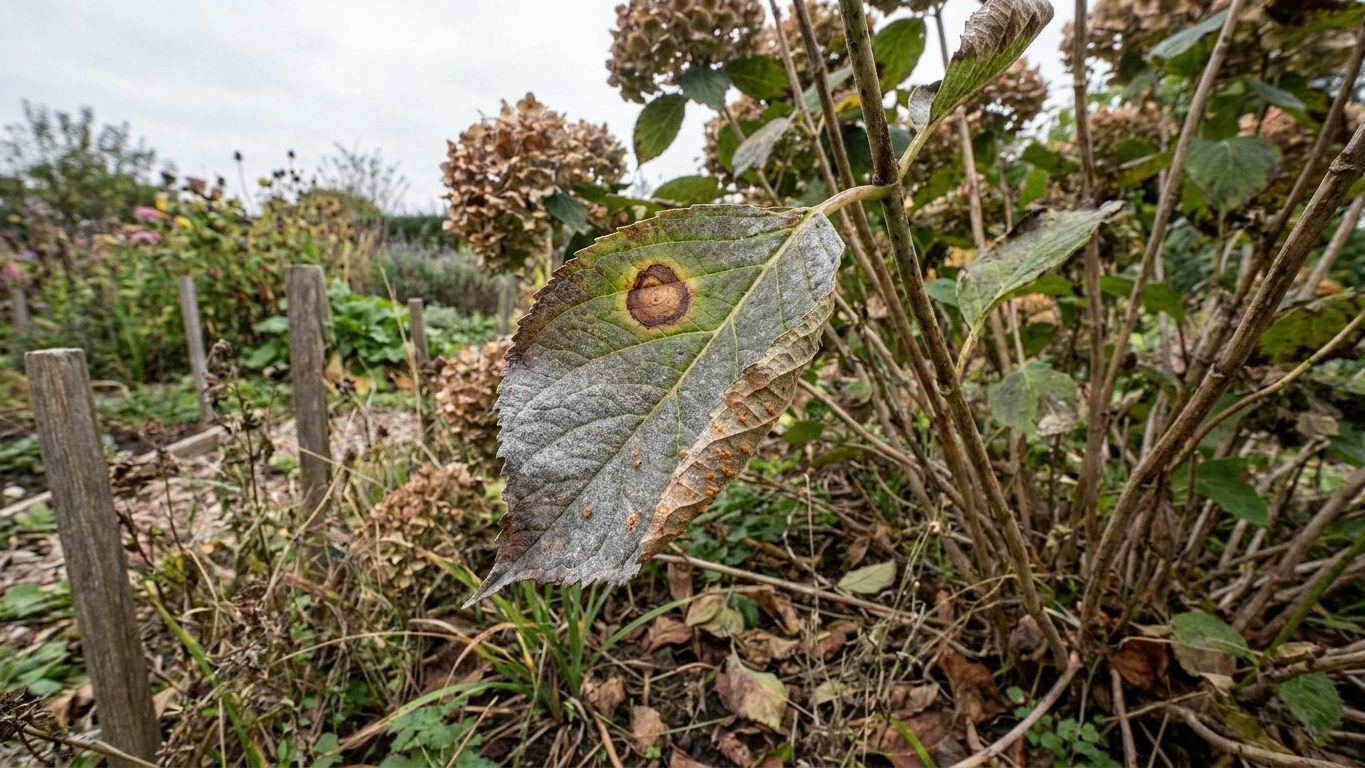

A hydrangea leaf rarely lies. Brown circles with a yellow rim, a dusty gray coating, sudden wilting on a well-watered plant, orange pustules on the underside: each pattern points to one of a short list of named problems, not a mystery. Reading it right starts with knowing which type of hydrangea you’re looking at, because rust and bud blight only show up on panicle types, and a pink flower that “should” be blue is a soil chemistry issue, not a disease at all.
Why this matters
Misreading a hydrangea leaf sends you toward the wrong fix, and the wrong fix has a cost. Spraying fungicide on a plant whose real problem is aluminum locked up by high-phosphorus fertilizer does nothing for the color and wastes a product that has its own handling risks. Ignoring genuine leaf spot because “hydrangeas are low maintenance” lets it spread through the canopy over a season, weakening a shrub that’s otherwise supposed to be one of the easier shrubs in the yard to keep going.
On the other side, treating every leaf problem as a disease leads to overtreatment. Deer browsing looks nothing like leaf spot once you know what to check, and a plant recovering from a late frost on old-wood buds can look stressed without being sick at all. The point of reading the leaf carefully isn’t paranoia, it’s matching the right response to the right cause, on a plant genus the extension literature rates as low-maintenance when the basics are right.
When to do it
There’s no calendar date for checking hydrangea leaves, because the signs show up at different points in the plant’s own cycle depending on which problem is developing. Leaf flush, right as new growth expands, is when leaf spot and early powdery mildew first appear on the lowest, oldest leaves. That’s the moment to start looking, not after the whole plant is spotted.
Bud set is the second checkpoint. On panicle hydrangeas, this is when rust pustules and bud blight typically become visible, since both affect the current season’s growth as it develops toward flowering. On bigleaf, mountain, oakleaf and climbing types, which flower on last year’s wood, bud set is a good moment to compare bud condition against the surrounding leaves rather than assuming any dieback is disease.
The third window is after flowering, during any stretch of high humidity or still, damp air. Powdery mildew and bacterial wilt both favor these conditions, and a plant that looked clean at bud set can develop visible symptoms weeks later. Checking after a humid spell, rather than on a fixed schedule, catches problems while they’re still limited to a few leaves.
How to do it
Start with the leaf pattern, not the whole plant
Pick three or four leaves showing symptoms, ideally at different heights on the shrub, and look at them one at a time before drawing conclusions. A hand lens or a phone camera zoomed in helps here more than distance viewing does, since the difference between a fungal spot and a bacterial streak often comes down to the edge of the mark, not its size.
Leaf spot shows as roughly circular brown or purplish spots with a fairly defined border, sometimes ringed with a paler halo, usually starting on the older, lower leaves first. Powdery mildew looks different: a gray-white, dusty film sitting on top of the leaf surface, often on new growth, that can be rubbed off between your fingers, unlike a true spot. Bacterial wilt presents as leaves that go limp and stay green rather than yellowing first, often on one branch while the rest of the plant looks fine, and soil moisture around the base won’t explain it.
On panicle hydrangeas specifically, rust shows as small orange to rust-brown pustules on the underside of the leaf, paired with corresponding yellow blotches on top. Bud blight on the same type shows as buds that stall, brown, and fail to open, sometimes with visible fungal growth on the surface of the bud itself.
Rule out pests and browsing before you call it disease
Not every leaf problem is a pathogen. The source lists aphids, scales, nematodes and mites as occasional pests, though it notes they’re rarely a serious problem on hydrangeas. Aphids leave sticky honeydew and curled new growth, often with visible clusters on the underside of leaves. Scales appear as small, immobile bumps along stems. Mites cause fine stippling and, in heavier infestations, faint webbing between leaf veins. None of these explain circular lesions or a wilting branch, so if you see insects or webbing, you’re looking at a pest issue, not one of the named diseases.
Deer are the other major cause of leaf and stem damage on hydrangeas, and browsing looks like torn, ragged leaf edges and stripped stems rather than spots, streaks or a dusty coating. Keep a small notebook or take dated photos of what you find and where on the plant, since a pattern that spreads from the bottom up over several weeks reads very differently from damage that appears overnight on the outer branches.
What goes wrong
The mistake that looks like extra care
Spraying a hydrangea preventively at the first sign of any discoloration feels responsible, but it’s often the wrong move. A shift from blue toward pink on a bigleaf or mountain hydrangea is a soil chemistry issue, tied to available aluminum and often pushed along by a high-phosphorus fertilizer, not a pathogen. Reaching for coffee grounds or citrus peel to fix the color is a widely held habit, but the pH shift they produce is small; what actually moves the flower color is available aluminum, which soil acidity releases, and fungicide changes none of that. Treating a color shift as a disease wastes a treatment and delays the real fix, which is a soil test and a fertilizer adjustment.
The second common error is watering more when a branch wilts suddenly, assuming drought stress. If the cause is bacterial wilt, extra water in already-wet soil favors the bacteria rather than the plant, and the wilting spreads instead of easing. A third error is applying a genus-wide diagnosis across types: rust and bud blight are named specifically for panicle hydrangeas, so finding orange pustules on an oakleaf or bigleaf plant deserves a second look rather than an automatic rust diagnosis, since the source ties that pattern to paniculata.
Doing it differently
Container-grown hydrangeas make leaf-reading easier in one sense: the plant is at eye level, isolated from neighbors, and easy to move into better light for a close look. The tradeoff is that containers dry out and overheat faster than ground soil, and drought stress on a shallow-rooted type like macrophylla or paniculata can mimic early wilt symptoms, so check the soil moisture directly before assuming disease on a potted plant.
Raised beds generally lower the risk of the wetter-soil problems, since drainage is easier to control than in dense clay, and both bacterial wilt and fungal leaf spot favor soil that stays soggy. A raised bed with good drainage doesn’t eliminate these diseases, but symptoms tend to appear later and more mildly than on a hydrangea sitting in poorly draining native soil.
Greenhouse or high-humidity growing setups raise the risk of powdery mildew and, on panicle types, rust, since both favor still, damp air around the foliage. Improving airflow around the plant, rather than treating chemically at the first sign, is usually the more useful adjustment in that setting.
Common questions
Can leaf spot kill a hydrangea?
Leaf spot on its own rarely kills an established hydrangea, but left unchecked across a full season it weakens the plant and reduces the leaf area available for photosynthesis, which shows up as smaller blooms and slower growth the following year.
Is powdery mildew dangerous or just cosmetic?
It’s mostly a cosmetic and vigor issue rather than a killer on its own. The dusty coating reduces the leaf’s ability to photosynthesize efficiently, which can stunt growth over time, but it’s rarely fatal by itself the way bacterial wilt can be.
My panicle hydrangea’s buds won’t open. Is that a disease?
It can be. Bud blight is named specifically for panicle hydrangeas in the extension source, and it shows as buds that brown, stall and fail to open, sometimes with visible fungal growth on the bud surface itself, rather than simply flowering late.
Will a disease on one hydrangea spread to a different type planted nearby?
That depends on the pathogen and isn’t detailed by type in the source beyond noting which diseases affect the genus generally versus panicle hydrangeas specifically. As a practical matter, isolating and removing badly affected leaves or stems, and avoiding overhead watering that splashes between plants, is the safest approach regardless of which types are growing next to each other.