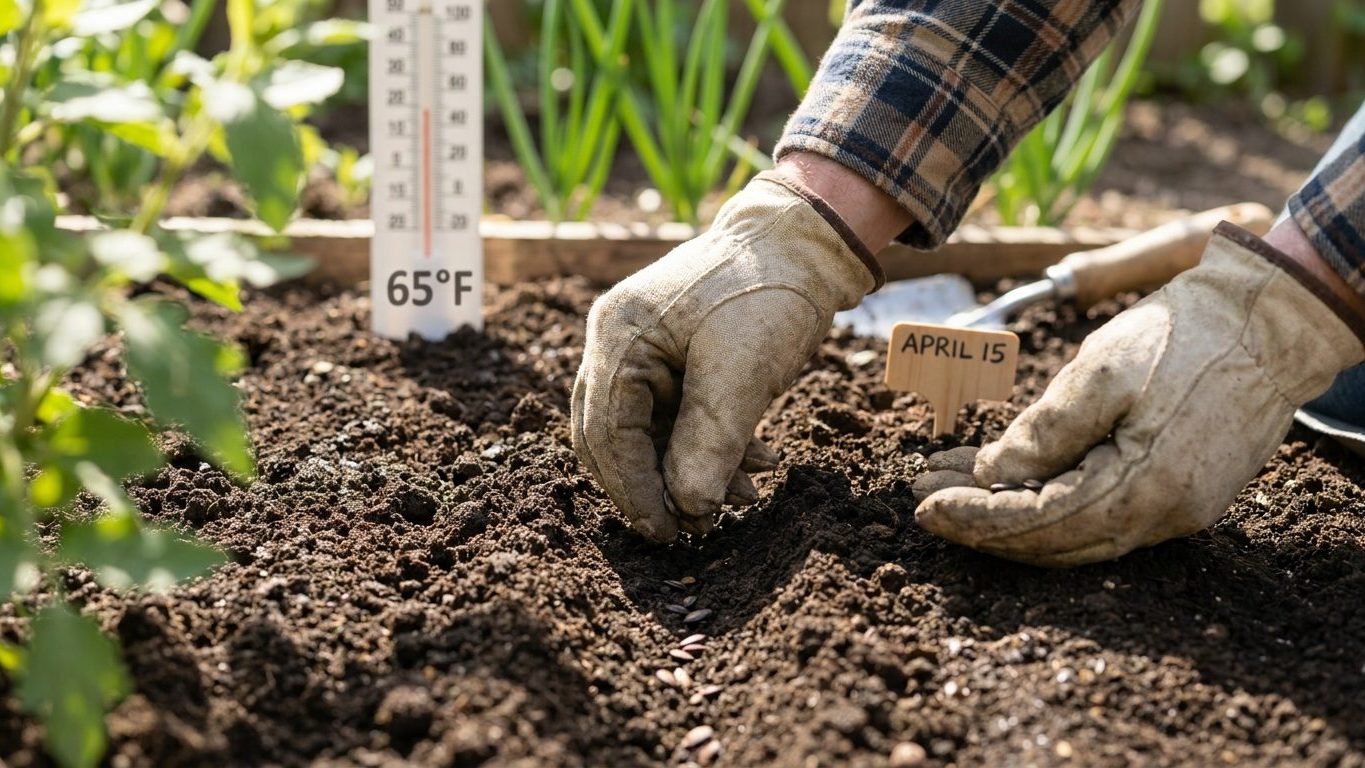

New Brunswick’s frost-free window runs about 132 days on average, from a mean last spring frost of May 23 to a mean first fall frost of October 2. That’s the frame melons have to work with, and it’s tight. Start seeds indoors roughly three to four weeks before the mean frost date, then move transplants outside only after soil has warmed, watching that the mean date is a midpoint, not a guarantee.
The short answer for New Brunswick
Sow melon seed indoors around late April, targeting transplant into the garden on or after May 23, the mean last spring frost date recorded at the Moncton reference station (1981-2010 normals). That date is not a safety line. Environment and Climate Change Canada builds it as an average, which means in roughly half of all years frost arrives after May 23. A gardener who transplants melon starts the day the calendar says “last frost” is playing a coin flip with a plant that dies outright at 32°F.
The safer play is to treat May 23 as the center of a window, not the edge of one, and push transplanting into the first days of June for anyone without row cover or cloches on hand. Melons also want warm soil, not just frost-free air. Black plastic mulch laid two weeks ahead of transplanting, or a low tunnel of row cover left on until night temperatures settle, buys real weeks in a season this short.
The other number that shapes the answer is heat, or the lack of it. Moncton’s normals show zero days a year averaging 90°F or higher. Melons are heat-driven fruit: they set flowers, size fruit and build sugar on accumulated warmth, not just on frost-free days. A 132-day window with no real heat spikes inside it is a very different growing season from a 132-day window in a place that regularly tops 90°F, even though the frost-free math looks similar on paper.
That combination, a short season and a season without hard heat, points the answer toward short-season, cool-tolerant melon varieties started indoors and transplanted under some form of soil-warming protection, rather than toward direct-seeding a full-season cantaloupe or a large picnic watermelon outdoors in late May and hoping.
What will not work here

Long-season melon types, the ones bred for 90 to 100-plus days from transplant to ripe fruit in hot climates, are the first casualty of this calendar. Count backward from the mean October 2 fall frost and forward from a realistic early-June transplant date, and there simply isn’t enough calendar left for a slow variety to size and sweeten before cold shuts it down. Even in a favorable year, a melon that needs 100 days from transplant is racing a frost that, on average, arrives 122 days after May 23, and that’s before accounting for a cool, cloudy stretch in July that stalls growth for a week or two.
Direct-seeding outdoors instead of transplanting is the second failure point. With zero average days above 90°F, soil in New Brunswick gardens warms slowly and stays cooler through the season than in a hot-summer state. Melon seed sown straight into cool spring soil germinates unevenly or rots before it sprouts. Every week spent waiting on direct-seeded germination is a week subtracted from an already short fruiting window, which is why starting indoors and transplanting is close to a requirement here, not a preference.
Heat-hungry varieties and watering habits
Melon varieties bred for the Southeast or the desert Southwest, the big slicing watermelons and heavily netted cantaloupes that depend on long runs of 90-plus-degree days to concentrate sugar, will vine and flower in New Brunswick but often disappoint at harvest: fruit stays undersized and bland because the heat load that finishes them simply isn’t in the local climate. Picking varieties bred for shorter, cooler seasons matters as much as picking the right transplant date.
Watering by habit rather than by feel is the last trap. Summer rainfall here totals about 10.5 inches across June, July and August, with August running driest at 3.18 inches. That’s a moderate supply, not a drought and not a deluge, but because there’s no real heat spike to dry the soil quickly, a gardener who waters on a hot-climate schedule can easily oversaturate melon roots in a cool, already-moist summer, inviting the rot and fungal issues melons are prone to in humid, saturated soil.
What changes across New Brunswick
Every figure in this article, the May 23 frost date, the October 2 fall frost, the zero days above 90°F, comes from a single reference point: the Moncton station. New Brunswick is not one climate, and a province running from the Bay of Fundy coast up through the Miramichi and into the upper Saint John River valley will not share one frost date or one hardiness zone.
The one zone figure available for this page, Canadian hardiness zone 5a, is specific to the Moncton reference city under Natural Resources Canada’s 1991-2020 mapping. It would be wrong to assume the rest of the province matches Moncton. Coastal areas moderated by the Fundy tides likely run milder in winter than inland or upland districts, and northern parts of the province, closer to the Quebec border, almost certainly see a later last frost and an earlier first fall frost than Moncton’s mean dates, shortening the already tight melon season further.
That means a reader gardening well north of Moncton, or at higher elevation inland, should treat May 23 as an optimistic starting point and lean toward the later end of any transplant window, with row cover or plastic mulch doing extra work to compensate for a shorter local season. A reader closer to the coast or in a known warm pocket may be able to push slightly earlier. Neither adjustment can be pinned to a specific date from this page, because the underlying zone and frost data here describe Moncton, not the reader’s own township.
Rather than guess at a personal zone from a provincial average, the next step is checking an actual zone map against a home address, which is the subject of the following section.
Where to check this for your own county
New Brunswick’s own agriculture department did not return a reliable connection for this page, so the working link here is Canada’s federal agriculture site, agriculture.canada.ca, verified live as of August 2026. It’s the honest fallback: a link that works beats one that doesn’t, even if it’s one level up from a provincial page.
What to look for once there, or through a provincial or regional extension contact reached from it, is a local planting calendar built for New Brunswick specifically, along with any list of melon varieties that have actually been trialled at a research station or demonstration garden in the province. A provincial or county-level calendar accounts for local frost patterns, local soil types and local pest pressure in a way that a single Moncton weather station never can. This page works from station-level averages because that’s the best data available at a province-wide scale, but a local calendar, where one exists, will always outrank it.
The same logic applies to variety lists. A melon variety that has been grown and measured at a New Brunswick trial garden, with actual days-to-maturity and fruit-size results from local conditions, tells a gardener more than any general recommendation for “short-season” or “cool-climate” melons can. This page can point toward the kind of variety that fits a short, cool season; it cannot substitute for a result actually grown in New Brunswick soil.
Checking the province’s own hardiness zone map at Natural Resources Canada, rather than assuming the Moncton 5a figure applies everywhere, is the other concrete step worth taking before committing garden space to melons this season.
Checking this against your own garden
No date on this page beats what a hand and an eye can confirm in an actual garden bed. Three signs, checked directly, tell a gardener more than any calendar average.
- Soil warmth by feel: push a bare hand two inches into the planting bed in the morning. Melon roots want soil that feels warm, not just frost-free air. Cold, damp soil that feels chilly to the touch, even weeks after the mean frost date, means transplanting should wait regardless of what the calendar says.
- The first flush of male flowers: male blossoms open before female ones and don’t set fruit on their own. Their appearance signals the plant has moved from vegetative growth into reproductive mode, a sign the local season is warm enough to keep the plant progressing rather than stalling.
- The first true leaves: the rounded seed leaves that first emerge aren’t the plant’s real foliage. The appearance of the first jagged, vine-shaped true leaves confirms the seedling has established and is ready to handle the stress of transplant, rather than sitting in a holding pattern indoors past its useful window.
A garden that lags behind these three markers compared to a neighbor’s plot, even one a few miles away, is signaling its own microclimate, a shadier corner, heavier clay soil, or a low spot that collects cold air, and that local reality outranks any provincial average every time.
Some gardeners also time melons by the Moon: when to plant watermelon and cantaloupe by the moon, as almanac tradition rather than fact.