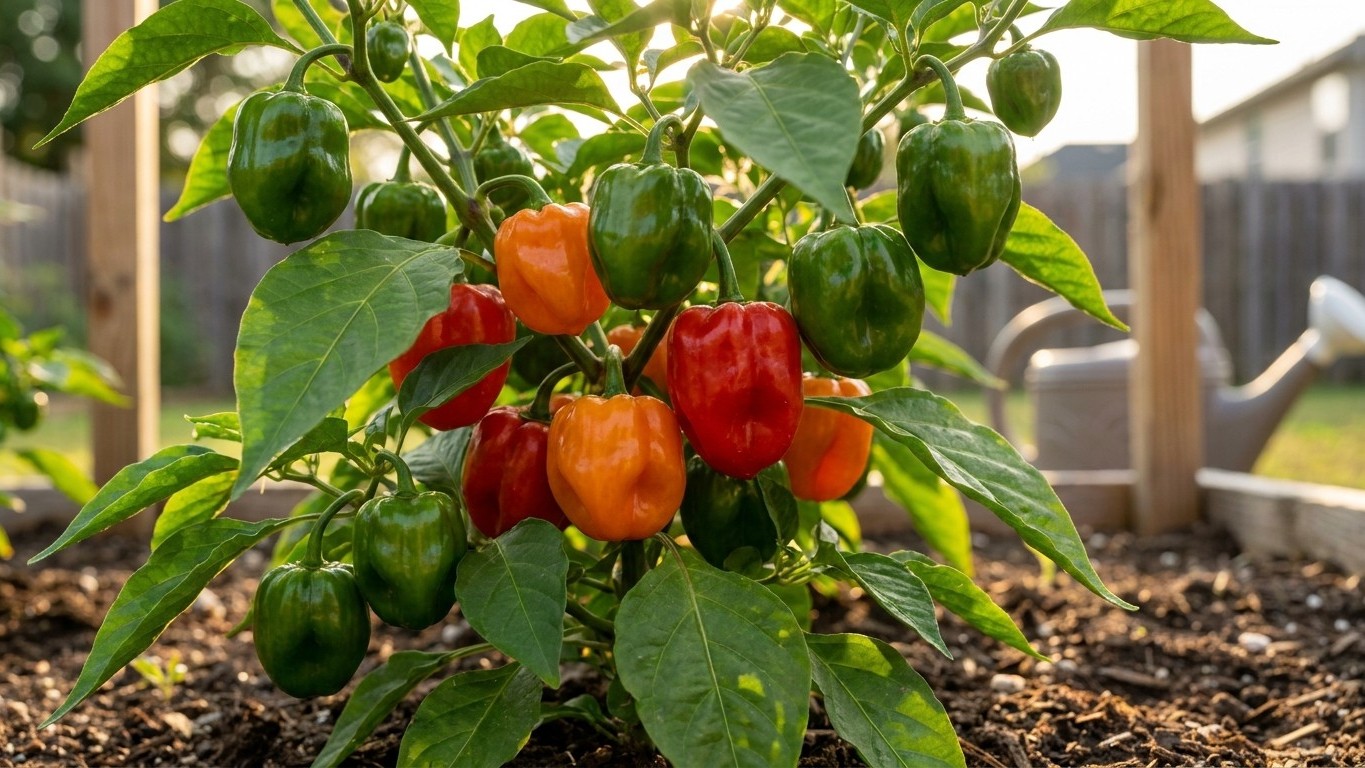

Six of the eight vegetable pests documented for Hawaii actually feed on pepper: aphids, beet armyworm, Chinese rose beetle, leafminers, southern green stinkbug, and mites, plus whiteflies. Timing tracks the plant’s own growth, not a calendar month, because lowland Hawaii has no frost season to anchor a planting date to. A few pests commonly listed for Hawaii vegetable gardens skip peppers entirely, which matters more than it sounds.
Which pests attack pepper in Hawaii

The University of Hawaii CTAHR Extension documents eight pests on vegetable crops across the islands: Aphids, beet armyworm, cabbage webworm, Chinese rose beetle, Leafminers and bean fly, melon fly, Southern green stinkbug and mites, and Whiteflies. That is the full list this site carries for the territory. It is short enough that adding anything else to it would be a guess, not a documented fact.
Not every name on that list has business on a pepper plant. Cabbage webworm feeds on brassicas, cabbage, broccoli, and their relatives, and has no reason to touch a Capsicum leaf. Melon fly targets cucurbits, cucumbers, melons, squash, pumpkins, because its larvae need the soft flesh of a cucurbit fruit to develop, not a pepper. Bean fly, grouped with leafminers in the CTAHR entry, is a legume specialist that tunnels into bean stems and has nothing to do with pepper foliage.
That leaves six names, and part of a seventh entry, that do feed on pepper in a home garden here. Aphids cluster on new growth and the undersides of leaves at almost any stage of the plant’s life. Beet armyworm caterpillars chew ragged holes in foliage and, once older, move into the fruit itself. Chinese rose beetle adults fly at dusk and chew round or scalloped notches into leaf margins overnight, feeding as adults rather than as larvae. The leafminer half of that combined CTAHR entry tunnels winding trails inside pepper leaves, separate from the bean fly’s stem-boring habit. Southern green stinkbug pierces developing fruit and leaves discolored feeding scars, and mites, grouped with it in the same line, cause stippling and bronzing on leaf undersides during hot, dry stretches. Whiteflies round out the list, feeding on sap and leaving sticky honeydew behind on lower leaves.
Six pests, one service, one source, once the general vegetable list gets sorted down to what actually lands on a pepper plant.
When each one shows up, and what it does first
Hawaii’s lowland gardens do not have a frost date to build a calendar around. NOAA’s 1991-2020 climate normals show zero days per year at or below 32 F for the reference station, with every freeze percentile flagged not-computable, which means the growing season here runs on soil temperature and rainfall, not a last-frost line. Utah State University Extension’s transplant guidance still applies to the plant itself: start pepper seed 8 to 10 weeks before moving it outside, and wait until the soil reaches 60 F before transplanting, rather than picking a date off a frost calendar that doesn’t apply here.
Because there is no cold season to reset insect populations, several of these pests can turn up within the first few weeks after transplant. Aphids are usually the earliest visitors, showing up on tender new growth as soon as the plant starts putting out leaves. Chinese rose beetle follows once the plant has enough leaf surface to attract nighttime feeding, appearing as small round holes with smooth, chewed edges rather than the torn look of caterpillar damage.
Leafminer trails tend to show up on those same early leaves, visible as pale, winding tunnels rather than surface holes. Beet armyworm arrives a bit later, once the plant has enough biomass to support a caterpillar that starts small and grows fast; the first sign is usually a few skeletonized patches rather than plant-wide damage.
Southern green stinkbug and mites tend to show up once fruit starts setting, which lines up with the plant’s own biology: fruit set fails at both ends of the temperature range, below 55 F at night and above 90 F in the day, so a plant that is fruiting has already cleared that hurdle. Stinkbug damage shows as cloudy, sunken spots on the fruit skin. Mite pressure builds during the hottest stretches, since Honolulu’s reference station averages 18.7 days a year at or above 90 F, and mites favor exactly that kind of dry heat. Whiteflies can appear almost any time there’s enough leaf canopy to host them, tipped off by a small cloud of insects lifting off the underside of a disturbed leaf.
Telling the damage apart from everything else
Not every ragged leaf or spotted fruit is an insect. Pepper plants in Hawaii’s heat and rainfall also show nutrient deficiency, water stress, and fungal or bacterial disease, and several of those mimic pest damage closely enough to send a gardener down the wrong path.
| What you see | Likely cause | What tells it apart |
|---|---|---|
| Yellowing leaves, no holes | Nutrient deficiency or root stress | Yellowing spreads evenly across the leaf, not starting at a chewed edge or tunnel |
| Wilting despite wet soil | Root disease or waterlogging | Wilting affects the whole plant at once, not just leaves near visible feeding marks |
| Cloudy or sunken spots on fruit | Stinkbug feeding or fungal lesion | Feeding scars stay dry and slightly corky; fungal spots often soften or spread |
| Torn or shredded leaf edges | Wind or mechanical damage | Wind tears follow the leaf’s natural stress lines; chewing leaves smooth, scalloped bites |
| Stippled, bronzed leaf undersides | Mites or sun stress | Mite damage often comes with fine webbing between leaf veins that sun stress never produces |
One rule holds across all of these: look at where the damage starts, not just what it looks like once it has spread. Feeding damage begins at a discrete point, a hole, a tunnel, a puncture, and grows outward from there. Environmental stress tends to show up more uniformly across a leaf or a whole plant at once.
None of this replaces an actual look at the plant. A county extension agent can examine a leaf or a fruit sample and confirm what’s actually happening, which matters because treating a nutrient problem like an insect problem, or the reverse, wastes time on a short growing window.
What actually works here, and what is a waste of time
Physical barriers beat most other tactics on a young pepper plant, and timing decides whether they work. Fine mesh or floating row cover placed over transplants right after they go into the ground keeps Chinese rose beetle off the plant during the vulnerable first few weeks, before it has enough leaf mass to shrug off light feeding. Cover has to go on before the pest finds the plant, not after the first hole shows up. Pulling it too early, once the plant starts flowering, cuts off pollinators along with the pest.
Hand-picking beet armyworm caterpillars off leaves works on a small planting, especially early, when populations are still low and the caterpillars are still small enough to spot before real damage sets in. Sticky traps help track whitefly and aphid pressure, giving a sense of when numbers are climbing, though they don’t control a heavy infestation on their own. Clearing old plant debris between plantings removes shelter for leafminers and mites that would otherwise carry over year-round, since there’s no winter here to knock them back naturally.
What doesn’t work: spraying on a fixed schedule instead of in response to an actual sighting. Without a cold season to reset pest populations, a calendar-based spray routine either treats a plant that has nothing on it or misses the pest entirely because it showed up between applications. Waiting for heavy leaf damage before acting also wastes the growing window, since stinkbug and mite pressure both build fast once daytime heat climbs toward that 90 F mark.
Any product decision, what’s labeled for pepper and legal to use in Hawaii, belongs with the county extension office, not a general internet search. Labels and registrations change by state, and a home gardener has no reliable way to check current status without that call.
Where to check this for your own county
Everything above comes from University of Hawaii CTAHR Extension, and it describes pest pressure at the scale of the whole state, not any one backyard. A garden in wet, windward conditions on one island faces a different mix of pressure than one in dry, leeward conditions on the same island, even though both fall under the same statewide pest list.
Hawaii’s extension work runs through county-level offices, on Oahu, Hawaii Island, Maui, and Kauai, each covering the specific conditions of that county. A pest documented for the state may be common in one area and rare in another a short drive away, so a statewide list is a starting point for identification, not a diagnosis for a specific plant.
Elevation and exposure change things fast in Hawaii. A pepper plant a few hundred feet up a slope, or on the wet side of an island instead of the dry side, can see a different balance of aphids, mites, and stinkbugs than one at sea level a few miles away, even under the same statewide pest documentation.
The most useful next step for anyone seeing unexplained damage is contacting the local CTAHR extension office directly, with a photo of the damage and, where possible, a sample of the affected leaf or fruit. That local contact can confirm which of the six pepper-feeding pests on the statewide list is actually active in that area this season, and whether what’s showing up is even one of them.
Common questions
Do pepper plants in Hawaii need frost protection?
No. NOAA’s 1991-2020 climate normals show zero days per year at or below 32 F at the reference station used for this territory, and freeze percentiles are flagged not-computable. Frost only occurs on high volcanic summits, never where people garden.
Why do peppers sometimes fail to set fruit even with no pest visible?
Fruit set fails at both ends of the temperature range: nights below 55 F and days above 90 F. A plant can look healthy and pest-free and still drop blossoms if temperatures cross either threshold during flowering.
How many hot days does a typical Hawaii growing season include?
The Honolulu reference station averages 18.7 days a year at or above 90 F, based on 1991-2020 NOAA climate normals. That count drives mite pressure and heat stress on pepper more than any single summer month.
What’s the fastest way to confirm which pest is actually on my pepper plant?
Contact the CTAHR extension office for your county, on Oahu, Hawaii Island, Maui, or Kauai, with a photo and, if possible, a sample of the damaged leaf or fruit. Local staff can match the damage against pests active in that specific area.