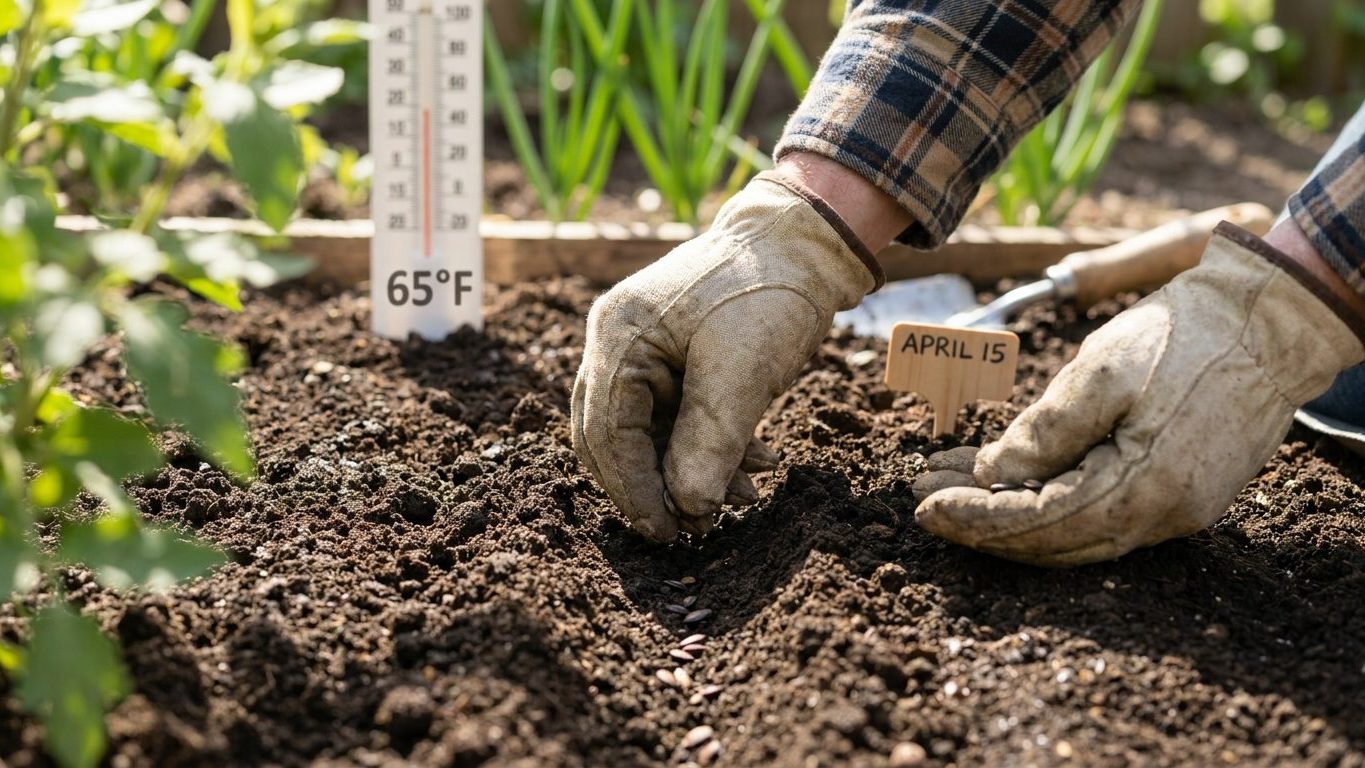

Transplant melons outdoors in South Dakota once soil has warmed past the chill of spring, roughly mid-to-late May for most of the state, and never before the local frost risk has genuinely passed. That timing comes straight from NOAA’s frost data for the reference station, not from a generic garden rule, and it shifts depending on where in the state you’re standing.
The short answer for South Dakota
NOAA’s 1991-2020 Climate Normals put the last spring frost for the Sioux Falls reference station (USW00014944) between April 29 and May 9. That’s not a single date. It’s a 30-70% probability band, meaning frost still has a meaningful chance of showing up on either side of it. The first fall frost lands between September 24 and October 4, same station, same kind of band.
Do the math on that window and the frost-free season runs somewhere between 138 and 158 days, depending on which end of each band you land on. Melons are not a quick crop. Cantaloupe generally needs 75 to 85 days from transplant to harvest, watermelon closer to 80 to 90, and both crops sulk badly if soil hasn’t warmed enough at planting. That’s why almost nobody in South Dakota direct-seeds melons outdoors and expects a reliable crop. The standard approach is starting seed indoors three to four weeks before the last frost date, so roughly early April, then moving transplants outside only after that frost risk has genuinely dropped, not just after the calendar hits the early end of the band.
Given the probability spread, a safer outdoor transplant target sits closer to May 10 through May 20 for most of the state, letting the riskier early-May stretch pass. Days above 90°F average 13.8 a year at the reference station, which tells you the heat will show up eventually to push fruit along, but it won’t arrive early enough to rescue a crop planted before soil temperatures cooperate. Melon roots stall in cold soil regardless of air temperature, so the frost date is really a floor, not a target.
None of this is a guarantee for any individual garden. It’s the reference-station answer, and the next sections explain exactly how much that answer moves once you leave the airport where the thermometer sits.
What will not work here
Long-season watermelon varieties, the ones bred for 90-plus days to maturity, are a poor match for a frost-free window that can run as short as 138 days once you account for a late spring frost and an early fall one. Even with a month’s head start indoors, a slow-maturing watermelon direct-seeded outdoors in South Dakota is racing a calendar it’s likely to lose. That’s a specific mismatch between crop biology and this state’s numbers, not a generalization borrowed from a milder climate.
Weekly watering is the other common failure, and the summer rainfall data explains why. June, July and August together bring about 10.8 inches of rain to the reference station, with July, the hottest stretch, delivering the least at 3.25 inches. Pair that with 13.8 days a year above 90°F and you get a summer where evaporation regularly outpaces what falls from the sky. Melons have shallow, spreading root systems and they show stress fast under that kind of deficit. A single soaking rain in July mostly runs off a dry surface rather than sinking in, so a gardener watering once a week on the assumption that “it rained Tuesday” is often watering into a crop that’s already been drought-stressed for days.
Direct-seeding before soil has actually warmed is a third trap, and it’s a timing error more than a variety error. Because the last-frost band runs a full ten days (April 29 to May 9), a gardener who plants on the early end and gets unlucky loses the crop outright, while one who waits for the late end but plants in soil still cold from a wet spring gets seed that rots before it germinates. Melons want soil warmth, not just an absence of frost, and chasing the calendar date without checking the ground itself is how both mistakes happen in the same season.
What changes across South Dakota
USDA places South Dakota across hardiness zones 3b to 5b, and that’s a wide spread for one state to carry. The zone system is built on a single measure, the average annual extreme minimum temperature, so a gap from 3b to 5b represents roughly a 20-degree difference in how cold winters typically get at the coldest end. That’s not a minor variation. It’s the difference between a garden that reliably clears frost by early May and one where a grower is still watching the sky in late May or even into June.
There is no single planting date for “South Dakota.” The higher, more western parts of the state and areas at greater elevation sit toward the colder end of that 3b-5b range, and gardeners there should expect the frost-free window to open later and close earlier than the Sioux Falls reference numbers suggest. The eastern and lower-elevation stretches of the state, closer to the reference station itself, run warmer and can generally trust the April 29 to May 9 band more directly.
The right move is checking the current USDA Plant Hardiness Zone Map by ZIP code, then adjusting the transplant timing in this article later if the result lands toward the 3b-4a end of the range, or treating it as roughly accurate if it lands closer to 5a-5b. A gardener in the Black Hills at real elevation is working a different season than one along the Big Sioux River, even though both are technically South Dakota.
Where to check this for your own county
SDSU Extension is the place to take this from a state-level estimate to something specific to where the reader actually gardens. This is the land-grant university extension service for South Dakota, and it’s built to answer exactly the question.
Two things are worth hunting for once there. First, a county or regional planting calendar, if one exists for the area, since local frost records often differ from the single airport station cited above by a week or more in either direction. Second, any variety trial results for melons specific to South Dakota conditions. Extension services frequently test which cantaloupe and watermelon varieties actually finish reliably within a given region’s real season length, and that’s a far more useful data point than a generic seed-catalog maturity date, since catalog numbers are usually measured in warmer, longer-season trial grounds.
A county-level recommendation beats a state-level one every time, and the state-level picture is the broader one. It’s built from a single reference station’s Climate Normals and a statewide hardiness zone range, which is useful for understanding the general shape of the season but not a substitute for local frost records, local soil temperature patterns, or a county extension agent who has watched melons succeed and fail in that specific area for years. Treat everything above as the starting estimate, and treat SDSU Extension as the correction.
Some gardeners also time melons by the Moon: when to plant watermelon and cantaloupe by the moon, as almanac tradition rather than fact.
Checking this against your own garden
Every date here is an average built from decades of weather records at one station. A gardener’s own observation of their actual plot will always outrank it, and three things in particular are worth watching before committing melon transplants to the ground.
Soil warmth by feel comes first. Push a bare hand into the planting bed several inches down in the morning, before the sun has warmed the surface. If the soil still feels cold and slightly damp in a way that lingers, rather than warm and dry-ish, the ground isn’t ready regardless of what the calendar says. Melons planted into cold soil often just sit there, sometimes for weeks, before either rotting or limping into growth well behind schedule.
Second, watch for the first flush of male flowers once plants are established. Melons produce male blossoms before female ones, often by a week or two, and a garden that’s running warm and vigorous will show that first flush earlier than one that’s been held back by a cool microclimate. It’s an early signal of how the season is actually unfolding on that specific plot, separate from any regional average.
Third, note how quickly the first true leaves appear after the seedling leaves. A fast transition suggests the plant has hit a genuinely favorable stretch of soil and air temperature; a slow, stalled one suggests the local conditions are running cooler than the state numbers assume, which is common in low spots, near tree lines, or on the shaded side of a house. That single observation, tracked across a season or two, tells a gardener more about their own frost-free window than any station-based date ever will.