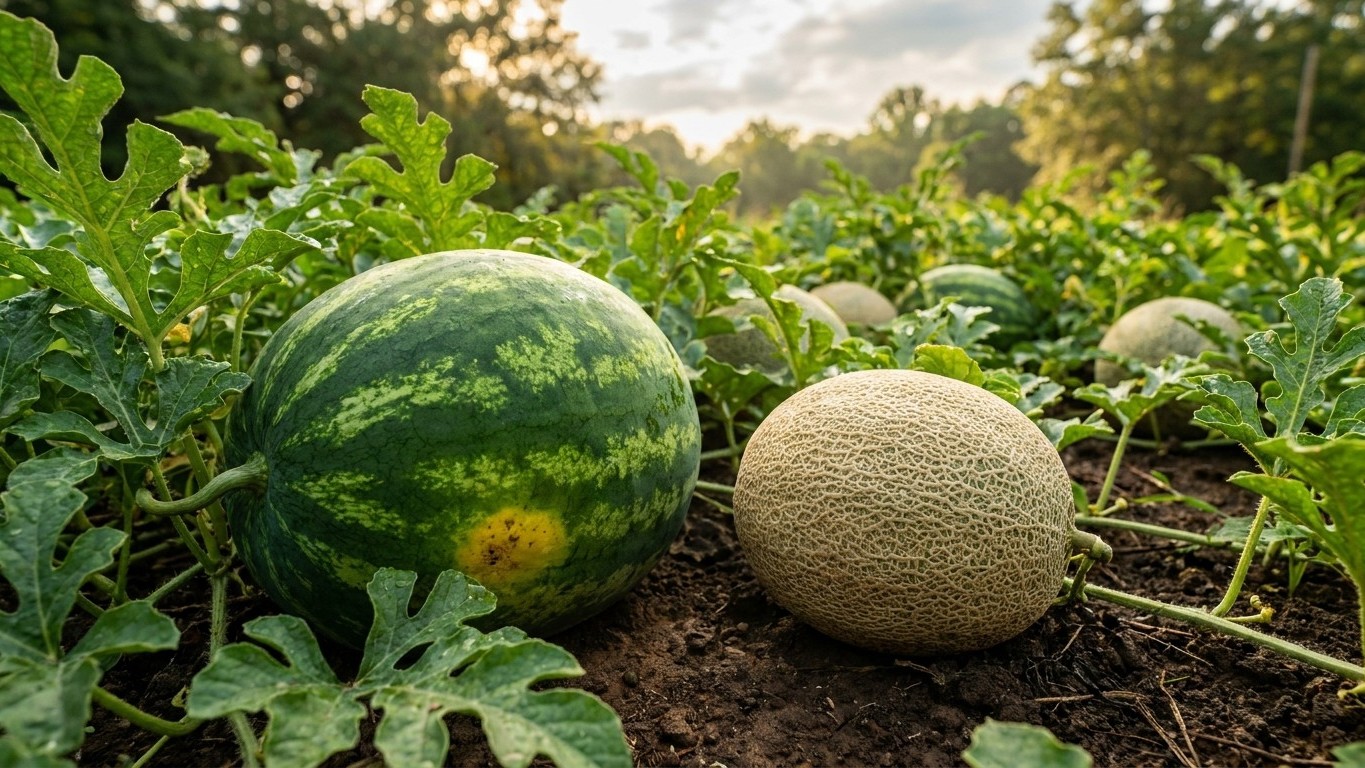

South Dakota’s short, heat-limited growing season favors fast-maturing muskmelons and icebox watermelons over anything bred for a long southern summer. The reference-station numbers put the safe window at roughly 138 to 158 days, with only about two weeks of real 90-degree heat to ripen sugar in the fruit, which rules out slow, heat-hungry types before you even pick a seed packet.
The short answer for South Dakota
Pick by days-to-maturity first, not by flavor preference. At the reference station used for these normals, the last spring freeze falls between April 29 and May 9, and the first fall freeze arrives between September 24 and October 4. That gives a frost-free stretch of about 138 to 158 days depending on the year, and that’s the outer limit, not a safe planting-to-harvest number, because melon seed needs warm soil to even germinate and a transplant needs a week or two to recover from shock before it starts real growth.
Once you subtract that startup lag, a melon variety listed at 90 days or more on the seed packet is cutting it close in most years and failing outright in a short one. The types that fit comfortably are short-season muskmelons (often marketed as cantaloupe) bred for 75 to 85 days, and icebox or personal-size watermelons bred for 70 to 80 days. Both categories were developed specifically for northern gardens with a compressed summer, and both are forgiving of a slightly cool start.
Heat matters as much as time here. The reference station averages only 13.8 days a year at 90°F or hotter, a modest heat load compared to states where melons are a traditional row crop. That number is the one that should steer you away from large slicing watermelons and honeydews, both of which need sustained heat to convert starch to sugar inside the fruit. A watermelon that needs 95 days and a long run of hot afternoons can size up in a South Dakota garden and still taste watery and pale at the core, because the heat units simply weren’t there.
So the short answer, by type: muskmelon over watermelon when in doubt, icebox size over full-size when growing watermelon at all, and nothing marketed as a “long-season” or “heirloom giant” variety unless you’re starting it under cover weeks before the frost-free window even opens.
What will not work here

Three specific mismatches show up every year in this climate, and each one traces back to a number in the local record rather than a general rule about melons.
The first is slow maturity against a short window. A 100-day watermelon or a full-size honeydew needs more clear growing days than the 138-to-158-day frost-free stretch reliably offers once you account for a cool spring start and a slow-to-warm soil. In a year that lands at the short end of that range, or in a garden that sits in a low spot where frost forms earlier than the airport station records, that variety simply runs out of season before the fruit finishes.
The second is heat-dependent flavor development. With only 13.8 days a year averaging 90°F or above, South Dakota does not deliver the sustained heat that large, thick-rind watermelons and true honeydews were bred to expect. The vine can produce a full-size fruit and still miss the sugar accumulation that heat drives, which is why growers who try Southern-bred giants here often describe the harvest as disappointing rather than a total failure, the fruit exists, it just never tastes like it should.
The third is a watering mismatch tied to the rainfall pattern. Summer rain here averages about 10.8 inches across June, July and August, with July running driest at 3.25 inches. That’s enough moisture to tempt a gardener into watering on a weekly schedule and assuming it’s covered. But melons are shallow-rooted through their most critical fruiting weeks, and on sandy soil that inch of July rain can drain through within a day, leaving the root zone dry again well before the next watering. A once-a-week schedule that works fine on clay can starve a melon vine on sand during the driest month of the summer, right when the fruit is sizing up and most sensitive to stress.
None of this means melons fail in South Dakota. It means the specific combination of a compressed season, a light heat load, and an uneven rainfall pattern selects hard against anything slow, anything bred for Southern heat, and anything watered on autopilot.
What changes across South Dakota
South Dakota is not one growing season. The USDA Plant Hardiness Zone Map places the state across zones 3b to 5b, which is a wide spread for a single state and means there is no single planting date or variety recommendation that fits the whole territory equally well.
That range matters because hardiness zone is built on one measurement, the average annual extreme minimum temperature, and it tracks closely with how long and how warm the growing season runs on either end of the state. The colder end of that spread, generally the higher, more exposed parts of the state, sees a shorter effective season than the frost dates cited above, which come from a single reference station and should not be read as a statewide guarantee. The warmer end, generally lower-elevation river valleys, tends to run closer to or slightly better than those reference dates.
A gardener working land at the colder end of that 3b-to-5b spread should shift toward the fastest maturing varieties available, lean harder on starting seed indoors three to four weeks before the last expected frost, and consider black plastic mulch or row cover to bank extra heat units early in the season. A gardener at the warmer end has more room to try a mid-range 85-day muskmelon or push an icebox watermelon a little later into fall before the first freeze risk climbs.
The right move is to check the current USDA Plant Hardiness Zone Map directly for the specific county in question, then treat the season-length numbers above as a starting point to adjust up or down from there.
Where to check this for your own county
Everything above comes from a single reference weather station and a statewide hardiness zone range, which makes it useful for narrowing down variety types but not precise enough to be the final word for any one county. That final word belongs to South Dakota State University Extension, the state’s land-grant extension service.
Two things are worth looking for specifically once there. The first is a local planting calendar, if the county or regional office publishes one, which will reflect the actual frost record for that area rather than the single airport station used for the statewide normals cited here. Extension offices closer to the Black Hills, for instance, work with a noticeably different frost pattern than offices in the southeastern river valleys, even though both fall inside the state’s broad 3b-to-5b hardiness range.
The second is any variety trial data the service has run on melons specifically. Land-grant extension programs frequently trial vegetable varieties at research stations across a state precisely because a single set of statewide numbers can’t capture how a given muskmelon or watermelon variety performs against local soil, local disease pressure, and local rainfall timing. If SDSU Extension has trialed short-season melon varieties in a county’s climate zone, that trial result outranks the general type-based guidance.
Statewide climate normals and a broad hardiness zone range answer the question at the state level. A county extension recommendation, built on local frost records and local variety trials, will always be a sharper answer than a state-level one.
Checking this against your own garden
Every date and range given is a normal, an average built from decades of past weather at one station. The garden in front of a reader on any given spring morning is not an average, and three simple observations will tell more about that specific plot than any calendar date.
The first is soil warmth by feel. Melon seed germinates poorly in cold soil regardless of what the calendar says, so pressing a hand into the planting bed a few inches down and feeling for warmth, not just dryness, is a better signal than counting days from the last frost. Soil that still feels cold to the touch in mid-May, even after the reference-station frost date has passed, is telling the gardener their particular spot runs cooler than the regional average, whether from shade, elevation, or heavy clay that’s slow to warm.
The second is the first flush of male flowers. Melon vines put out male blossoms before female ones, and a healthy vine that’s tracking the season normally will show that first flush a few weeks after true vine growth starts. A vine that sits leafy and green without flowering for an unusually long stretch is often signaling stress, most commonly uneven watering or a nitrogen-heavy soil that’s favoring leaf growth over fruiting.
The third is the appearance of true leaves after the seedling’s first rounded leaves. That transition marks the point where the plant shifts from living off the seed’s stored energy to actively feeding itself, and it’s a more reliable marker of real growth momentum than the plant’s overall size. A seedling that’s tall but slow to push true leaves is often stretching for light rather than growing strong, which matters more in a short season than in a long one where a slow start can still be made up.