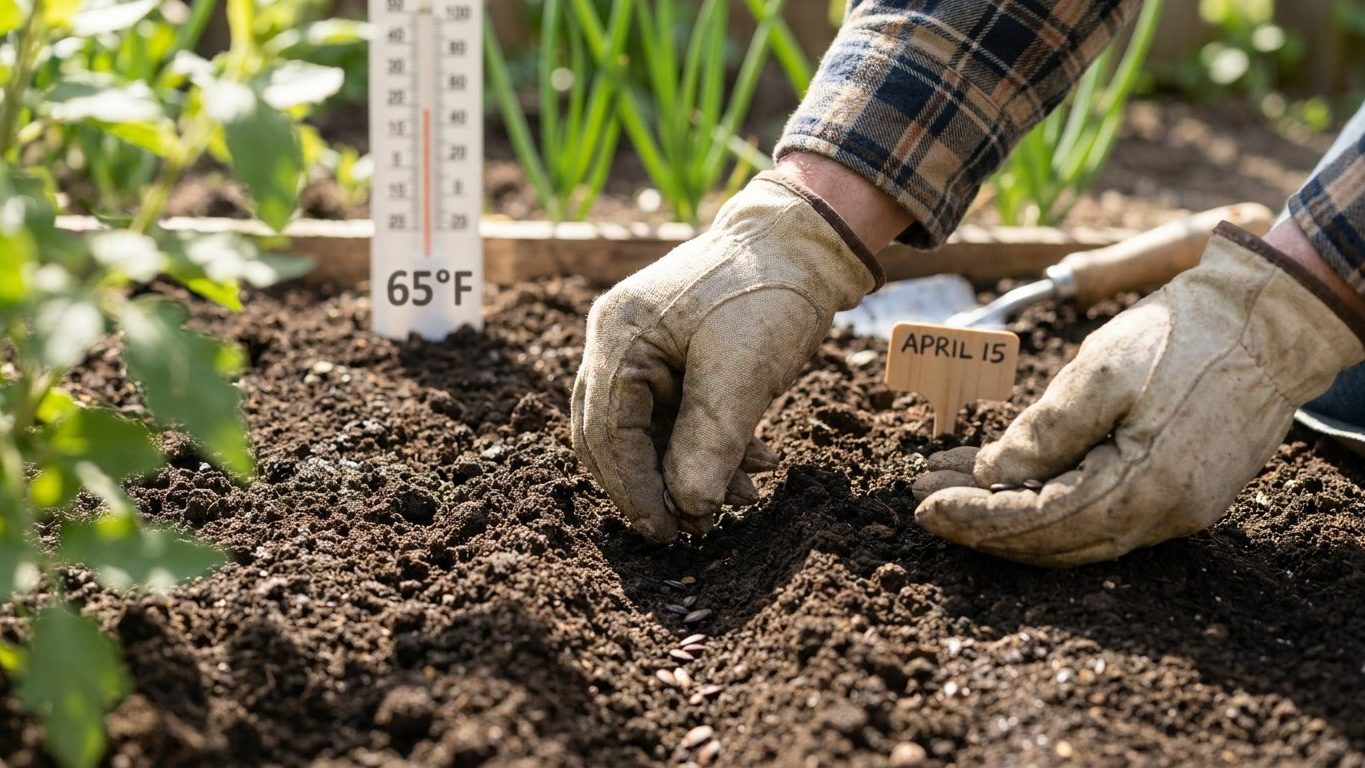

Melons go in Tennessee gardens once soil has warmed past the last frost risk, generally from late April through mid-May in Middle Tennessee, later in the eastern hills. That window comes straight from the region’s own frost data, not a generic rule, and it shifts depending on where in the state you’re digging.
The short answer for Tennessee
NOAA’s 1991-2020 Climate Normals for station USW00013897 put the last spring frost between March 31 and April 12, and the first fall frost between October 28 and November 8. Those dates mark the 30-70% probability band for a 32F freeze, meaning frost is neither a sure thing nor a long shot on either end of that window. It’s a probability, not a promise, which is exactly why melon growers in this state don’t seed the day after the calendar clears.
Melon seed rots in cold, wet soil, and the seedlings sulk if nighttime temperatures dip much below 55F. Given a last-frost window that closes around April 12 at the reference station, most Middle Tennessee gardeners are safe direct-seeding or transplanting from late April into mid-May, once soil has had a few warm weeks to catch up. Waiting past the frost date itself isn’t caution for its own sake, it’s giving the ground time to actually warm, since air temperature and soil temperature don’t move in lockstep.
On the back end, the first fall frost arriving between October 28 and November 8 gives the state a long runway. Count backward from early November and there’s roughly six and a half months of frost-free growing available at the reference station, more than enough for full-season melon varieties that need 75 to 90 days to mature. That’s the headline: Tennessee’s frost-free window is generous. What it doesn’t tell you is how the middle of that window behaves, and that’s where the real planning happens.
One caution worth repeating from the source data: East Tennessee and the Cumberland Plateau run cooler and later in spring than the Nashville-area station these frost dates come from. A grower in the higher country shouldn’t treat April 12 as their finish line for frost risk. That same lag applies to fall, pushing first frost later in some pockets and earlier in others depending on elevation, which is a separate wrinkle covered further down.
What will not work here
Given how long the frost-free season runs, a slow-maturing melon variety isn’t really the enemy in Tennessee the way it might be in a shorter-season state further north. The real failure points here are heat management and moisture timing, not the calendar itself.
Start with the heat load. The Nashville reference station averages 40.0 days a year at or above 90F. That’s not the average summer temperature, it’s a count of how many days push into genuinely stressful heat for a shallow-rooted vine crop. A melon planted on a weekly watering schedule through a stretch like that is running on empty by midsummer. Shallow, infrequent watering trains roots to stay near the surface, and surface roots are the first to fail once a run of 90-degree days shows up back to back.
Then there’s the dry stretch that tends to land right when fruit is filling out. Summer rainfall across June, July and August averages about 12.3 inches, but it isn’t spread evenly: June brings 4.36 inches, July 4.16, and August drops to just 3.79 inches, the driest month of the growing season. August is also, for most Tennessee plantings, prime fruit-fill time. A melon that gets inconsistent water during that stretch is a strong candidate for blossom end problems, cracked rinds, or fruit that sizes up unevenly. Watering on a fixed weekly schedule regardless of what the sky is doing doesn’t hold up against a month that can swing from a soaking thunderstorm to two weeks of nothing.
Humidity compounds the risk. Tennessee’s summer rain mostly arrives as thunderstorms rather than steady soaking rain, and that pattern, combined with the warm nights typical of a 40-day-over-90 climate, is exactly the setup that favors foliar disease on melon vines. Planting on tight spacing, the kind that might get away with it in a drier climate, cuts off the airflow a wet-leaf, high-heat garden needs to dry out between storms. Vines crowded together hold humidity at leaf level long after the rain stops, and that’s when powdery and downy mildew get their foothold.
What changes across Tennessee
Tennessee’s USDA Plant Hardiness Zone spans 5b to 8a, a genuinely wide range built on one variable: the average annual extreme minimum winter temperature. That spread alone tells you there’s no single planting date that fits the whole state, and the frost data above only describes conditions at one reference station.
| Region | General pattern | What it means for planting |
|---|---|---|
| Middle Tennessee (Nashville area) | Reference station for the frost dates cited above | Last frost window March 31-April 12 applies most directly here |
| East Tennessee / Cumberland Plateau | Cooler, higher elevation, later spring warm-up | Expect the frost-safe planting window to open later than the Middle Tennessee dates |
| West Tennessee | Lower elevation, generally milder | Often trends toward the earlier end of the state’s frost-free range |
A gardener working a hillside in the Cumberland Plateau and one working a bottomland field near the Mississippi border are gardening in different climates even though both are technically “Tennessee.” The zone range of 5b to 8a covers roughly a two-and-a-half zone spread, which in practical terms can mean weeks of difference in when the ground is safely warm enough for melon seed.
The USDA Plant Hardiness Zone Map is built for exactly that lookup, using a ZIP code or county to narrow a statewide range down to a specific location. Anyone gardening outside the immediate Nashville area should treat the frost dates above as a starting reference, not a local guarantee, and check where their own ground actually sits within that 5b-8a spread before locking in a planting date.
Where to check this for your own county
Everything above describes Tennessee at the state level, built from one reference weather station and one statewide hardiness range. A county-level recommendation will beat that every time, because it accounts for local elevation, local frost pockets, and which melon varieties have actually performed well in trials near that specific address.
The University of Tennessee Institute of Agriculture runs the state’s Cooperative Extension Service, and their site is the place to look for that finer detail. Two things are worth searching for specifically once there: a county-level or regional planting calendar that adjusts the frost-date guidance above for local conditions, and any list of melon varieties that extension agents have actually trialled in Tennessee soil and climate rather than just seed-catalog descriptions written for a national audience.
County extension offices, staffed under that same UTIA system, often publish guidance tuned to their specific stretch of the state, since an agent working the Cumberland Plateau sees a different growing season than one working the Mississippi River bottomlands. That local knowledge is exactly what a state-level page like this one can’t replace. Treat the frost windows and rainfall figures cited here as the statewide baseline, useful for understanding the pattern and the risks, and treat the county extension office as the source for the specific date and variety that actually fits one particular garden.
It’s also worth checking whether a local county office has published its own version of a planting calendar rather than relying solely on the statewide one, since those county documents are usually built from years of local observation rather than a single reference station’s normals.
Some gardeners also time melons by the Moon: when to plant watermelon and cantaloupe by the moon, as almanac tradition rather than fact.
Checking this against your own garden
Every date in this article comes from averaged climate data spanning three decades. A reader’s own two hands, checking their own dirt, will beat all of it in any given year. Soil warmth, not the calendar, is what melon seed actually responds to.
The simplest check needs no tools: press a bare hand into the soil a few inches down, mid-morning, before the day has heated up. If it feels cool and damp rather than cold, and that feeling holds steady for several days running rather than swinging back to cold overnight, the ground has likely turned the corner that melon seed needs. Cold, clammy soil that still shocks the hand is a soil that will rot melon seed even if the calendar says the frost date has passed.
Once seedlings are up, the first flush of male flowers is worth watching. Melons produce male blooms before the female flowers that actually set fruit, and a strong early wave of male flowers is a sign the plant considers conditions favorable enough to start investing in reproduction. A vine that’s still purely vegetative, no flowers at all, well past the point neighboring gardens are blooming, is often a sign of a cooler or shadier microclimate than the general area suggests.
The appearance of the first true leaves, the ones that look like actual melon foliage rather than the rounded seed leaves the plant starts with, marks the point where the seedling has shifted from living off stored seed energy to actually photosynthesizing on its own. A slow, stalled transition here, compared to how fast a neighbor’s plants moved through the same stage, usually points to soil that’s colder or wetter than the surrounding area, information no regional frost date can hand a gardener directly.