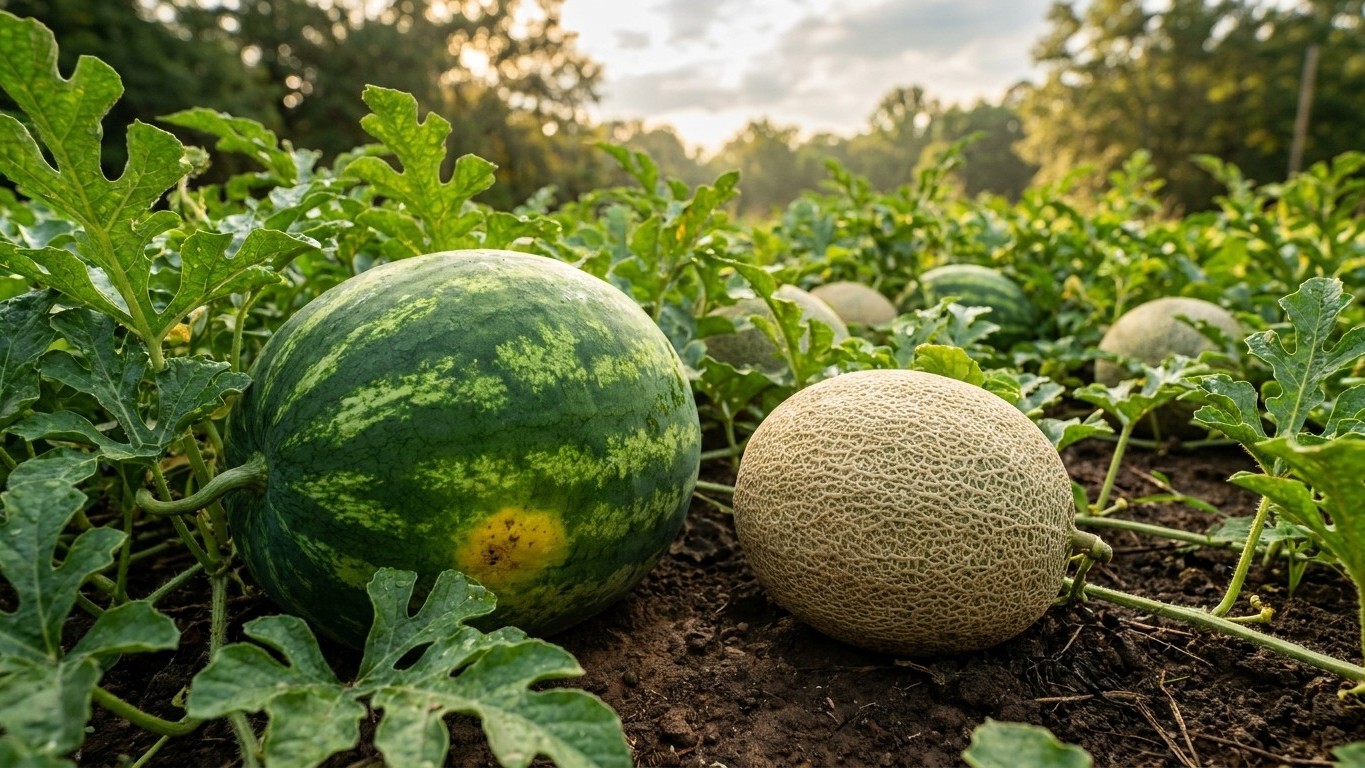

Tennessee’s frost-free window runs from around early April to late October, wide enough for nearly any melon. The variable that actually decides success here isn’t season length, it’s summer heat and humidity: 40 days a year at 90F or hotter, and rain that thins out fast by August. Disease-resistant cantaloupe, honeydew, and watermelon types built for humid climates consistently outperform seed bred for the arid West.
The short answer for Tennessee
Run the frost dates and Tennessee’s growing season stretches somewhere between 199 and 222 days, depending on where in the state you sit and how the year behaves. That’s the spread between the latest likely last spring frost (April 12) and the earliest likely first fall frost (October 28) on one end, and the earliest spring frost (March 31) paired with the latest fall frost (November 8) on the other. NOAA frames both dates as a 30 to 70 percent probability band, not a guarantee, but even the tighter 199-day estimate covers every melon type sold in home garden catalogs, including the slowest honeydews.
That changes the whole question. In a state with a short season, the decision is which melon ripens fastest. In Tennessee, the decision is which melon survives the middle of summer without collapsing to disease. Forty days a year above 90F is a heavy load on a plant that’s mostly water, and the humidity that comes with it (paired with June through August rainfall of 12.3 inches, front-loaded early and thinning to 3.79 inches by August) creates exactly the leaf-wetness conditions that fungal disease needs.
| Melon type | Typical days to maturity | Fits the 199-222 day window? | Main disease pressure in TN humidity |
|---|---|---|---|
| Watermelon | 80-100 | Comfortable margin | Fusarium wilt, anthracnose |
| Cantaloupe / muskmelon | 75-90 | Comfortable margin | Powdery mildew, downy mildew |
| Honeydew | 85-100 | Fits, but tighter if transplanted late | Fusarium wilt, alternaria leaf spot |
The practical takeaway: pick within these categories for disease resistance first, days-to-maturity second. A watermelon or cantaloupe bred with a resistance package for fusarium wilt and powdery mildew will out-produce a longer-season, disease-naive variety almost every year here, even though the naive one would technically have time to ripen. Honeydew is the one type where the season length matters more, since it needs more sustained heat to finish sweet, and a late transplant date pushes its harvest close to that October 28 to November 8 window.
What will not work here

Two habits sink more Tennessee melon patches than any variety choice: watering on a weekly schedule, and planting disease-naive types too close together.
The rainfall numbers explain the first one. June averages 4.36 inches, July 4.16, and August drops to 3.79, the driest month of the growing season, right when fruit are sizing up and heat is at its worst. Layer 40 days a year above 90F on top of that drop and a once-a-week watering habit leaves melon plants running a moisture deficit for days at a stretch during the exact window when consistent water matters most. The result shows up as blossom drop, misshapen fruit, and fruit that cracks the moment it does get a soaking. Melons want steady soil moisture through fruit set and sizing, not a big drink followed by a dry spell followed by another big drink. On heavy clay that dry spell is masked longer because the soil holds water; on sandier ground it shows up within a day or two of the last rain. Either way, a fixed weekly schedule ignores what the plant is actually experiencing that week.
The second failure point is variety choice mismatched to humidity. Cantaloupe and muskmelon strains developed for the arid growing regions of the West are bred against a completely different disease pressure. Dropped into a Tennessee summer, with June’s 4.36 inches of rain and high humidity sitting on the leaves overnight, those varieties run straight into powdery mildew and downy mildew with no genetic defense. Fusarium wilt is the other one to watch, since it persists in soil and shows up worst in a hot, wet season exactly like the ones this state produces. Tight spacing compounds all of it by trapping moisture around the crown and keeping foliage from drying between rain events, which is why a disease-naive variety planted close together often looks fine in June and collapses by mid-July, right as the 90-degree days start stacking up.
Late honeydew transplants belong on this list too. Push a transplant date back a few weeks and a 90-day honeydew is racing the October 28 to November 8 frost window with no margin left, especially in the cooler parts of the state where fall frost tends to arrive on the early side of that range.
What changes across Tennessee
The state’s hardiness zone range, 5b to 8a on the USDA map, is a wide spread for one state to carry, built from the average annual extreme minimum temperature at stations across the map. That’s a winter measurement, not a summer one, but it’s a useful stand-in for how much the growing conditions shift between the western lowlands and the higher ground to the east. A zone spread that wide (roughly four half-zones) means there is no single melon calendar that fits the whole state, and the middle of that range is the one described here rather than either edge.
East Tennessee and the Cumberland Plateau run cooler and later in spring than the Nashville-area station these frost dates are built on. A gardener up in that terrain should expect the last spring frost to land closer to, or past, the late end of the April 12 window, which pushes transplant dates back accordingly. The same elevation effect likely trims some of those 40 annual days above 90F, since higher ground doesn’t hold heat the way the lower, western part of the state does. That cuts both ways: less heat stress on the plants, but also fewer of the hot days that push a slow-ripening honeydew across the finish line before frost.
None of this tells an individual reader which zone or which side of that spread their own garden falls into. What it does say is that a transplant date and variety choice that works well in Nashville needs a buffer, typically shifted later, for anyone gardening at elevation or further east, and that the buffer should be checked locally rather than assumed from a statewide range this broad.
Where to check this for your own county
The University of Tennessee Institute of Agriculture runs the state’s Cooperative Extension Service, and it’s the right next stop for anyone who wants a number sharper than a statewide range. The directory is at utia.tennessee.edu/extension, and from there the useful county-level material comes in two pieces.
The first is a local planting calendar. County extension offices adjust the state’s frost-date normals against the microclimate on the ground, elevation, valley cold-air drainage, urban heat effect, all of which shift the practical transplant window earlier or later than the statewide 30 to 70 percent probability band cited here. The second is variety trial data specific to that county or that agricultural district. UT Extension and university trial programs test melon varieties under regional disease pressure and heat load, and a variety that trialed well in a county with heavy fusarium wilt pressure is a more reliable pick than a general statewide recommendation built off climate normals alone.
That distinction matters more than it sounds. A county extension agent has seen what actually happened in nearby gardens over recent seasons, including years when the August rainfall ran drier than the 3.79-inch normal or wetter than it. That lived record, plus trial data grown specifically in that county’s soil and disease environment, will always outrank a state-level estimate.
Checking this against your own garden
A reader’s own garden is a different microclimate, and three things a gardener can check without any equipment will settle what the calendar can’t.
Soil warmth by feel is the first. Melon seed germinates poorly in cold soil regardless of what the calendar says, and soil that still feels cool and damp to the back of a hand in early spring is telling the gardener to wait, no matter where the calendar’s window sits that year. The second is the first flush of male flowers. Melon plants produce male blossoms before female ones, and their appearance signals the plant has moved from vegetative growth into reproductive mode, a stage that tracks accumulated heat far better than a calendar date does. A patch running its first male flowers unusually early suggests that spot is warmer than the regional average; running late says the opposite.
The third is the timing of the first true leaves after the seed leaves. A quick emergence of true leaves points to soil and air conditions running warm for the season; a slow, stalled emergence, even with adequate watering, is the plant reporting that the local microclimate is running behind the statewide normal that year. None of these three replace the frost-date probabilities or the extension office’s county data, but they’re the fastest read a gardener has on how their own patch of ground is actually behaving that particular spring.