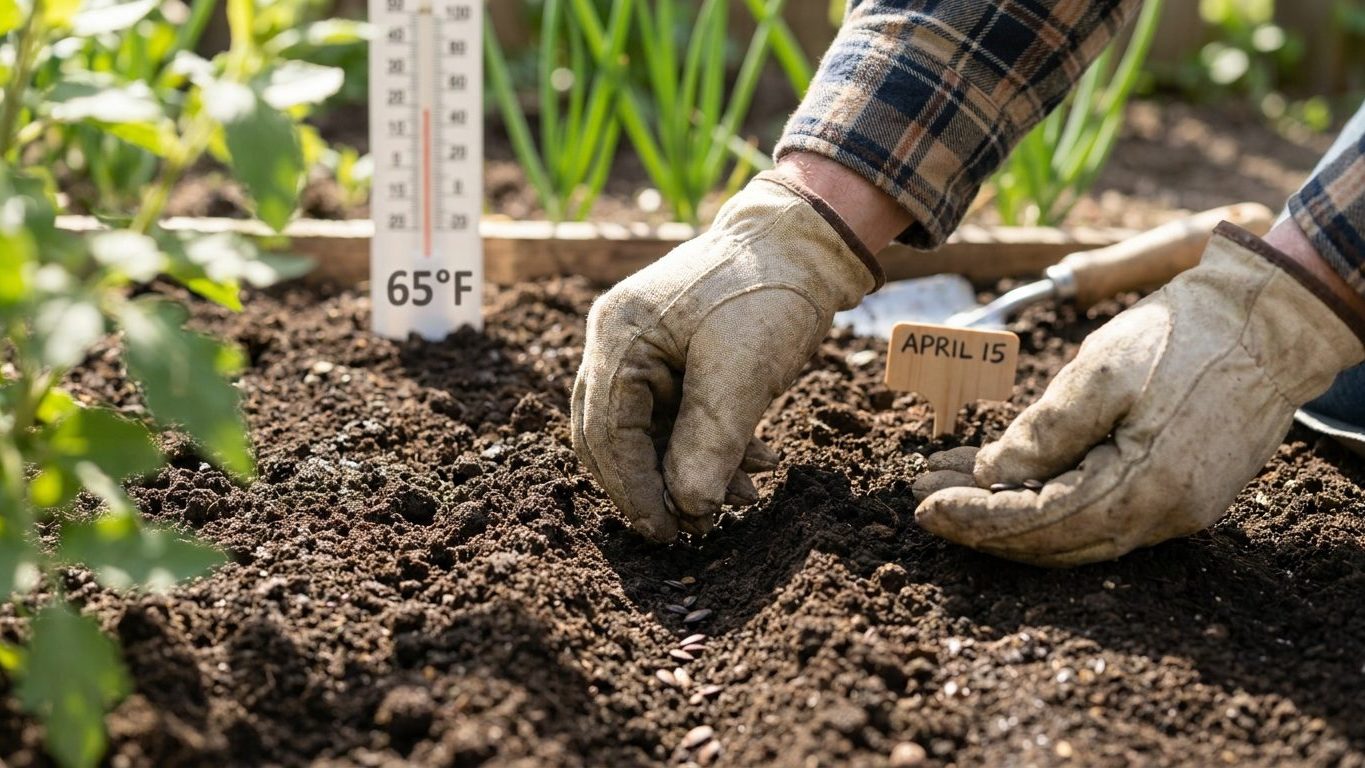

Melons in Utah go in the ground after the last spring frost passes, which at the Salt Lake City reference station runs from April 12 to April 29, but seed also needs soil warm enough to sprout instead of rot. Depending on elevation, that combination pushes actual planting anywhere from late April to early June.
The short answer for Utah
Plant melons after your local last spring frost date. For the Salt Lake City reference station (USW00024127), NOAA’s 1991-2020 Climate Normals put that date somewhere between April 12 and April 29. That’s not a single day, it’s a 30-70% probability band for a 32F freeze, meaning there’s still a real chance of frost even after April 29, and a fair chance the ground is already safe by April 12. Treat the window as a range to watch, not a calendar square to circle.
Melon seed does more than dodge frost, though. It needs soil in the mid-60s Fahrenheit to germinate at all, and cold, damp soil right after a frost date is a good way to lose a seed packet to rot before it ever sprouts. In practice, most Salt Lake-area gardeners wait two to three weeks past the last-frost window before direct-seeding melons outdoors, or start transplants indoors and set them out once nighttime lows have settled.
On the other end of the season, the first fall frost at the same reference station falls between October 18 and October 29 — again a 30-70% freeze-probability band, not a hard stop. Melon fruit needs to size up and sweeten before that window arrives, since a hard freeze ends the plant’s ability to finish ripening fruit on the vine.
Stack those two windows and the Salt Lake valley’s usable season runs somewhere between roughly 172 and 200 days, depending on which end of each band you land on. Most melon varieties need 65 to 100 days from seed to harvest, so there’s room to work with in the valley itself, but that math changes fast once you leave it, which is the subject of the next section.
What will not work here
Two things sink melon crops in Utah more than anything else: rushing the planting date, and underwatering through a dry summer. Both are visible in the numbers.
Start with water. The reference station’s summer rainfall totals only about 2.0 inches across June, July and August, out of 15.5 inches for the whole year. July is the driest month of all, averaging just 0.49 inches. That’s not enough to carry melons through fruit set and sizing on its own, no matter how deep the soil looks after a rare thunderstorm, a single downpour mostly runs off rather than soaking into dry summer ground. Gardeners who water once a week on a fixed schedule, the way they might in a wetter state, tend to see blossom drop, stunted fruit, or fruit that turns bitter under stress. Melons want deep, consistent moisture, especially once fruit starts swelling, and Utah’s summer rainfall simply won’t supply it without supplemental irrigation.
Heat compounds the problem rather than solving it. The reference station averages 52.1 days a year at 90F or hotter. Melons are heat-loving plants, so that’s mostly good news for flavor and fruit set, but heat also drives evaporation, meaning the little rain that does fall disappears from the soil surface faster than it would in a cooler climate. A watering routine that would be plenty in a humid, 90-degree-light state falls short here.
Season length at altitude
The other failure mode is timing. A slow-maturing watermelon variety bred for a 100-day season can outrun the frost-free window in higher, colder parts of the state, even though it fits comfortably in the Salt Lake valley itself. Planting a long-season melon at elevation, or planting it late because the soil stayed cold into May, is a common way to end the season with vines full of unripe fruit and a fall frost bearing down.
What changes across Utah
Utah is not one growing climate. The USDA Plant Hardiness Zone Map puts the state anywhere from zone 4a to zone 9a, based on the average annual extreme minimum winter temperature, a single measurement, but one that tracks closely with how long and how forgiving a growing season is. That’s a five-zone spread inside one state’s borders, so there is no single “Utah” answer to when soil warms up or how late frost lingers.
A gardener near the cold end of that range, in a high mountain valley, should expect a shorter frost-free season than the Salt Lake reference station’s numbers suggest, and should plan on planting later and choosing quicker-maturing melon varieties to have any chance of finishing before fall frost. Someone near the warm end, in the lower, southern parts of the state, typically works with a longer season, an earlier safe planting date, and more room to grow longer-season watermelon varieties without racing the calendar.
The Salt Lake City station data used above is a reference point, not a stand-in for every Utah garden. It sits in a comparatively mild valley; higher ground nearby, and much of the rest of the state, runs colder, while parts of southern Utah run milder still. Rather than guess which end of the state’s zone range applies to a particular yard, check the USDA Plant Hardiness Zone Map directly for that address, it’s built for exactly this kind of local lookup, and it beats assuming the state average applies where you garden.
Where to check this for your own county
This page describes Utah generally, using one reference station’s frost and rainfall data. That’s useful for understanding how the state’s climate behaves, but it’s not a substitute for what your county’s extension office knows about your specific area. Utah State University Extension is the place to go next.
Once there, look specifically for two things. First, a county-level or regional planting calendar, many extension offices publish dates adjusted for local elevation and microclimate, which will be more precise than a statewide frost-date range built from a single station. Second, look for melon varieties that have actually been trialled in your county or region. Extension offices often track which cantaloupe, watermelon, and specialty melon varieties have performed well locally, including which ones reliably mature within the area’s real growing season, not just the season length on paper.
A county recommendation will always beat a state-level one. This page works from statewide data and a single reference station, which is the right scale for understanding how Utah’s climate works in general and why frost dates and rainfall vary as much as they do across the state. It is not the right scale for deciding the exact week to put melon seed in the ground in a specific county. That decision belongs to whoever has been tracking frost and harvest dates in your area over multiple seasons, and that’s exactly what an extension office does.
Checking this against your own garden
Every date on this page is built from decades of averages at one weather station. Your own garden will tell you something more current and more local, if you know what to watch for.
Start with soil warmth, checked by feel rather than any gauge. Push a hand a few inches into the bed where melons will go. If the soil feels cool and damp rather than warm, it’s not ready for seed yet, regardless of what the calendar says, melon seed sitting in cold soil is far more likely to rot than to sprout.
Next, watch for the first flush of male flowers on the vines once plants are established. Melons typically produce male flowers before female ones, and their timing is a real-time signal of how much heat the plant has already banked in your specific spot, a warmer microclimate, like a south-facing bed against a wall, tends to push that first flush earlier than the open garden a few yards away.
Finally, note when the first true leaves appear after germination, as distinct from the rounded seed leaves that show up first. The gap between planting and true leaves is a direct read on how quickly your soil and site are actually warming, which matters more to melon growth than any single frost date. Between these three signs, soil feel, first male flowers, and first true leaves, your own garden gives a clearer answer than any regional average can.