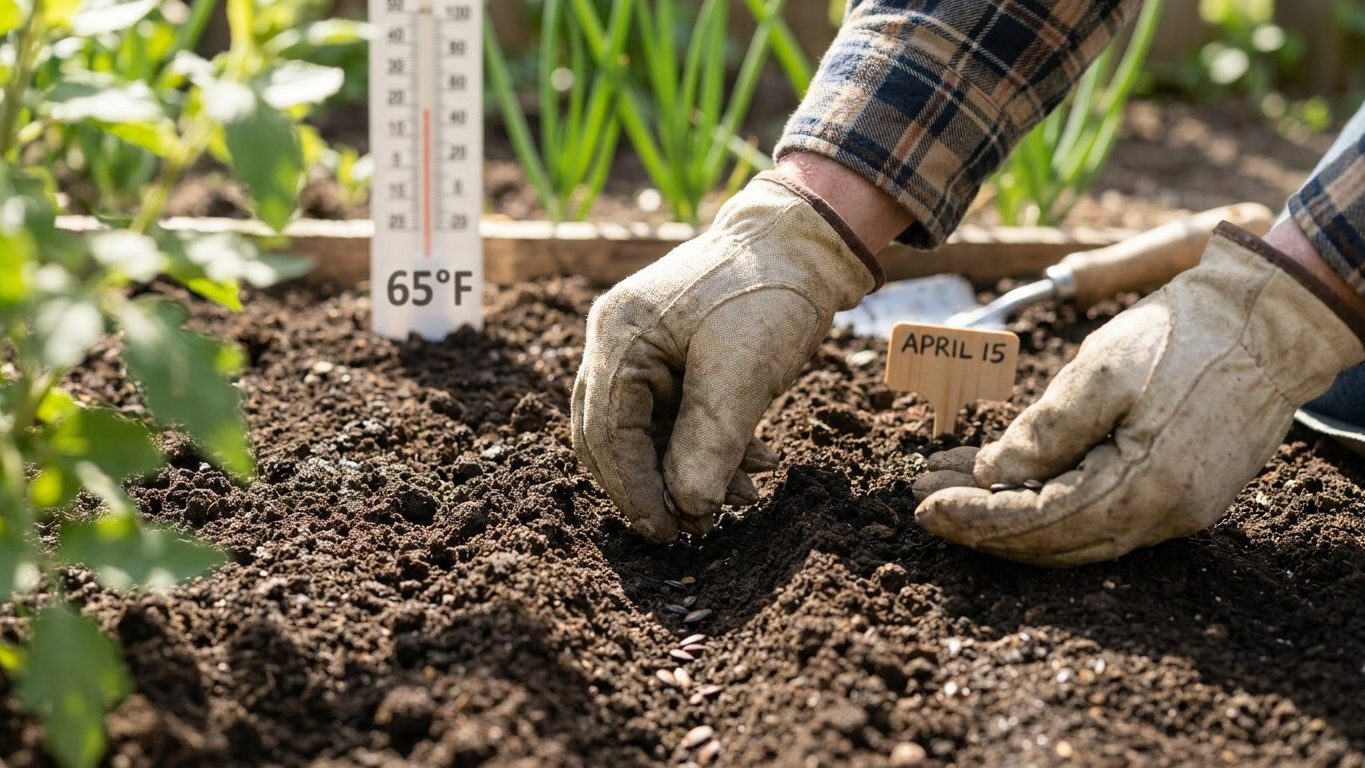

Melons go into West Virginia ground only after the soil has actually warmed, which in most of the state means late May, not the calendar date of the last frost. The frost-free window itself runs from April 9 to April 23 in spring and October 18 to November 1 in fall at the Charleston reference station, but that’s a probability, not a promise, and elevation changes everything.
The short answer for West Virginia
Start with the numbers NOAA actually gives for this state. At the Charleston station (USW00013866), the last spring freeze falls somewhere between April 9 and April 23 in a typical year, and the first fall freeze lands between October 18 and November 1. Those are 30-70% probability bands built from 1991-2020 climate normals, meaning there’s real spread on both ends, not a single magic date you can circle on a calendar.
Melons don’t care about frost dates the way lettuce or peas do. A tomato can go in the ground the week after the last freeze and sulk through cool nights. A melon seed sitting in 55°F soil just rots. The practical rule gardeners in this climate zone use is to wait two to three weeks past that spring frost window, once nighttime lows are reliably staying above 55°F, before direct-seeding or setting transplants. In the Charleston area, that pushes actual planting into the first half of May for most years. Higher up the ridges, it’s later, sometimes closer to Memorial Day.
What the facts do support is working backward from the fall side of the calendar. With first frost arriving as early as October 18 in a cooler-than-average year, a melon that needs 85 to 90 days to mature and goes in the ground in mid-May has a comfortable cushion. One that needs 100-plus days and goes in during the first week of June is racing the clock, especially at higher elevation where frost tends to show up before it does in the river valleys.
Heat load matters too. Charleston averages 16.0 days a year at or above 90°F, which is a moderate but real summer heat signature, enough to speed up fruit sizing once vines are established, but not so extreme that melons need shade cloth or afternoon relief the way they might in the Deep South. Plan the planting date around the frost window, then let the mid-summer heat do the work of ripening.
What will not work here

Run the frost dates against each other and you get a frost-free season somewhere between 178 and 206 days, depending on which end of each probability band actually shows up in a given year. That’s a workable window for almost any short or mid-season melon variety, but it stops being workable the moment a gardener plants late and picks a long-season type at the same time. A 100-to-110-day melon started the first week of June, in a year where fall frost arrives on the early side (October 18), is cutting it uncomfortably close, especially anywhere above the valley floor where cold settles first.
Watering on a weekly schedule is the second common failure. Summer rainfall here averages about 13.8 inches across June, July, and August, but it isn’t spread evenly: June brings 4.72 inches, July 5.38, and August drops to just 3.75. That August dip lines up almost exactly with the stretch when melon fruit is sizing up and demanding the most consistent soil moisture. Combine a dry August with 16 days a year of 90°F-plus heat driving evaporation, and a once-a-week watering habit leaves the root zone dry for days at a time right when the plant can least afford it. Rain that does fall in a single summer thunderstorm often runs off rather than soaking in, which makes the actual number lower than the monthly total suggests on heavier soils, and even lower on sandy ones that drain fast.
Close spacing is the third trap. June and July rainfall totals here aren’t drought numbers, they’re solid, and paired with summer humidity that lingers in these valleys, tight spacing between vines cuts off airflow and keeps foliage wet longer after rain or dew. That’s the exact setup that favors powdery and downy mildew on melon leaves. Vines planted on the tight end of a seed packet’s spacing recommendation, in a wet June, tend to show mildew stress by mid-July, well before the fruit has finished sizing.
What changes across West Virginia
West Virginia’s hardiness zone range, 5a to 7a under the USDA Plant Hardiness Zone Map, is wide enough that there’s no single planting answer for the state. That’s roughly a two-zone spread, which in practical terms can mean several extra weeks of frost risk on one end compared to the other. The USDA system is built on one variable, the average annual extreme minimum winter temperature, so it doesn’t map directly onto spring planting dates, but it’s a useful signal for how much the state’s terrain varies.
The Charleston reference station sits in a river valley, and river valleys tend to run warmer and see later fall frosts than the ridges and plateaus around them. Higher elevations across the state freeze noticeably earlier in autumn than the numbers cited here, which is the exact caution NOAA attaches to this station’s data. A gardener working a plot at higher elevation should expect the growing season to close earlier than the October 18 to November 1 window suggests, and should treat that as reason to lean toward shorter-season melon varieties rather than stretch for the biggest, latest-maturing type.
The zone range spans low mountain valleys to higher elevation terrain, and the difference between the two ends of that range is large enough to shift a planting date by weeks, not days. The right move is checking the USDA Plant Hardiness Zone Map directly for the specific address in question, then treating the Charleston-based frost dates above as a valley-floor baseline rather than a statewide rule.
Where to check this for your own county
State-level numbers are a starting point, not a substitute for what West Virginia University Extension publishes for individual counties. It’s worth spending time on their extension service before finalizing a planting date, especially for anyone outside the Kanawha Valley.
Two things are worth looking for specifically. First, a county-level planting calendar, if the local extension office publishes one, will reflect the actual frost pattern of that county rather than the Charleston station’s valley-floor numbers. Higher counties in the eastern panhandle or along the Allegheny Front often run a noticeably different calendar than the Kanawha Valley does. Second, look for any variety trial results or recommended melon varieties specific to that county. Extension offices frequently track which cantaloupe or watermelon varieties have performed well in local trial gardens, and that kind of on-the-ground testing beats a general statewide recommendation every time.
A county recommendation is built from conditions closer to an actual garden than a single reference station ever can be. Statewide climate normals and one station’s frost data are useful for understanding the broad pattern across West Virginia, but they aren’t a substitute for what a county extension agent has watched happen in real gardens over real seasons. Anyone serious about nailing down a planting date should treat the state-level numbers here as context, and the county-level information from WVU Extension as the deciding factor.
Checking this against your own garden
Every date is a regional average, and a reader’s own soil will always outrank it. Before trusting any calendar date, there are three things worth checking by hand, literally.
First, feel the soil itself, a few inches down, mid-morning. If it’s still cool and slightly clammy to the touch rather than warm and dry-ish, melon seed sitting in it is more likely to rot than sprout, regardless of what the frost-date math says. Second, watch for the first male flowers on any vines already planted. Male flowers typically show up a week or two before the female flowers that actually set fruit, and their appearance is a decent signal that the plant has settled into its stride in that particular spot. Third, watch how fast true leaves develop after the initial seed leaves. Slow, stunted true-leaf growth in a spot that should be warm enough usually points to a colder microclimate than the regional averages suggest, maybe a low spot that collects cold air, or a north-facing slope that lags the rest of the yard by a week or more.
These three signals, soil feel, flower timing, and leaf vigor, read the actual microclimate of one specific garden, which no state or even county calendar can fully capture. A backyard tucked against a north-facing hillside in Kanawha County can run a week or two behind a flat, south-facing garden a few miles away, even though both sit under the same regional frost dates.
Some gardeners also time melons by the Moon: when to plant watermelon and cantaloupe by the moon, as almanac tradition rather than fact.