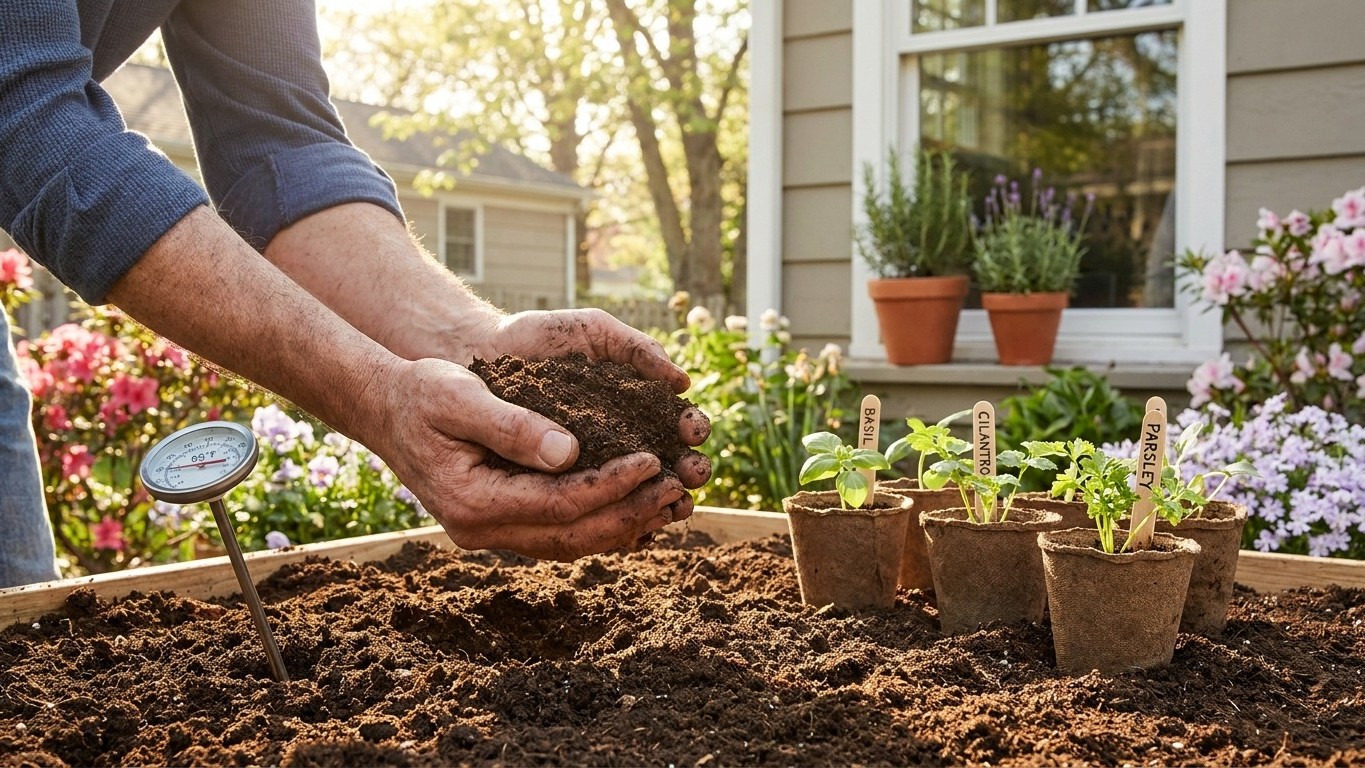

Maryland herb gardeners get a straightforward answer for planting dates, but the harder question is what happens after that: how long the season actually runs, how the heat and humidity of a Mid-Atlantic summer treat different herb types, and which ones survive the winter here without help. Those three factors, more than the calendar date, decide what belongs in a Maryland herb bed.
When the soil is warm enough in Maryland

The last spring frost across Maryland falls between April 3 and April 16, according to NOAA’s 1991-2020 Climate Normals, which track the 32°F freeze probability band at 30 to 70 percent (data referenced from station USW00093721). That’s a two-week window, not a single date, and it exists because frost risk fades gradually, not on a switch.
Here’s the part that trips people up: frost date and soil temperature are not the same thing. Air can clear the frost threshold while the ground underneath is still cold from winter, and herbs don’t care what the thermometer says at 6 a.m. They care what’s happening a few inches down, where their roots sit. Warm-season herbs, the tender types that come from Mediterranean or tropical origins, want soil that’s held steadily warm for several days running, not just soil that survived one mild night. Cool-tolerant herbs, by contrast, germinate and grow fine in soil that’s still on the cool side, which is why some gardeners get impatient and start those earlier while waiting on the rest.
That two-week frost band also isn’t uniform across the state. Western Maryland, in Garrett and Allegany counties, sits at higher elevation and in a cooler air mass, so its frost-free date typically lands weeks after the statewide range given above. The Eastern Shore, sitting lower and closer to the moderating effect of the Chesapeake Bay, tends to warm earlier. A gardener in Oakland and one in Salisbury are not working from the same calendar, even though both are technically in Maryland.
One more thing worth saying plainly: that April 3 to April 16 window is a probability, built from 30 years of weather records, not a guarantee for this particular year. A late cold snap outside that band isn’t rare enough to ignore. Gardeners who push tender herbs into the ground the moment the calendar clears that range are taking a calculated risk, and some years it doesn’t pay off.
This page won’t recommend specific herb varieties, and it also won’t wade into the health claims attached to certain herbs. Several herbs common in home gardens, rosemary and sage among them, carry long-standing reputations for traditional remedies. That’s a separate conversation from growing them, and not one this page evaluates. What matters here is soil, timing, and climate, not identification of wild lookalikes or any preparation beyond the kitchen.
How long the season lasts here
Pair the last spring frost (April 3 to April 16) with the first fall frost, which lands between October 26 and November 5 per the same NOAA Climate Normals dataset. Doing the subtraction across the full range gives a frost-free season running from roughly 193 days, on the shorter end (a late spring frost paired with an early fall one), up to about 216 days on the longer end (early spring frost, late fall frost). Call it somewhere between six and a half and seven months, depending on where in the state you garden and how a given year plays out.
That’s a genuinely long window by national standards, and it changes the math on how many rounds of planting are worth attempting. A season under four months forces gardeners into a single sowing and makes every week of delay costly. Maryland’s season is long enough that a first planting in spring doesn’t have to be the last one. Quick-cycling leafy herbs can go in again in mid-to-late summer for a second round that matures before the fall frost band arrives, and slower woody types have enough runway to establish a full root system before cold weather tests them.
The length of the season also affects a decision that gets less attention than it deserves: whether to start herbs from seed directly in the ground or raise them as transplants first. In a short season, transplanting is close to mandatory for anything slow to germinate, because there isn’t time to waste on direct-seeding delays. With close to seven months of frost-free growing here, direct seeding becomes a reasonable option for more herb types, though transplants still get a head start that matters for anything meant to reach a mature, harvestable size early.
Timing a second sowing correctly, so it has enough of the remaining season to mature before the October-November frost band arrives, is its own small planning exercise. The succession sowing guide on this site walks through how to count backward from a fall frost date to figure out the last safe planting window for a second round.
Heat and water in Maryland

Maryland summers run hot and humid, the kind of stretch that’s typical for the Mid-Atlantic corridor, with sustained warmth and sticky air more often the story than any single heat spike. For herbs, though, that summer stretch usually isn’t the limiting factor. Most kitchen herbs tolerate a hot, humid Maryland summer well enough, provided they get airflow and don’t sit in soggy soil. The bigger question, the one that actually reorganizes what you can grow here long-term, is winter.
The mean daily minimum temperature in Maryland’s coldest month sits at 25.4°F, based on NOAA Climate Normals for the Baltimore reference station. That figure matters more than any record low, because it reflects the temperature a plant faces on a typical cold night, night after night, for weeks. A herb that shrugs off one freak cold snap can still die from three weeks of nights hovering in the mid-20s.
Maryland’s USDA Plant Hardiness Zone, using the official 2023 map built on 1991-2020 averages, spans 5b to 8a across the state. That’s a wide range for one state to carry, and it’s not a detail to gloss over. A herb that survives outdoors year-round near the Bay in a zone 8a pocket can die back completely in a 5b spot in the western counties. Any recommendation that cites “Maryland’s zone” without naming a reference point is guessing. Baltimore’s own zone falls within that range, but a gardener in Garrett County is working with meaningfully colder winters than one in St. Mary’s County.
This is the number that separates the herbs that become permanent fixtures in a Maryland garden bed from the ones that need a pot and a trip indoors every fall. Woody Mediterranean herbs, the ones bred for dry, mild winters in their native range, often sit right at the edge of what a 25.4°F average coldest-month minimum allows, and in the colder end of Maryland’s zone range they don’t reliably make it through without help. Herbaceous perennial herbs with hardier root systems tend to handle that same cold far more comfortably, dying back above ground and returning in spring without any intervention.
Which herbs suit Maryland
Reasoning through Maryland’s numbers points toward three broad categories rather than any specific product to buy, and that’s the honest way to approach this. A season near seven months is generous enough to support a second sowing of fast annual herbs. A coldest-month minimum of 25.4°F, inside a 5b-8a hardiness range that varies sharply by county, is what actually decides which herbs stay in the ground year-round. And summer humidity means airflow and drainage matter more than heat tolerance for most kitchen herbs grown here.
| Herb type | How it fits Maryland’s season | Winter fate here |
|---|---|---|
| Fast annual leafy herbs | Matures well within the season; good candidate for a second sowing | Dies at first fall frost regardless of location |
| Tender warm-season herbs | Needs soil warmed well past the frost date to establish | Killed by any frost; grown as an annual statewide |
| Hardy herbaceous perennials | Comes back from the root each spring; no re-sowing needed | Generally survives the 25.4°F coldest-month average across most of the state |
| Woody Mediterranean perennials | Slow to establish; benefits from the long season to root in deeply | Marginal in colder zone-5b pockets; more reliable in warmer zone-8a areas or containers |
None of that points to a specific cultivar, and it shouldn’t. The varieties that have actually been trialed for disease resistance and cold tolerance under Maryland conditions are tracked by the University of Maryland Extension, which runs the state’s land-grant research and testing program. A regional guide like this one can lay out the climate math; it can’t replace a local trial. Anyone deciding between specific rosemary types or basil types for their county is better served by checking what Extension has actually tested nearby than by a name picked off a national seed rack.
The county-by-county spread in frost dates and hardiness zone matters here too. A gardener on the Eastern Shore working in a milder pocket of the zone range has real options for pushing woody perennials as permanent plantings that a Garrett County gardener, working several zones colder within that same 5b-8a statewide span, would need to treat as container plants brought indoors each winter.