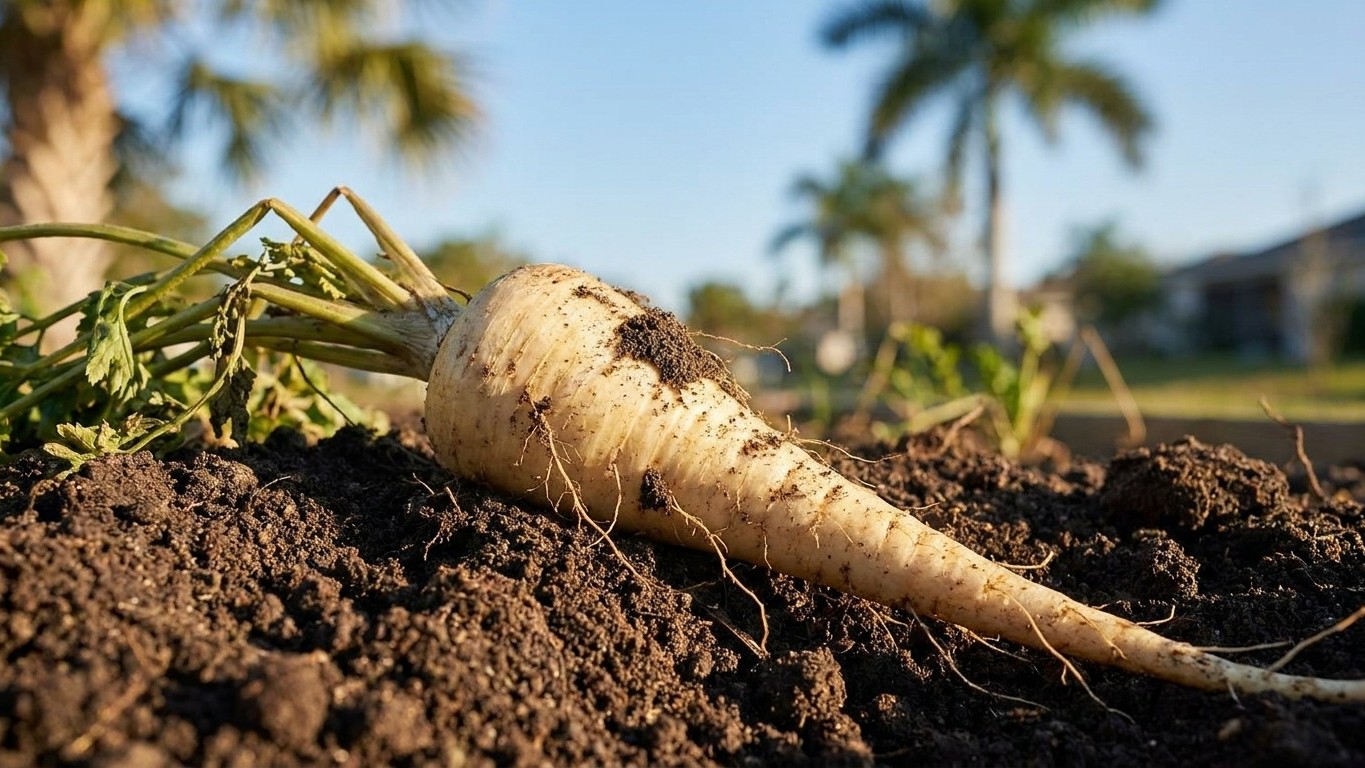

Only two of the pests Kansas gardeners hear about most turn up on parsnip: blister beetle and grasshopper. Both are generalist leaf feeders, and they show interest in parsnip’s carrot-like tops rather than the root underground. The rest of the state’s commonly documented garden pests belong to other crop families entirely, and knowing which ones to ignore matters as much as knowing which ones to watch.
Which pests attack parsnip in Kansas
K-State Research and Extension documents ten pests for Kansas home gardens: bagworm (Thyridopteryx ephemeraeformis), blister beetle (Epicauta spp.), Colorado potato beetle, grasshopper, harlequin bug, pine sawyer beetle, spotted cucumber beetle, squash bug (Anasa tristis), squash vine borer, and striped cucumber beetle. That’s the full list this service tracks for the state, and it doesn’t get padded with anything beyond it.
Most of that list has no business on a parsnip bed. Bagworm builds its spindle-shaped cocoons on evergreen trees and shrubs like juniper and arborvitae, not on vegetable foliage. Colorado potato beetle targets the nightshade family (potato, tomato, eggplant), while parsnip belongs to the carrot family, a completely different plant chemistry that doesn’t attract it. Harlequin bug feeds almost exclusively on brassicas like cabbage and broccoli. Pine sawyer beetle is a wood-borer of pine trees and has no reason to visit a vegetable garden at all. Spotted cucumber beetle, squash bug, squash vine borer, and striped cucumber beetle are all cucurbit specialists, drawn to cucumbers, squash, melons, and pumpkins, none of which parsnip resembles to an insect looking for a host.
That leaves blister beetle and grasshopper as the only two pests on K-State’s documented list likely to bother parsnip in a Kansas garden. Neither one is a parsnip specialist. They’re opportunists that feed on a wide range of garden plants, and parsnip’s feathery, celery-like foliage is simply one option among many when populations build up. If you’re scouting a parsnip row for insect damage, these are the two names worth knowing, and the rest of that list is better spent worrying about a different bed entirely.
When each one shows up, and what it does first
Parsnip is sown directly in the ground, roughly two to three weeks before the last spring frost, which falls between April 4 and April 18 near the Wichita reference station used for Kansas climate normals. Seeds are slow: expect 14 to 21 days before anything breaks the soil surface, and gardeners who dig up bare ground before then are usually just disturbing seeds that haven’t germinated yet. Those Wichita dates come from an airport weather station, and gardens away from the city, especially at higher elevation, often see frost arrive a week or two earlier in fall and later in spring, so treat the window as a starting reference rather than a guarantee for your yard.
Grasshopper pressure is the one to watch first, because grasshoppers feed on tender young growth as soon as it appears. In the weeks right after germination, when parsnip seedlings are still soft and low to the ground, ragged notches along the leaf margins are the first sign. Damage tends to be worse near garden edges bordering unmown grass or dry field margins, where grasshoppers breed and then move in as the vegetation there dries out.
Blister beetles generally arrive later in the season, and they travel in groups. Instead of scattered nibbling, their feeding shows up as patches of foliage stripped down close to bare stem, often on just one section of a row while the rest looks untouched, because the whole swarm works one area before moving on. Since parsnip needs 100 to 120 days from seeding to mature, and the crop’s flavor only develops after weeks of frosty fall weather, foliage stays exposed and vulnerable across most of the growing season, which is longer than many quicker vegetables spend at risk. That long window is exactly why both pests get more than one chance at a parsnip bed before harvest.
Telling the damage apart from everything else
Not every rough-looking parsnip leaf means an insect is involved. Kansas summers bring heat stress, uneven watering, and heavy or stony soil into the mix, and all three can mimic pest damage at a glance.
| Symptom | Likely cause | What tells it apart |
|---|---|---|
| Ragged, irregular holes at leaf edges | Grasshopper feeding | Coarse, uneven chewing; insects often visible nearby during the day |
| Foliage stripped to bare stem in patches | Blister beetle feeding | Damage clustered in one spot; beetles feed in groups and can cause skin irritation if handled bare-handed |
| Uniform yellowing across the whole plant | Nutrient deficiency or waterlogged, compacted soil | No chew marks anywhere; discoloration spreads evenly rather than in bite-sized patches |
| Forked or hairy roots at harvest | Heavy or stony ground, or inconsistent overwatering | These are two separate causes, not one: check soil texture for rocks and clay first, then review whether watering has been irregular |
| Roots that never taste sweet | Not enough exposure to frost | Compare harvest date to the first fall frost window; sweetening needs several frosty weeks after that, and a mild winter zone alone won’t do it |
Utah State University Extension is the authority behind the growing details on this page, including that soil-forking distinction and the frost-sweetening mechanism, and it’s worth remembering the state’s guidance on soil type is a starting point for planning a bed, not a diagnosis for a plant that’s already struggling. If chewing damage is visible and the culprit isn’t obvious, that’s the point to bring in a local expert rather than guess.
What actually works here, and what is a waste of time
Timing beats treatment on a crop with this long a season. A lightweight floating row cover set over the bed at sowing and left on through germination and early growth, roughly the first month while seedlings are still soft, keeps grasshoppers off the plants during the exact stretch when they do the most damage. The vulnerable window is that first month after sowing, not the whole season, so covers can come off once plants have several true leaves and tougher foliage.
Blister beetles respond better to handpicking than to covers, since they arrive later and in groups, but gloves matter: the beetles release a compound that can blister bare skin, so knock them into a container of soapy water rather than crushing them by hand. Keeping the area around the bed mowed and free of the dense grass grasshoppers favor for egg-laying also reduces how many show up in the first place.
What doesn’t help is treating the whole garden for pests that were never a threat to parsnip to begin with. Since eight of the ten pests K-State documents for Kansas target cucurbits, nightshades, brassicas, or trees, spending effort Protecting a parsnip row against squash bug or Colorado potato beetle is wasted time. Waiting until damage is severe before acting is also a losing strategy with blister beetles, since a swarm can strip a section of foliage and move to a neighboring plant within days. No product or active ingredient is named here on purpose. Product options and what’s legally approved for use in Kansas gardens are questions for your local extension office, not a general gardening article.
Where to check this for your own county
K-State Research and Extension is the service documenting these pests statewide, but a statewide list doesn’t mean every pest on it shows up in every county, or even in every yard within a county. Grasshopper and blister beetle pressure in particular tends to track local conditions like nearby pastureland, alfalfa fields, or unmanaged grass edges, so a garden in one part of Kansas can see heavy pressure while another twenty miles away sees almost none.
Call your county extension office before assuming what’s in your garden matches what’s documented for the state. They can confirm whether a pest currently active in your area, help identify damage from a photo or sample, and point to options that are actually approved for use in Kansas. That local check matters more than any general list, because pest presence is decided at the county and even the yard level, not by a document written for the whole state.
Common questions
Do I need to worry about squash bugs or cucumber beetles on my parsnip bed?
No. Those pests target cucurbit crops like squash, cucumbers, and melons. Parsnip belongs to the carrot family and isn’t a host plant for any of them.
Why are my parsnip roots forked instead of straight?
Forking comes from one of two separate causes: heavy or stony soil that blocks the taproot’s downward growth, or inconsistent overwatering. Checking soil texture first, then your watering schedule, will point to which one applies.
My parsnips grew fine but taste bland. What went wrong?
Nothing pest-related. Parsnip needs several weeks of frosty weather after the first fall frost to convert stored starch into sugar. Harvesting too early, before that cold exposure, leaves the flavor undeveloped even on a healthy plant.
Should I plant a row cover for the entire growing season?
Not necessary. The highest-risk period is the first month after sowing, while seedlings are soft and germinating (14 to 21 days) then establishing true leaves. Covers can come off once the plants toughen up.