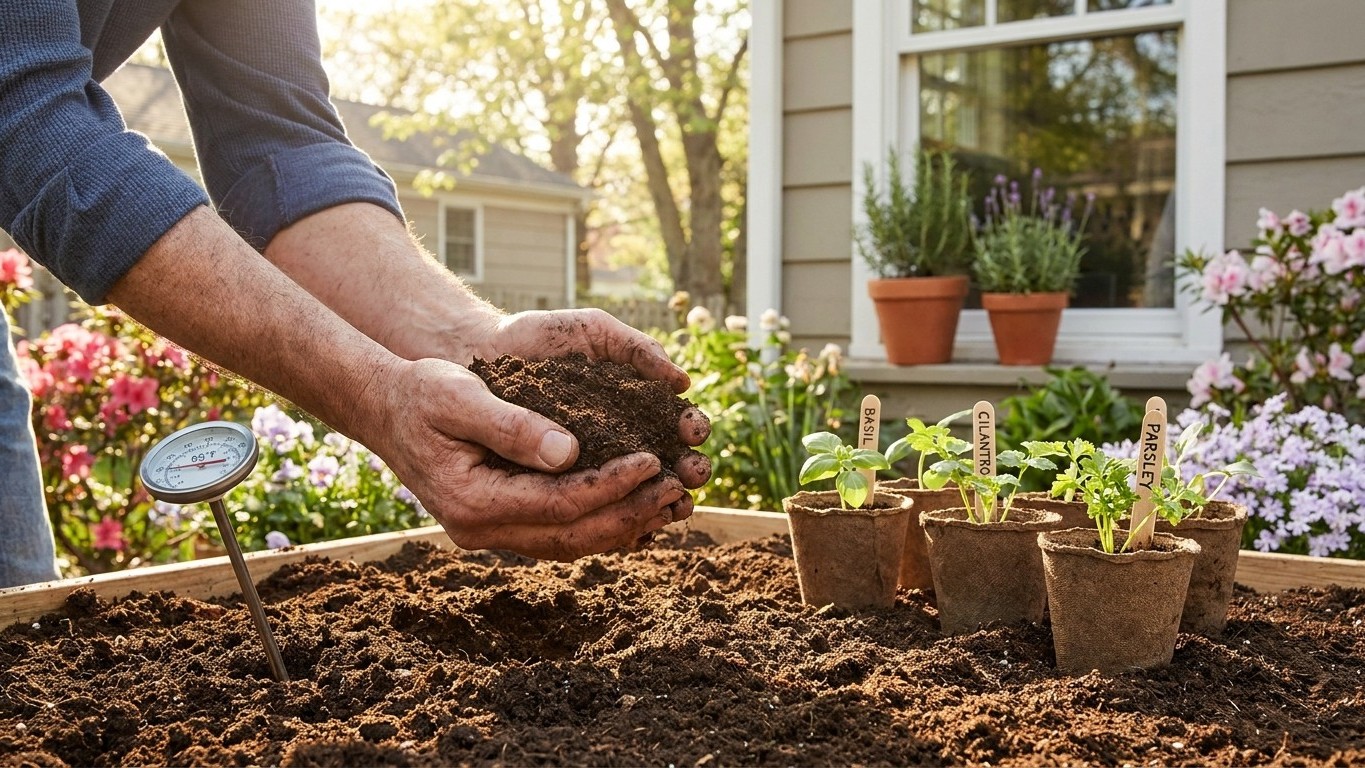

In most of Virginia, herbs go into open ground once nighttime soil temperatures hold above the mid-50s, which lands somewhere between mid-April and early May depending on elevation and distance from the coast. The growing window that follows runs seven to eight months in a typical year. Winter, not summer heat, is what actually splits the state’s herb garden into permanent plantings and pots that come indoors before frost sets in for good.
When the soil is warm enough in Virginia

The average last spring frost at NAS Oceana in Virginia Beach falls between March 20 and April 3, according to NOAA’s 1991-2020 Climate Normals for station USW00013769. That thirty-to-seventy percent probability band is the closest thing to an official date the region has, and it comes from the mildest corner of the state. Inland and up toward the Blue Ridge and southwest Virginia, the same freeze risk lingers for weeks longer, so a gardener in Roanoke or Abingdon should treat the coastal date as a floor, not a target.
Frost is a convenient marker because NOAA tracks it station by station, but it is a proxy, not the real trigger. Herbs germinate and root by soil temperature, and soil warms on its own schedule after the air stops freezing at night. A cold snap can end on the calendar while the top few inches of garden bed are still too cool for seed to sprout evenly, so waiting a week or two past the frost date is normal practice here, especially in a wet spring when soil holds onto cold longer than dry ground does.
That gap matters more for some herbs than others. Tender annual herbs, the basil-type and other warm-season leafy herbs, sit and sulk in cold soil and are better started indoors or held back until the ground has genuinely warmed. Hardy perennial herbs, the woody Mediterranean types and cold-tolerant biennials, tolerate a cooler start and can go in as soon as the soil can be worked, sometimes weeks before the last frost date arrives. Reading the herb by its type, rather than by the calendar alone, avoids the common mistake of planting everything on the same day.
One frost date is also not a promise. NOAA’s band describes a probability, not a guarantee, and a light frost after the “average” date is common enough that experienced gardeners keep some row cover or cloches on hand into May. Several herbs also carry long-standing medicinal reputations.
What the frost date does settle, reliably, is the earliest reasonable planting window for the coastal third of the state. Everywhere else, add time, and let the soil, not the calendar, make the final call.
How long the season lasts here
Pair the two NOAA figures for station USW00013769 and the frost-free window at the coast runs from a last spring frost of March 20 to April 3 out to a first fall frost of November 10 to November 24. Depending on where each date falls inside its probability band in a given year, that puts the usable season somewhere between roughly 221 and 249 days, call it seven to eight months.
| Marker | Date range |
|---|---|
| Last spring frost | March 20 to April 3 |
| First fall frost | November 10 to November 24 |
| Frost-free window | About 221 to 249 days |
That is a long season by East Coast standards, and it changes what makes sense to plant and when. An eight-month window leaves room for a spring sowing of quick annual herbs, a harvest, and a second sowing later in summer aimed at a fall crop, rather than betting everything on one planting date. Gardeners further from the coast, where both frost dates arrive on the harsher end of the range or later, get a shorter version of the same window and should treat a second sowing as optional rather than assumed.
The length of the season also decides whether transplanting is worth the trouble. With seven or more months to work with, there is time to start slow perennial herbs from seed indoors, harden them off, and still get a full season of growth once they move outside. In a shorter window, buying starts or dividing an established perennial saves weeks that a seed-grown plant would otherwise spend just getting established, weeks the calendar here does not always spare in the western and mountain parts of the state.
Anyone planning a second sowing, or staggering plantings to spread out a harvest instead of getting it all at once, should work through the site’s succession sowing guide before picking dates, since the timing math changes with each herb’s own speed to usable size.
Heat and water in Virginia

Summer in the Piedmont and coastal lowlands runs hot and sticky, with afternoon humidity that keeps garden beds damp well after a rain has passed. That pattern favors fungal trouble, mildew on crowded foliage, and slower drying between waterings, more than it threatens herbs with outright heat stress. Most kitchen herbs tolerate a hot Virginia summer without complaint as long as airflow around the leaves is decent and water does not pool at the root.
But summer heat is the wrong question for herbs in this state, and it is worth saying plainly. The figure that actually sorts Virginia’s herb garden into two categories is winter cold, specifically the USDA hardiness zone and the coldest month’s average minimum temperature. Those two numbers decide which herbs live outdoors year after year as permanent plants and which ones need to come inside, or get treated as an annual, before the cold settles in.
Virginia spans USDA Plant Hardiness Zones 5a through 8b, according to the 2023 USDA Plant Hardiness Zone Map built on 1991-2020 climate normals. That is a wide range for one state: the mountains and far southwest sit at the cold end near zone 5a, while the coastal plain around Virginia Beach sits at the mild end near zone 8b. A hardiness zone recommendation that works in Norfolk can fail outright in Highland County, so any planting decision tied to zone needs the local zone, not the statewide range, as its reference point.
At the reference station in Virginia Beach, the coldest month’s average daily minimum runs 31.6°F, per NOAA’s 1991-2020 Climate Normals. That is a mean of overnight lows across the coldest month, not a record low and not a daytime average, and it sits just below freezing. It is also the mild end of the state’s winter. Inland and upland gardens see colder nights than that figure suggests, often by a wide margin, which is exactly what a five-zone spread across one state implies.
That gap between 31.6°F on the coast and the colder nights inland is the real dividing line for a Virginia herb bed. Woody Mediterranean-type herbs bred for a mild, dry winter often survive outdoors near the coast and struggle or die back hard in the mountains, while cold-hardy perennial herbs shrug off either end of the range. The practical move is to check a herb’s cold tolerance against the local zone before deciding whether it belongs in the ground year-round or in a container that moves indoors or into a garage for winter.
Which herbs suit Virginia
Three facts about this territory point toward three different qualities to look for, sorted by type rather than by name. The coastal season runs seven to eight months, long enough to favor herbs that can be sown twice if a gardener wants a fall crop as well as a summer one. Humid summers push disease resistance to the top of the list for anything grown dense or in a crowded bed. And the five-zone spread in winter hardiness means the single most useful question before buying any perennial herb is whether it survives the coldest month where it will actually spend the winter, not what the seed packet claims for the state as a whole.
| Herb type | What Virginia’s climate asks of it |
|---|---|
| Tender annual (warm-season leafy types) | Wait for warm soil; grow fast in the long coastal season |
| Hardy annual or biennial | Tolerate a cooler start; suit a second sowing for fall |
| Woody Mediterranean-type perennial | Needs a mild winter; often container-grown inland |
| Cold-hardy perennial | Survives outdoors across most of the zone range |
Airflow matters more here than in a drier climate, since humidity gives mildew and rot a head start on anything planted too close together. Herbs grown for dense foliage benefit from wider spacing and a spot that dries out between waterings, rather than a low corner of the yard that stays damp. That single adjustment does more for a Virginia herb bed than most other decisions combined.
Plant breeders release new herb cultivars every year with different disease resistance, different cold tolerance, and different speed to a usable size, and the only trials that mean anything for this territory are the ones run in it. Virginia Cooperative Extension, part of the land-grant university system, tracks exactly that kind of local performance data and publishes recommendations by region rather than by national averages. Their directory is available at ext.vt.edu, and a call to the local extension office is the fastest way to get a variety list that has actually been tested against this state’s winters and summers, not just described as suited to them.