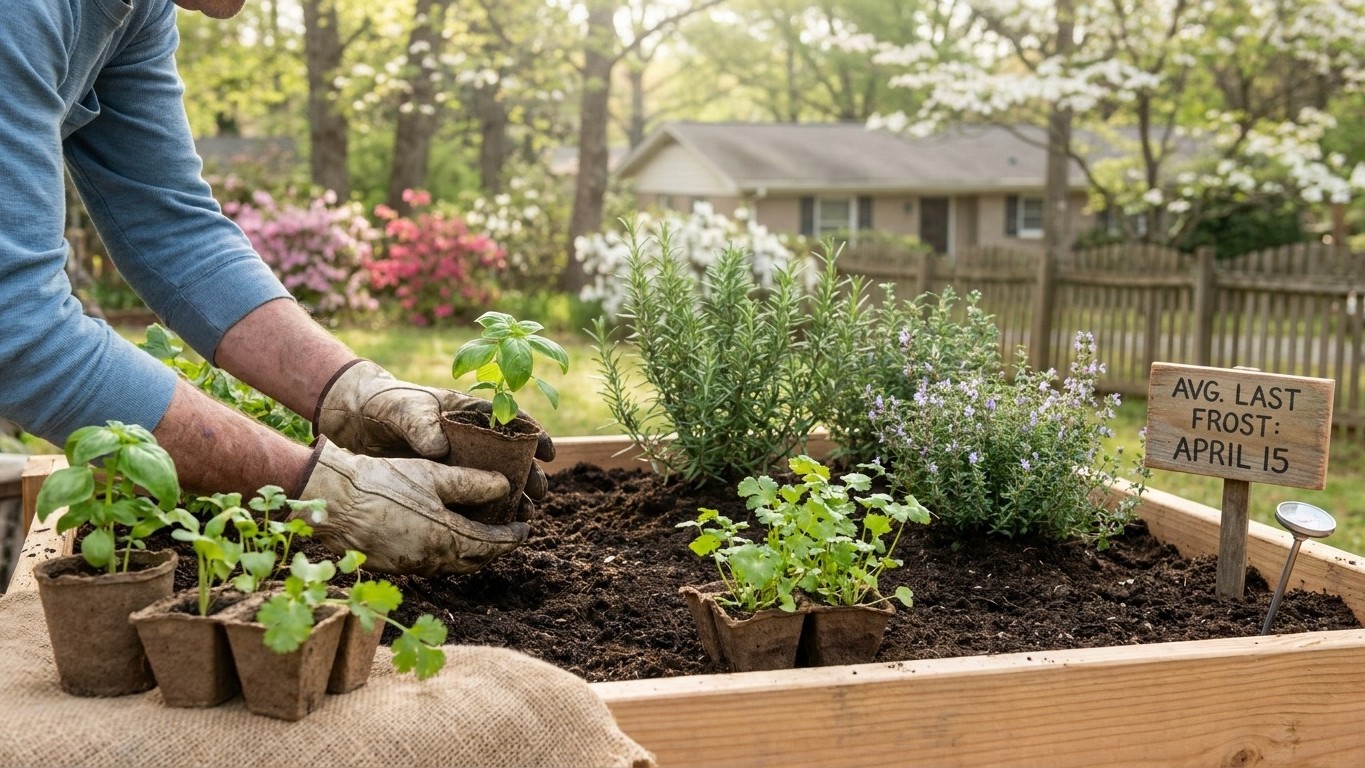

California doesn’t run on a single planting calendar. Coastal and southern gardens see no measurable frost in an average year, so herb timing there is set by heat and water, not by a last-frost date. Inland valleys, the Sierra foothills, and the north are a different story entirely.
The short answer for California
For coastal and southern California, NOAA’s 1991-2020 climate normals show zero days at or below 32°F over three decades of record, with the frost-free season logged as the full 365 days. There is no computable last-spring-frost or first-fall-frost date for this reference station, because there’s effectively no frost to date. That single fact reshapes the whole question: instead of asking “when is it safe to plant after the last freeze,” the real question in this part of the state is “when is it cool enough, and wet enough, to get an herb established before summer heat and drought stress take over.”
The mean daily minimum during the coldest month here runs 49.1°F. That’s the number that actually decides winter survival for herbs, not the record low and not a monthly average. At 49°F, nothing goes dormant from cold, and nothing gets killed back. Perennial Mediterranean herbs, rosemary, thyme, oregano, sage, can be planted or left in the ground through winter without a second thought. Basil, which sulks and blackens anywhere near freezing, has no frost risk to plan around here either.
What this means practically: cool-season herbs like cilantro, parsley, and dill can go in through fall and winter in the frost-free zone, since there’s no killing cold to cut the season short, and they’ll avoid the bolt-and-die pattern that summer heat forces on them. Warm-season herbs like basil go in once soil has warmed and the risk of the year’s brief cool, damp stretch has passed, again a decision driven by soil temperature and moisture, not frost.
For the inland valleys, the Sierra, and the northern part of the state, freezing is real and routine most winters. This page’s frost data comes from a coastal and southern reference station, and it would be wrong to stretch that zero-frost figure over ground that actually ices over. If your county freezes, this particular dataset doesn’t carry a usable spring or fall frost date for you, and the right move is checking a local source rather than borrowing the coastal number.
What will not work here

The standard “count backward from your last frost” method fails outright across large parts of California, because there’s nothing to count backward from. A gardener in the frost-free zone who plants basil in late May, treating it like a Midwest transplant date, has simply wasted six or eight weeks of good growing conditions. The constraint that actually bites here isn’t cold. It’s a long dry summer stacked on top of watering rules that many California water agencies impose during drought years, often limiting outdoor irrigation to a set number of days per week.
That watering pattern quietly kills the wrong herbs. Basil, mint, cilantro, and chervil want fairly even soil moisture and will show it fast, wilting, going bitter, or bolting, if they’re stuck on a once- or twice-a-week schedule through a hot, dry stretch. Meanwhile, rosemary, thyme, sage, and oregano, all native to a summer-dry Mediterranean climate to begin with, tolerate that same schedule without complaint. Planting the thirsty group and the drought-tolerant group side by side on one irrigation zone is a mismatch that shows up by midsummer no matter how good the soil prep was in spring.
Heat, not cold, is the real filter
Because the coldest month here still averages a 49.1°F nightly minimum, gardeners sometimes assume the growing conditions are gentle across the board. They’re gentle in winter. They are not gentle in the dry season, when herbs that need consistent, cooler root zones, cilantro especially, bolt to seed within weeks of a heat spike. Trying to nurse a spring-planted cilantro crop through a hot summer in the frost-free zone is fighting the plant’s biology, not the climate data.
Close, humid-climate spacing is also a mismatch here. Guides written for the Southeast often recommend tight herb spacing to maximize a short humid season. Along the California coast, fog can hold enough dampness at ground level, especially with basil, to invite powdery mildew if plants are crowded, even though the region isn’t humid in the way the Gulf Coast is. Wider spacing and morning watering beat a tight, humid-climate layout transplanted onto a fog-belt garden.
What changes across California
The USDA Plant Hardiness Zone Map, built from 1991-2020 average annual extreme minimum temperatures, places California across an enormous range: zone 5a up through 11a. That’s not a typo and it isn’t a rounding error. It’s one of the widest hardiness spreads of any state in the country, and it means a single statewide planting instruction genuinely does not exist.
Zone 11a, at the mild end, describes conditions like the frost-free reference station discussed above, where the coldest month still averages a 49.1°F nightly minimum and freezing basically doesn’t happen. Zone 5a sits at the other extreme, the kind of cold found at higher Sierra elevations, where extreme minimum winter temperatures drop into territory that would kill an unprotected rosemary plant outright and where the growing season is measured in a handful of frost-free months, not year-round.
A reader gardening in the north of the state or at elevation should shift the whole framework: expect a real last-frost date in spring and a real first-frost date in fall, plan warm-season herbs like basil for a defined window between them, and bring tender perennials like rosemary indoors or accept replanting them each year. A reader in the coastal or southern lowlands, closer to the 11a end, can plant many herbs on a near-continuous cycle and should worry more about summer drought stress than about any frost date at all.
This page can’t tell an individual reader which of those zones they’re standing in. The USDA’s interactive hardiness zone map, searchable by ZIP code, does that job precisely and is the right next step before locking in any planting date based on the ranges above.
Where to check this for your own county
California’s land-grant university extension system is the University of California Cooperative Extension, reachable at ucanr.edu. That’s the source built for exactly this gap, because a state as climatically split as California can only be given useful, dated advice at the county level.
Two things are worth hunting for once there. First, a local planting calendar, usually published by the county’s Cooperative Extension office or its affiliated Master Gardener program, that’s built from that county’s actual frost data rather than a statewide average that means nothing in a state with a 5a-to-11a spread. Second, a list of herb varieties that have actually been trialed in that county’s conditions, since a rosemary or basil variety that thrives in coastal fog can behave completely differently in Central Valley heat or Sierra foothill cold.
A county-level recommendation will beat anything on this page, because this page is necessarily the state-level version, built to explain the mechanics rather than to hand out a date. Treat what’s written here as the reasoning, and treat the county extension office as the source for the actual number that applies to a specific address. Many California counties also run a Master Gardener hotline or in-person plant clinic through their Cooperative Extension office, which is worth using directly if the online calendar for that county turns out to be sparse or out of date.
Checking this against your own garden
None of the numbers above outrank what’s actually happening in a specific yard, and California’s climate range is exactly why the garden itself deserves the final word. Three signals are worth tracking by hand, no gauge or thermometer required.
- Soil warmth by feel: push a finger a couple of inches into the bed in the morning. Cool and damp still means basil and other warm-season herbs are better off waiting; warm through most of the day means the soil has caught up with the air, even if the calendar says it’s early.
- The first true leaves on a direct-sown herb: cilantro, dill, and similar herbs put out a simple pair of seed leaves first, then a second, more feathery set. That second set showing up fast, within a week or two, signals a warm, fast-growing stretch. A long stall between the two sets suggests the soil is still cooler than it looks.
- How fast newly set transplants perk back up: a basil or parsley transplant that’s standing upright and glossy again within a day of going in the ground is telling you the microclimate, sun, wind, and soil temperature together, suits it right now. One that sulks for the better part of a week is a sign conditions in that particular spot are running behind the rest of the yard, whatever the county calendar says.
A single yard in California can run several microclimates at once, a warm south-facing bed against a wall, a cooler spot under afternoon shade, a windy corner that dries out fast, and these three checks catch that variation in a way no zone map or extension calendar is built to do.
The Moon calendar is a separate, older custom: see when to plant herbs by the moon, written as tradition rather than fact.