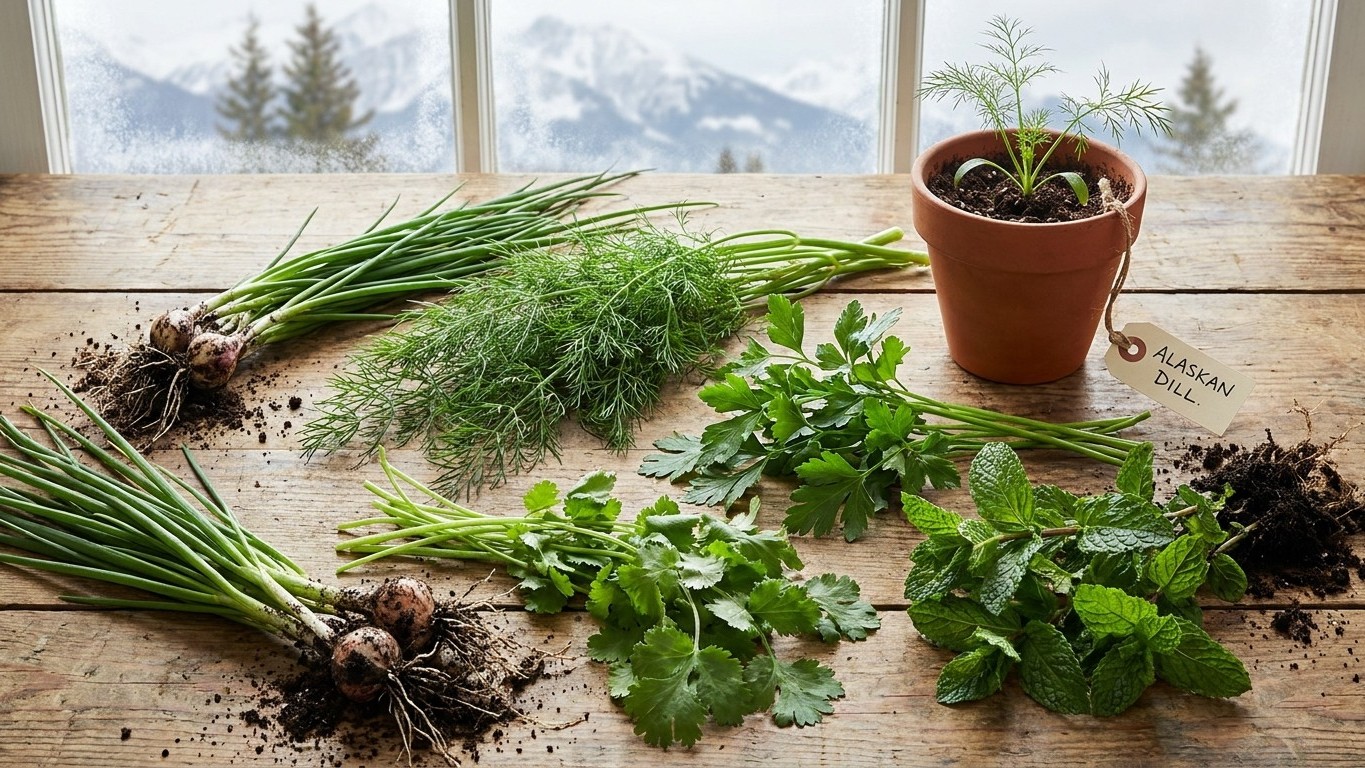

Indiana’s herb garden works best when you split your list into two piles: perennials tough enough to survive winter here (chives, oregano, thyme, sage, mint), and warm-season annuals that need the long stretch between spring and fall frost (basil, dill, cilantro). Rosemary and bay laurel belong in pots, not the ground.
The short answer for Indiana
Start with the frost-free window, because it decides everything else. Indianapolis data puts the last spring frost between April 9 and April 21, and the first fall frost between October 21 and October 30. Stretch those dates end to end and you get somewhere close to six months of growing season, depending on where in that range your particular spring and fall land. That’s enough time to run basil from seed to a heavy harvest, and enough time for two or even three sowings of dill or cilantro before the cold shuts things down.
The second number that matters is the coldest month’s mean daily minimum: 20.9°F. That’s not the record low, it’s the average low during the coldest stretch of a typical winter, and it’s the figure that separates herbs that survive here as perennials from herbs that don’t. Chives, mint, oregano, thyme, and most sages shrug this off. They’re hardy to USDA zones 3 through 5, well within the state’s 5b to 7a range, so once established they come back year after year without help.
Rosemary is a different story. Most rosemary varieties are only reliably hardy to zone 8, sometimes a sheltered zone 7. A mean minimum of 20.9°F in the coldest month will kill an in-ground rosemary plant in most Indiana winters, even in the mildest southern counties. The workaround isn’t a better spot in the yard, it’s a container you can move indoors or into an unheated garage before the first hard frost lands in that October window.
So the type-based answer looks like this: build the backbone of your herb bed from cold-hardy perennials, treat basil and other tender annuals as season-long crops that get planted after the spring frost date has passed for your area, and keep Mediterranean natives like rosemary and bay in pots you control. Parsley sits in between, biennial and reasonably cold-tolerant, often surviving a mild Indiana winter under mulch even though most gardeners grow it as an annual.
What will not work here

In-ground rosemary is the clearest failure case, and it’s worth repeating because so many garden centers sell it without a warning label. A 20.9°F average minimum in the coldest month sits well below what rosemary’s root system tolerates. Even a “cold-hardy” cultivar planted in the ground in central or northern Indiana is playing against odds that don’t favor it. Bay laurel and lemon verbena fail for the same reason: their hardiness ceiling doesn’t reach down to what a typical Indiana January delivers.
Cilantro fights a different problem. It isn’t the cold that beats it, it’s the calendar. Cilantro bolts to seed once summer heat arrives, and Indiana’s frost-free stretch runs straight through the hottest, most humid part of the year. A single spring sowing planted right after the last frost date will often flower and stop producing usable leaves before June is out. The fix isn’t a different herb, it’s succession sowing: small batches every few weeks through spring and again in early fall, so you’re never depending on one planting to carry the whole season.
Herbs that expect a dry, airy Mediterranean summer run into trouble with Indiana’s humidity, even though humidity itself isn’t one of the measured facts here. Thyme and oregano tolerate it fine once established, but they need looser soil and wider spacing than a seed packet grown for a drier climate might suggest. Crowd them the way you would in a low-humidity region and the extra moisture sitting between plants invites fungal problems that a drier state never has to worry about.
Finally, anything marketed as needing a “long, mild growing season” without frost risk is going to disappoint. Indiana’s frost-free window, generous as it is at roughly six months, still closes hard in that October 21 to October 30 range. Herbs bred for near-frost-free regions, some basil cultivars included, can get caught by an early fall frost if planted too late in the season to mature.
What changes across Indiana
Indiana isn’t one climate, it’s a stretch of them. The state spans USDA hardiness zones 5b through 7a, which is a meaningful gap: 7a winters run noticeably milder than 5b winters, and that gap changes what survives outdoors without help. A perennial herb bed that thrives unprotected in the southern tip of the state along the Ohio River can struggle in the same spot two hundred miles north.
Frost timing shifts along with it. The Indianapolis-based dates in this article, April 9 to April 21 for the last spring frost and October 21 to October 30 for the first fall frost, are a useful central reference, but they’re not universal. Southern Indiana typically sees its last frost earlier in spring and its first frost later in fall, often by two weeks or more compared to the north. That’s the difference between fitting in three cilantro sowings and only managing two, or between rosemary surviving an unusually mild winter in a sheltered southern yard and not standing a chance further north.
This isn’t something to guess at from a county name or a mental map of the state. The zone range spans enough ground that a reader in one part of Indiana and a reader two hours away could be gardening in genuinely different conditions. Rather than assign a zone here, the right move is checking the current USDA Plant Hardiness Zone Map directly for your specific location, since zone boundaries have shifted with updated climate normals and don’t always follow county lines cleanly.
The practical takeaway: if you’re in the northern half of the state, lean harder into container culture for marginal herbs and mulch perennial beds heavier going into winter. If you’re in the south, you likely have more room to experiment with borderline-hardy herbs, though “more room” still isn’t a guarantee with a 20.9°F coldest-month average in the mix.
Where to check this for your own county
Everything above is built from a single reference station in Indianapolis. That’s useful for a state-level picture, but it’s not a substitute for what your own county extension office has on file. Purdue Extension maintains county-level offices across Indiana, and that’s the right next stop before you finalize a planting plan.
Two things are worth pulling up specifically. First, the local planting calendar for your county, which will reflect actual frost patterns recorded closer to you than the Indianapolis station this article relies on. If you garden in Vincennes or Vevay, your real frost window may run meaningfully earlier and later than the dates cited here. If you’re in Fort Wayne or South Bend, expect the opposite adjustment. Second, look for any herb or vegetable variety trials Purdue has run in your region. Extension offices frequently test cultivars under local soil and climate conditions and publish which basil, thyme, or oregano varieties held up best, information that a national seed catalog simply can’t offer.
A county recommendation will always beat a state one. What you’re reading here is deliberately built at the state level, using one reference station and a hardiness zone range, because that’s the right altitude for comparing Indiana to its neighbors or understanding the broad shape of the growing season. It is not a substitute for the finer-grained data your county office has gathered specifically for your soil, your microclimate, and your local frost history. Treat this article as the starting framework, and treat your county extension page as the correction layer that gets applied on top of it.
Checking this against your own garden
Dates on a page, even a well-sourced one, are probabilities, not promises. Your own garden will tell you more than any calendar once you know what to look for, and none of it requires equipment beyond your hands and eyes.
Start with soil warmth by feel. Push a finger a few inches into the bed where you plan to direct-sow basil or dill. If the soil still feels cool and slightly damp rather than warmed by the sun, it’s telling you the ground hasn’t caught up to the air temperature yet, even if the calendar says the frost date has passed. Basil seed in particular sits and sulks in cold soil rather than germinating.
Watch your perennial herbs for their first flush of new growth. Chives sending up fresh green shoots, or oregano and thyme pushing new leaves at the base, are a more honest signal of local spring timing than any regional frost date. These plants are responding to the actual conditions in your yard, including whatever microclimate your specific spot creates, whether that’s a warm south-facing wall or a low patch that collects cold air.
Finally, check for the first true leaves on any seedlings you’ve started, the second set that appears after the initial seed leaves. That’s the point where a seedling has enough root and leaf structure to handle a move outdoors or a thinning out. A garden that’s running a week or two ahead of or behind the Indianapolis-based dates in this article isn’t wrong, it’s just telling you something specific about the ground you’re actually working with.