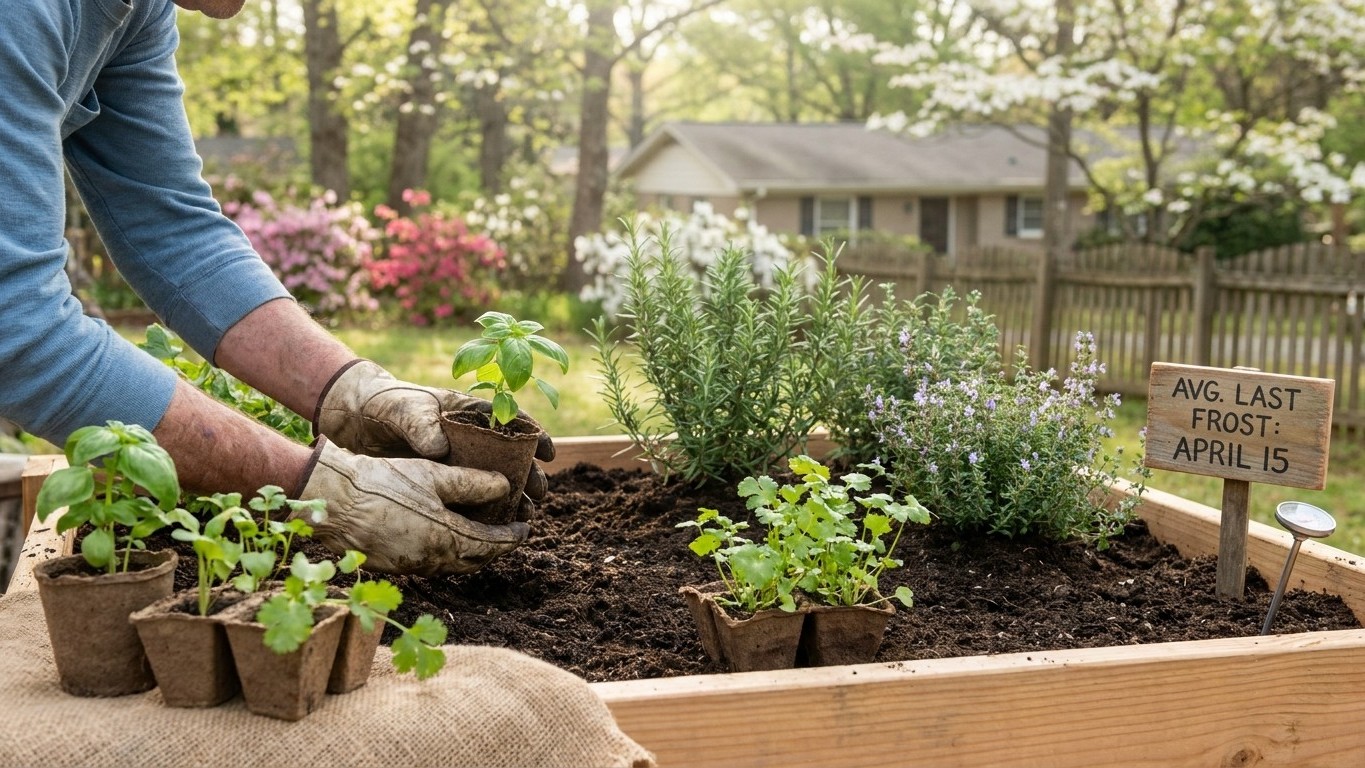

Plant tender herbs like basil, dill, and cilantro outdoors in Indiana between April 9 and April 21, the window when the last spring frost typically clears at the Indianapolis reference station. Hardy perennials such as thyme, sage, and chives can go in several weeks earlier. Those frost dates carry roughly a 30 to 70 percent probability of a freeze occurring somewhere in that stretch, not a guarantee against one.
The short answer for Indiana
Tender annuals: April 9 to April 21
Basil, dill, cilantro, and other frost-tender annual herbs go into the ground between April 9 and April 21. That’s the window NOAA’s 1991-2020 Climate Normals mark as the 30 to 70 percent probability band for the last 32°F freeze at the Indianapolis reference station (USW00093819). On April 9, there’s still roughly a 70 percent chance of a freeze happening on or after that date; by April 21 the odds have dropped closer to 30 percent. It’s a probability curve, not a switch that flips cleanly from “frost” to “no frost.”
Purdue’s extension work adds a caution worth repeating: even after the published spring date, there’s still about a 10 percent chance of a 32°F event. That residual risk is why growers who plant on the early edge of the window, say April 10 rather than April 20, keep row cover or an old sheet within reach for the first two or three weeks after transplanting.
Hardy perennials and the fall end date
Perennial herbs read that calendar differently. Chives, thyme, oregano, and sage tolerate a light frost and can be set out two to three weeks ahead of the tender-annual window, often in late March once the soil has thawed and dried enough to work. These are the herbs whose root systems shrug off a 20.9°F mean nightly low in the coldest month, the figure that actually decides which perennials survive an Indiana winter rather than just germinate in an Indiana spring.
On the back end of the season, first fall frost arrives between October 21 and October 30 at that same Indianapolis station. That gives tender annuals roughly six months of open-air growing, assuming they went in near the early edge of the spring window and got picked or covered before the October date. The USDA hardiness zone map lists Indiana as a spread from 5b to 7a, which matters more for perennial herbs’ winter survival than for annual sowing dates, a difference unpacked further below.
What will not work here
Mediterranean perennials against a 20.9°F winter
Rosemary, bay laurel, and other tender Mediterranean perennials rarely survive an Indiana winter planted straight into garden soil. The number that matters is 20.9°F, the mean nightly low for the coldest month at the Indianapolis reference station. That’s an average, not a floor; a hard cold snap regularly pushes well past it. Rosemary foliage suffers real damage in the mid-20s and the plant often dies back hard below 10°F, so leaving it outdoors here is gambling against a number the climate normals say is typical, not extreme. Growers who want rosemary as a perennial either pot it and bring it indoors before first fall frost (October 21 to October 30) or treat it as an annual and replant every spring.
Slow herbs against a six-month season
Slow-maturing herbs run into a different wall: the length of the season itself. Between the tail end of the spring frost window and the start of the fall one, Indiana offers roughly six months of frost-free growing. Herbs that need a long, warm run, lemongrass is the common example, often don’t reach a useful harvest size before that window closes, especially if they went into the ground in mid-May instead of the earlier edge of the recommended range. Starting these indoors weeks before the outdoor date, then transplanting, is less optional here than it would be in a longer-season state.
Tight spacing is its own failure mode in a state where summer humidity keeps foliage damp well into the evening. Basil planted at nursery-pot spacing, six inches apart, tends toward downy mildew and other leaf disease by midsummer; the plants that make it to September are usually the ones given real airflow between them from the start. This isn’t a soil problem or a watering mistake. It’s a spacing decision made in April that shows up as a disease problem in July.
What changes across Indiana
North versus south, a two-zone spread
A hardiness zone spread from 5b to 7a means Indiana isn’t one climate, it’s several stacked north to south. That’s a two-zone range on the USDA Plant Hardiness Zone Map, built on the average annual extreme minimum temperature, and a two-zone difference is enough to decide whether a marginal perennial herb like rosemary or bay has a real shot at overwintering outdoors or none at all. There’s no single answer for “does rosemary survive here” that applies from the Michigan border to the Ohio River.
The frost dates carry the same north-south stretch. Indianapolis sits roughly in the middle of the state, and its April 9 to April 21 last-frost window and October 21 to October 30 first-frost window are the reference points for the state. Purdue’s own guidance flags that southern Indiana runs both earlier in spring and later in fall by two weeks or more compared to the north. That’s not a small adjustment. A gardener near the Ohio River could reasonably plant tender herbs close to two weeks before the Indianapolis date and keep harvesting two weeks past the Indianapolis fall date, stretching the six-month growing window discussed above toward seven.
Run that same logic north, toward Lake Michigan, and the shift goes the other direction: a later last frost, an earlier first frost, and a shorter season than the state-level numbers suggest. None of this resolves from a state-level page, deliberately. The right move is checking the USDA Plant Hardiness Zone Map directly for a specific address or ZIP code, rather than assuming which end of the 5b-7a range applies.
Where to check this for your own county
What to look for at the county level
Purdue Extension is the land-grant service for Indiana, and it’s the next stop for county-level answers. Everything above comes from statewide climate normals measured at one reference station in Indianapolis. Purdue’s county offices work from local trial data and local frost records, a finer instrument than a single-station average for the whole state.
Two things are worth pulling from a county extension office or its website specifically. The first is a local planting calendar, if the county publishes one, showing sowing windows adjusted for that county’s actual microclimate rather than the Indianapolis-anchored range used here. The second is a list of herb varieties actually trialled in that county or region, since Purdue’s horticulture programs test performance under local soil and disease pressure, information a state-level page like this one has no way to capture.
A county recommendation beats a state one every time they disagree. Calling or emailing the local office directly, most Indiana counties have one, tends to get faster and more specific answers than searching the main Purdue site for county pages, especially for less common herbs without a dedicated factsheet.
Some gardeners also time this by the Moon: when to plant herbs by the moon, as almanac tradition rather than fact.
Checking this against your own garden
Three signals from the plant itself
Every date here is an average built from thirty years of weather records at one station. A reader’s own garden is a sample size of one, measured this year, and it settles disagreements the calendar can’t.
Soil warmth by feel is the first check, and it matters more than air temperature for germination. Push a finger two or three inches into the bed where herbs are going. If it still feels cold and damp in a way that lingers, seeds sown there will sit and sulk rather than sprout, regardless of what the calendar says. A bed that feels warm to the hand even in early morning, before the sun has hit it directly, is usually ready before the stated window closes.
The first flush of male flowers on herbs like basil or dill is a second signal, this time about pace rather than timing. Herbs that flower unusually early, well before they’ve reached a normal harvest size, are usually responding to stress: a cold snap, a dry spell, crowding. That’s the plant reporting on its own microclimate, not a sign the calendar was wrong.
First true leaves, the second set that appears after the initial seed leaves, tell a similar story about pace. Herbs that reach their true leaves quickly are growing in conditions closer to ideal than the ones taking noticeably longer in the same bed, same week. That gap between two plantings in the same yard is often more useful information than any state-level date, because it’s specific to that soil, that sun exposure, that particular corner of a particular property.