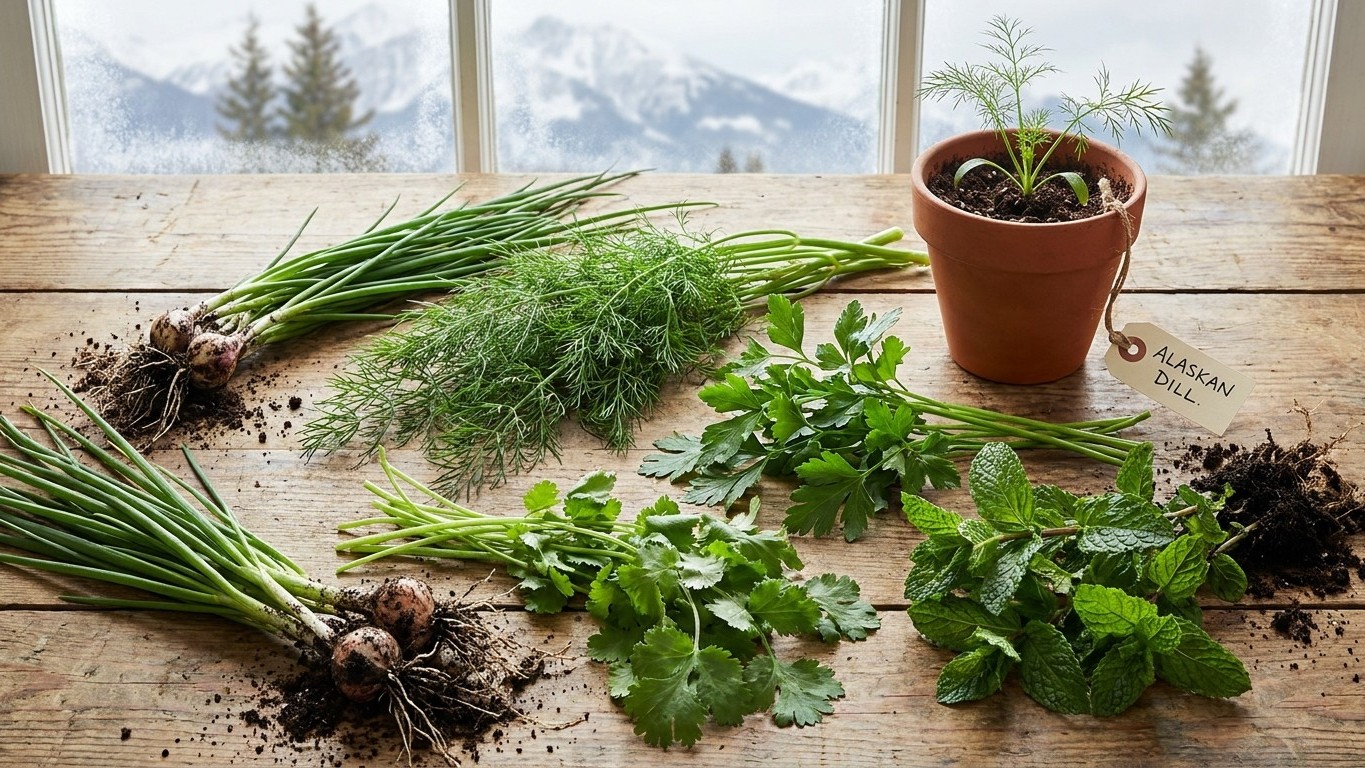

Iowa gardeners get a real growing season, roughly five to six months between frosts, and a winter cold enough to end any hope of Mediterranean shrubs surviving outdoors unprotected. The safest bets: chives, dill, parsley, and cilantro as dependable annual crops, basil once soil has warmed, and thyme, sage, and oregano as perennials if you give them sharp drainage and a winter mulch. Rosemary and bay laurel need pots you can bring inside.
The short answer for Iowa
Two numbers decide most of what grows well here. The first is season length: last spring frost falls between April 12 and April 24, first fall frost between October 14 and October 25, both measured at the Des Moines airport station. That gives a frost-free window of roughly 173 to 196 days at the optimistic end. But Iowa State Extension’s county-level figures, drawn from 1950-2021 records, run about 4 days later in spring and 10 days earlier in fall than that airport station. Trim those 14 days off and a realistic county season lands closer to 159 to 182 days, depending on where you sit in the state.
The second number is winter cold: the mean daily minimum of the coldest month at Des Moines is 13.8°F. That is not the record low, it is the average low you should expect every single winter, and it is the figure that actually decides whether a woody perennial herb survives here at all, not just whether it survives one bad night.
Those two facts sort Iowa’s herb choices into three groups pretty cleanly.
| Group | What it needs | How it fits Iowa |
|---|---|---|
| Fast annuals (dill, cilantro, chives) | 60-70 days to harvest, tolerate cool starts | Fit easily inside a 159-182 day window |
| Heat-loving annual (basil) | Warm soil, zero frost tolerance | Fine once planted after last frost, but the window narrows on both ends |
| Hardy perennials (thyme, sage, oregano, chives again) | Winter survival down to roughly 10-15°F minimums with good drainage | Workable at 13.8°F mean minimum, with mulch |
| Tender Mediterranean shrubs (rosemary, bay laurel) | Winter minimums no colder than roughly 20-30°F | Fails outdoors at 13.8°F every single winter |
Basil deserves its own note. It grows fast and thick through an Iowa July and August, but it cannot be rushed into the ground before that April frost window closes, and it will blacken overnight the first time temperatures dip near freezing in October. Plant it as the last thing you put in the ground each spring and the first thing you pull each fall.
What will not work here

Rosemary and bay laurel are the two herbs Iowa gardeners keep losing, and the math explains why. Both are shrubs bred for Mediterranean and Pacific coastal winters where the coldest month rarely averages below the low 20s. Des Moines averages 13.8°F for its coldest month, a gap of roughly ten degrees on the daily minimum, every single winter, not just in a hard one. Left outdoors without protection, both plants die back to the roots or die outright well before spring. The workaround gardeners actually use is a container: grow rosemary in a pot all summer, then bring it inside before that October frost date arrives.
French tarragon and some of the less cold-tolerant lavender cultivars sit in a riskier middle ground. They can survive an Iowa winter in a sheltered, well-drained spot, but they fail almost as often from a different cause entirely: summer humidity. Iowa summers combine heat with enough moisture that lavender’s Mediterranean-bred roots rot in heavy clay soil long before winter cold becomes the problem. The fix is not a warmer spot, it is a raised bed or a gritty, fast-draining mix, because the plant that survives 13.8°F just fine can still drown in a wet July.
Cilantro fails for the opposite reason: too much heat, too fast. It is a cool-season herb that bolts to seed the moment daytime temperatures push into the 80s, which in most of Iowa happens well before the frost-free window closes. Gardeners who plant it once in May and expect leaves through August are set up to fail; the realistic play is two or three short successive plantings, spring and again in early fall, rather than one long summer stand.
Close spacing is the quieter failure. A frost-free window running 159 to 182 days brings warm, humid air with it, and basil, oregano, and bee balm planted shoulder to shoulder in that humidity develop powdery mildew and other fungal issues by midsummer. The plants that would sail through a drier climate at tight spacing need real airflow here. Give them the room a seed packet recommends for a dry state, not the tighter spacing some catalogs suggest for cooler, drier regions.
What changes across Iowa
Iowa is not one growing zone, it spans a range from USDA Hardiness Zone 4b in the north to 6a in parts of the south, all under a system built on a single variable: the average annual extreme minimum temperature. That is a real spread, not a rounding error, and it means a rosemary that struggles in a sheltered Des Moines yard has effectively no chance in a north-central Iowa winter, while a hardy sage that overwinters reliably near the Missouri border might need extra mulch or a raised bed further north.
Season length shifts with that same gradient. The frost dates cited above come from a single reference station; a location further north in the state will typically see its last spring frost arrive later and its first fall frost arrive earlier than the statewide figures suggest, shortening that already trimmed 159 to 182 day window further still. A gardener in the northern part of the state planning around the Des Moines numbers is likely planting into a colder spring and losing crops to an earlier fall frost than the reference data implies.
None of this means picking a different set of herbs county by county. Chives, dill, parsley, and the hardy perennial trio of thyme, sage, and oregano work across the whole 4b-6a spread. What shifts is timing and protection: gardeners at the colder end should push basil and other frost-tender plantings later into spring, pull them earlier in fall, and lean harder on mulch for anything perennial. Which zone you garden in depends on a specific address, not a state average. The USDA’s online hardiness zone map, searchable by ZIP code, settles that question in about ten seconds.
Where to check this for your own county
Everything above is a state-level picture, built from one reference station and a statewide hardiness range. A county recommendation will always beat a state one, because frost dates, soil types, and even which pests show up first genuinely differ between, say, a county along the Missouri River and one up near the Minnesota border. Iowa State University Extension and Outreach, the state’s land-grant extension service, is the place that turns this state-level answer into a county-level one.
Iowa State University Extension maintains a website. Two things are worth looking for specifically once there. The first is a local planting calendar for your county or region, which will reflect the more conservative frost dates extension researchers have logged over decades of county-level records, rather than the single-airport figures. The second is any list of herb or vegetable varieties that extension horticulturists have actually trialled in Iowa conditions, since a cultivar bred and tested for humid Midwest summers will usually outperform a generic seed-catalog pick bred for a drier climate.
Extension offices also field walk-in and phone questions from local gardeners, and many county offices keep informal notes on what has struggled or thrived in that specific soil and microclimate over recent seasons, information that never makes it into a statewide climate normal. That kind of local, accumulated observation is exactly the layer this state-level page cannot provide on its own.
Checking this against your own garden
Every date here is a probability built from decades of averages, not a guarantee for this particular spring in this particular yard. Your own garden will tell you more than any calendar, if you know what to watch for.
Soil warmth by feel is the first check. Basil and other heat-loving herbs sulk, yellow, or simply refuse to grow in soil that still feels cool and damp to the touch, even if the calendar says the last frost has passed. Waiting until the soil itself feels warm, not just the air, catches microclimate differences a frost date average cannot.
Watch for the first true leaves on anything direct-sown, dill and cilantro especially. The first thin seed leaves that emerge are not the plant proving itself; the first set of true, feathery or serrated leaves that follow is the signal the plant has actually rooted into conditions it can handle, and it is a better guide to when to thin or transplant than counting days on a packet.
For anything in the mint or squash-adjacent herb family that flowers, an early flush of flowers before the plant has built real size is often a stress signal rather than a success, frequently triggered by a cold snap or a dry spell rather than genuine maturity. A plant flowering small and early is usually asking for water or protection, not applause.
None of these signs need a thermometer or a soil probe, just a hand in the dirt and a season of paying attention, and together they will outlast any frost-date average.