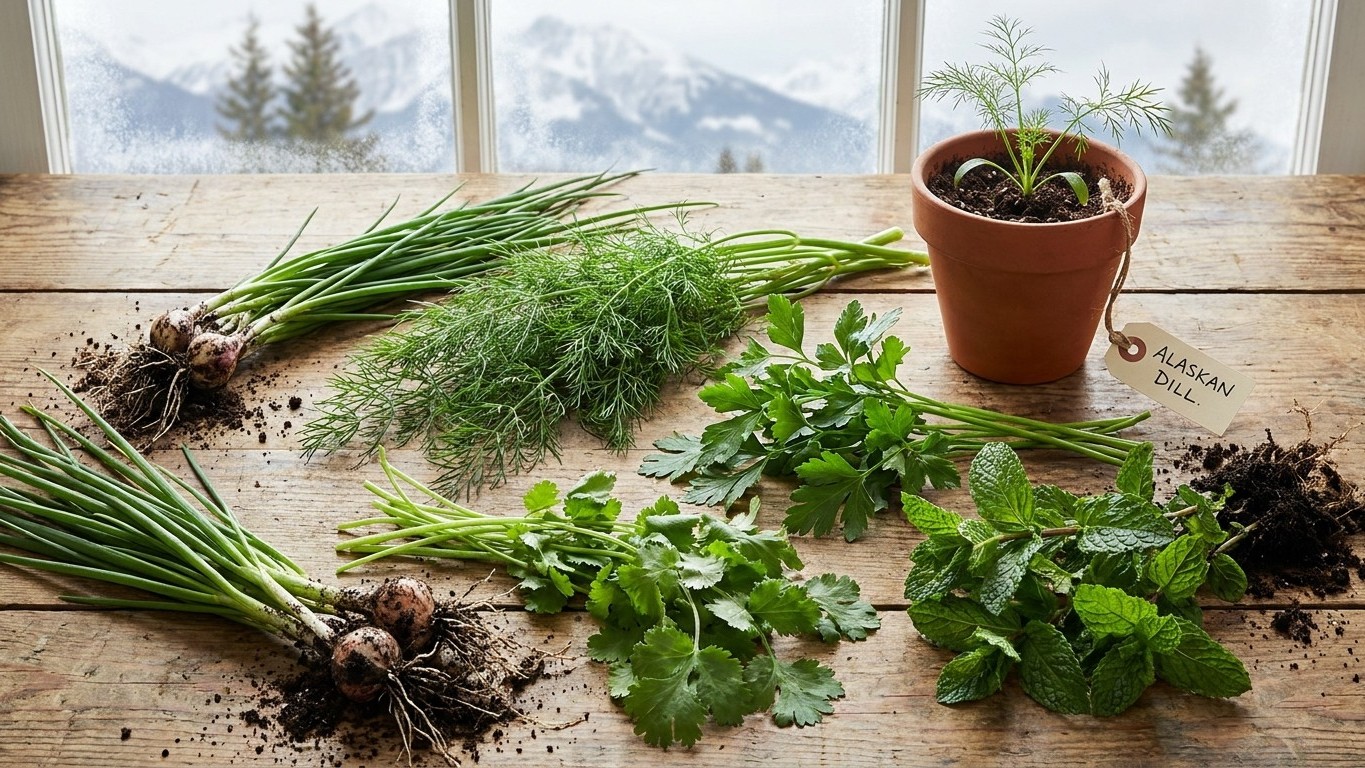

Missouri gardeners get the best results from hardy perennials like thyme, oregano, chives, and sage, which shrug off winter across the state, paired with heat-loving annuals like basil planted after the frost risk passes. Rosemary and bay laurel are the herbs to skip outdoors here, or grow in pots you can move.
The short answer for Missouri
Start with the season length, because that’s what separates the herbs that thrive here from the ones that just survive. Using Kansas City as the reference station, the last spring frost falls between April 6 and April 20, and the first fall frost arrives October 18 to October 29. That gives a frost-free window of roughly six months, plenty of time for both quick annual herbs and the long, slow build of a perennial bed.
The number that actually decides winter survival, though, isn’t the frost date. It’s the coldest month’s average daily minimum: 19.5°F at the Kansas City reference station. That’s the temperature a perennial herb has to shrug off, night after night, for the whole of January. Thyme, oregano, chives, sage, and most mints handle that figure without trouble. Their listed hardiness ranges sit well below 19.5°F, so they come back reliably as true perennials across most of the state.
Rosemary is a different story. Commonly listed as hardy only into the upper 20s or the teens in the best cultivars, it sits right at the edge of what 19.5°F allows, and that’s before accounting for wind exposure or a harder-than-average cold snap. Treat it as a one-season annual or a container plant you carry indoors for winter, especially in the northern half of the state.
Heat matters just as much as cold here. Missouri summers push well into the 90s for weeks at a time, and that favors basil, which actually picks up growth speed in hot weather, while punishing cool-season herbs like cilantro and dill, which bolt to seed the moment daytime temperatures settle into the 80s. The practical move is to treat cilantro and dill as spring and fall crops, sown early enough to mature before the heat locks in, then sown again once it breaks in September.
So the herb lineup for Missouri splits cleanly by type: perennials for the structural backbone of the garden, tender Mediterranean herbs as annuals or potted specimens, and cool-season annuals timed to dodge the worst of the summer rather than fight it.
What will not work here
Bay laurel is the clearest failure waiting to happen. It’s rated hardy only to USDA zones 8 through 10, and Missouri’s hardiness range tops out at 7b in its mildest pockets. Left outdoors through a Missouri winter, a bay laurel in the ground has no realistic path to spring. It has to live in a pot and come inside before the first real cold snap, full stop.
French tarragon has a quieter failure mode. It doesn’t die outright most years, but it sulks. The plant wants cool nights and moderate, dry summers, and what it gets instead in most of Missouri is muggy, humid heat that encourages root rot and weak, leggy growth. Gardeners who’ve grown it in drier climates often find it disappointing here, not because of a hard frost limit but because the summer conditions work against it all season long.
Cilantro’s failure is about timing, not hardiness. Once daytime highs climb past the low 80s, which happens reliably by late May or early June across the state, cilantro bolts to flower and seed within a couple of weeks. A single spring sowing timed to the general “plant after last frost” advice will give a grower maybe three or four weeks of usable leaf before the plant quits on them. The fix is smaller, more frequent sowings rather than one big spring planting.
Missouri’s humidity also punishes crowding. In a drier climate, tight spacing on basil or oregano might just mean smaller plants. Here, that same crowding traps moisture around the leaves overnight and invites downy mildew and other fungal issues, especially in the wetter stretches of a Missouri summer. Herbs planted at the spacing recommended for arid regions tend to look fine in June and struggle by August, exactly when they’d otherwise be at peak production.
Finally, anyone watering a Mediterranean herb bed on a once-a-week schedule copied from a drought-tolerant xeriscape guide will run into trouble the first week temperatures spike into the mid-90s. Missouri’s clay-heavy soils in many areas hold water differently than the sandy, fast-draining soils those watering schedules were written for, which can mean either drowning roots in a wet spring or leaving plants gasping in a hot, dry August stretch. The soil type on a given property matters more than any generic watering calendar.
What changes across Missouri
Missouri isn’t one climate. The state’s hardiness range runs from USDA zone 5b in the north to 7b in parts of the south, which is the difference between a plant needing to survive winter lows near -15°F and one only needing to survive down to around 5°F. That’s not a rounding error. It’s the gap that decides whether a marginal perennial like rosemary has any shot at all outdoors, or whether lavender, another borderline case in this state, makes it through a normal winter versus a hard one.
A gardener in the northern tier of the state, closer to zone 5b, should plan as though every borderline herb is an annual unless proven otherwise locally. Mulching heavily around the base of perennial herbs going into winter buys some insurance, but it doesn’t change the underlying zone math. Herbs rated for zone 6 or warmer are playing a real game of chance that far north.
A gardener in the southern part of the state, closer to zone 7b, has more room to experiment. Rosemary that would need to come indoors near the Iowa border might overwinter outdoors with just a sheltered spot and some mulch farther south. The frost dates shift too, since the reference station data notes that areas well south of Kansas City run milder still, with both spring’s last frost and fall’s first frost arriving on a friendlier schedule than the Kansas City averages suggest.
There’s no single hardiness zone for “Missouri.” Any recommendation based on a single zone number is quietly assuming a location, and that assumption breaks down fast for a state with this much north-to-south spread. The right move is checking the USDA Plant Hardiness Zone Map directly for a specific address rather than relying on a statewide average.
Where to check this for your own county
Everything above is a state-level answer, built from one reference station’s data. It’s a reasonable starting point, not a substitute for what actually grows well in a specific county. Missouri’s land-grant extension service, run through the University of Missouri, publishes county-level planting guidance built from local trial data rather than a single weather station’s 30-year averages.
The address is extension.missouri.edu. Two things are worth hunting for once there: the local planting calendar for the specific county, and any list of herb or vegetable varieties that have actually been trialled by extension agents in that region. A variety that performs well in a trial plot near the Missouri River bottoms may behave differently on a rocky Ozark hillside, and the extension office covering that specific county is the source that would know.
County offices also tend to have a better read on microclimate quirks that a statewide frost-date average can’t capture: low-lying areas prone to late frost pockets, urban heat-island effects near St. Louis or Kansas City that push effective zones warmer, or elevation differences in the Ozark highlands that push them cooler. None of that shows up in a state-level hardiness range.
A county recommendation beats a state one every time there’s a conflict between the two. The state-level view is useful for understanding the broad forces at play (frost windows, winter minimums, the north-south zone spread) but not a replacement for a local office that has watched actual plants perform in actual local soil across multiple seasons.
Checking this against your own garden
Calendar dates are averages, and averages miss the specific patch of ground a person is actually planting into. Three direct observations tell more than any calendar date.
Soil warmth, checked by hand, is the first and most useful. Pushing fingers a couple of inches into the bed on a morning in early spring reveals whether the soil still feels cold and damp, or whether it’s started to feel merely cool and workable. Basil and other tender herbs sulk and rot in cold soil no matter what the calendar says about frost being past; warm soil, felt directly, is a better green light than a date on a page.
The first true leaves on any direct-sown seedling, like dill or cilantro started right in the ground, are the second signal worth watching. The initial pair of leaves that unfurl after germination look rounded and simple; the next set, the true leaves, show the plant’s actual mature shape. Their appearance confirms the germination conditions were right for that specific spot, something a printed planting window can only estimate.
The third is the first flower stalk on basil or cilantro. Once either plant starts pushing up a flower spike, it’s a direct signal that heat or day length has tipped it toward bolting in that particular microclimate, regardless of what the regional heat pattern is doing on average. A gardener who watches for that first spike, rather than assuming a fixed number of weeks from planting, gets a much more honest read on when to pull one crop and start the next.