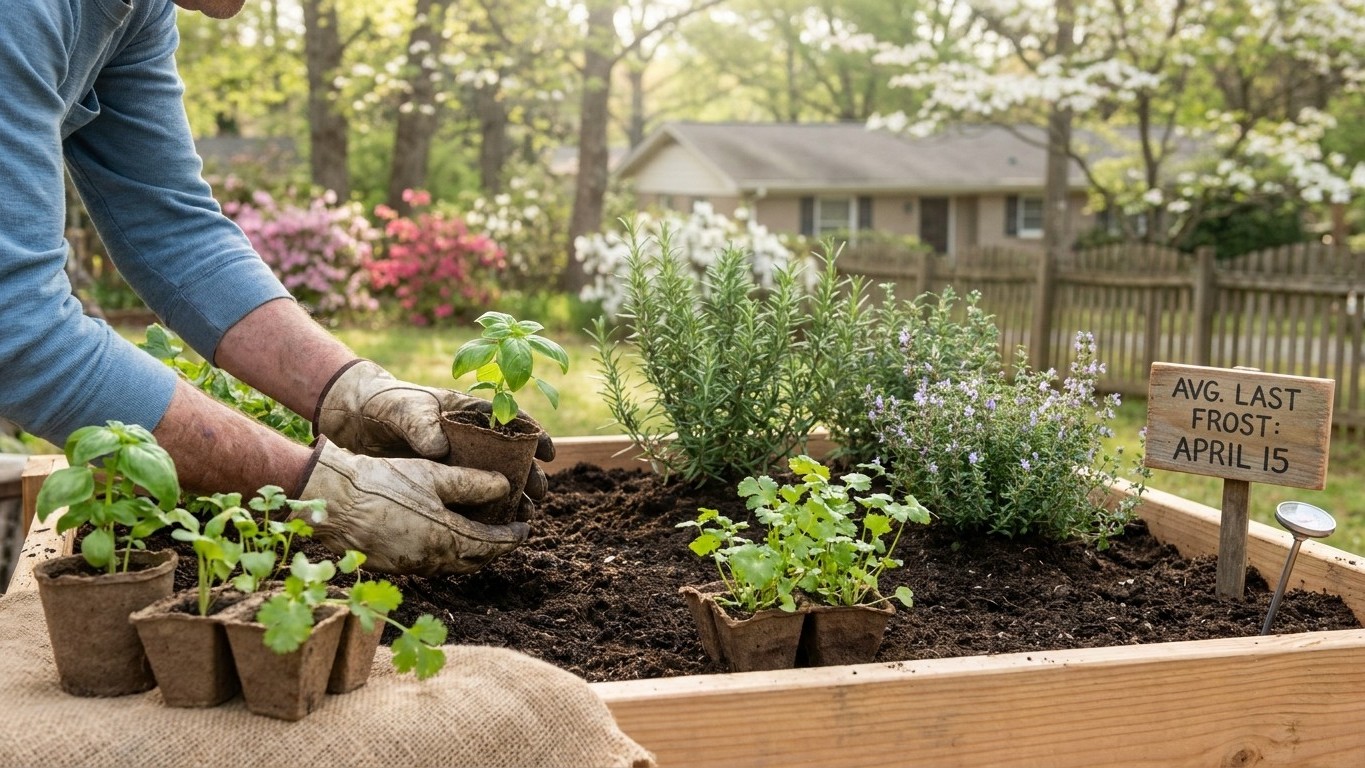

Missouri gardeners can start hardy herbs like chives, cilantro, and parsley outdoors between April 6 and April 20, once the risk of a 32°F freeze drops into the 30-70% range. Tender herbs like basil need to wait until well past that window, since their leaves turn black at the first light frost, not just a hard freeze.
The short answer for Missouri
The state’s last spring frost falls somewhere between April 6 and April 20, and the first fall frost arrives between October 18 and October 29, according to NOAA’s 1991-2020 Climate Normals for the Kansas City reference station. Those aren’t hard cutoffs. They mark the window where a 32°F freeze has a 30 to 70 percent chance of happening on any given day. Outside that window, the odds shift further in one direction or the other, but they never hit zero in early spring and never hit certainty in late fall.
That distinction matters for how you use the dates. Planting parsley or chives on April 6 doesn’t guarantee a frost-free start. It means you’re accepting roughly a coin-flip’s worth of risk on the early end of the window, tapering down as you move toward April 20. Gardeners who hate any frost risk plant closer to the back end of the window. Gardeners chasing an early harvest of cold-hardy herbs plant near the front and keep a bedsheet handy.
For herbs that shrug off a light frost, sowing seed directly into the ground around the early part of the window works fine. Chives, cilantro, dill, and parsley all tolerate temperatures a few degrees below freezing without much damage. Basil, on the other hand, needs soil that has warmed well past the frost-risk period, typically two to three weeks after the last frost date, because its growth stalls in cold soil even before a frost touches the leaves.
On the back end of the season, the same probability logic applies in reverse. The first fall frost window of October 18 to October 29 tells you when to start hardening off tender herbs or bringing potted rosemary indoors. Cold-hardy herbs like thyme and sage can often keep producing past that window, since a light frost only nips new growth rather than killing the plant.
None of these dates come from a station sitting in your backyard. They’re built from Kansas City’s climate record, and Missouri stretches roughly 300 miles north to south. That gap changes the calendar more than most gardeners assume, which is worth unpacking before you commit seed to soil.
What will not work here
Basil sown on the calendar’s earliest safe date is the most common mistake in Missouri gardens. Even after the 30-70% frost-risk window closes, soil temperature often lags behind air temperature by a week or two. Basil seed sitting in soil below the mid-60s Fahrenheit just rots or germinates so slowly that weeds outcompete it. Waiting until early-to-mid May, well past the frost window on the calendar, produces stronger plants than rushing the April dates that work for hardier herbs.
Woody Mediterranean herbs face a different problem: winter, not spring. The coldest month in Kansas City averages a daily minimum of 19.5°F. That’s not the record low. It’s the average low across the whole month, which means most winter nights dip into that range or colder. Rosemary varieties rated for USDA zone 8 or warmer routinely die outdoors here, even with mulch, because 19.5°F sits well below what those cultivars tolerate. Gardeners who plant rosemary as a permanent outdoor perennial in Missouri, expecting it to behave like it does in the Carolinas or the Gulf states, are usually replacing it every spring.
Missouri summers bring their own failure mode. Humid, muggy stretches from July through August create ideal conditions for fungal diseases in herbs planted at tight spacing. Basil crowded into a small bed develops downy mildew and fusarium wilt far more readily here than it would in a drier climate, because the leaves stay wet longer after rain or dew. Spacing plants for airflow matters more in Missouri’s humidity than the seed packet’s minimum distance suggests.
Herbs that need a long, cool growing season without much summer heat also struggle. Cilantro is the textbook case: it bolts to seed within weeks once temperatures push into the 80s, which happens early in a Missouri summer. A single spring planting rarely produces more than a few weeks of usable leaf before the plant switches to flowering and seed production. Succession sowing every two to three weeks, rather than one big spring planting, is the workaround, not a one-time fix.
What changes across Missouri
Missouri’s USDA hardiness zone spans 5b to 7b, based on the average annual extreme minimum temperature. That’s not a narrow range. A zone 5b winter can bottom out ten to fifteen degrees colder than a zone 7b winter in the same state, which changes what survives outdoors between growing seasons far more than it changes when you plant in spring.
The frost dates cited above come from the Kansas City station, but Kansas City International Airport sits well north of the downtown core, and the downtown station itself runs about five days earlier in spring. Southern Missouri, closer to the Arkansas border, is milder still, with both a later first fall frost and an earlier last spring frost than the numbers used here. A gardener in the Bootheel region can often push tender herbs into the ground a week or more ahead of what this page’s dates suggest, while a gardener near the Iowa line should expect the opposite.
What this means in practice: treat the April 6 to April 20 window and the October 18 to October 29 window as a starting reference tied to the Kansas City area, not a statewide rule. The direction of the adjustment is predictable, north runs later in spring and earlier in fall, south runs the reverse, but the size of the adjustment depends on exactly where in the state you sit.
For overwintering perennial herbs, the zone spread matters even more than the frost-date spread. A rosemary or lavender variety that limps through a 5b winter in northern Missouri might sail through a 7b winter in the southeast without protection. There is no single answer for the whole state on which herbs survive winter outdoors. There’s a spread, and where you land in it depends on your specific location within Missouri’s borders.
Where to check this for your own county
Missouri’s land-grant extension service publishes county-specific guidance at extension.missouri.edu, and that’s the next stop for anyone who wants a planting date sharper than the statewide range given here. State-level frost data averages together conditions from the Ozark plateau, the Missouri River valley, and the northern plains edge. County extension offices don’t have that problem, because their recommendations get built from local trial data and local frost records rather than a single reference station three hours away.
Look specifically for two things once you’re there. First, the local planting calendar for your county or region, which adjusts the frost-date window to match conditions closer to your actual garden rather than the Kansas City airport. Second, the list of herb and vegetable varieties that have been trialled in your county’s climate and soil, since a cultivar that thrives in the bootheel’s longer season may underperform in a shorter-season county further north.
A county recommendation beats a state recommendation every time, for a simple reason: it’s built from fewer miles of variation. Your county’s extension office narrows that range down to something closer to your actual backyard, and that narrower number is the one worth planting by.
If your county’s page doesn’t list herbs specifically, the vegetable planting calendar usually applies to the same frost-sensitivity categories. Cold-hardy herbs follow the same early-planting logic as leafy greens and brassicas, while tender herbs like basil follow the same logic as tomatoes and peppers.
If you follow the almanac, here is when to plant herbs by the moon. It is a tradition, not a proven method.
Checking this against your own garden
Every date here is an average built from decades of weather records. Your garden this year is one data point, and it can run a week or two ahead of or behind that average in either direction. Three simple checks beat any calendar for deciding when your specific plot is ready.
Feel the soil, not the air. Push a finger two inches into the bed where you plan to sow. If it feels cool and damp rather than cold, seeds like basil and cilantro will germinate reasonably fast. If it still feels chilly to the touch in mid-April, your particular spot, shaded, low-lying, or slow to drain, is running behind the neighborhood average, and waiting another week costs you nothing.
Watch for the first true leaves on anything you’ve already sown. Herb seedlings put out a pair of rounded seed leaves first, then a second set that actually looks like the plant’s mature foliage. That second set showing up strong and green, rather than yellowed or stalled, tells you the soil and air conditions in your yard are genuinely supporting growth, not just tolerating it.
For perennial herbs coming out of winter, look at new growth at the base of the plant rather than trusting a fixed date. Thyme, sage, and oregano that survived the winter will show fresh green shoots pushing up from the woody base once soil temperatures climb enough to matter. That new growth, on your specific plant in your specific spot, is a better signal than any regional frost date for when it’s safe to prune back the winter-damaged stems and expect real recovery.