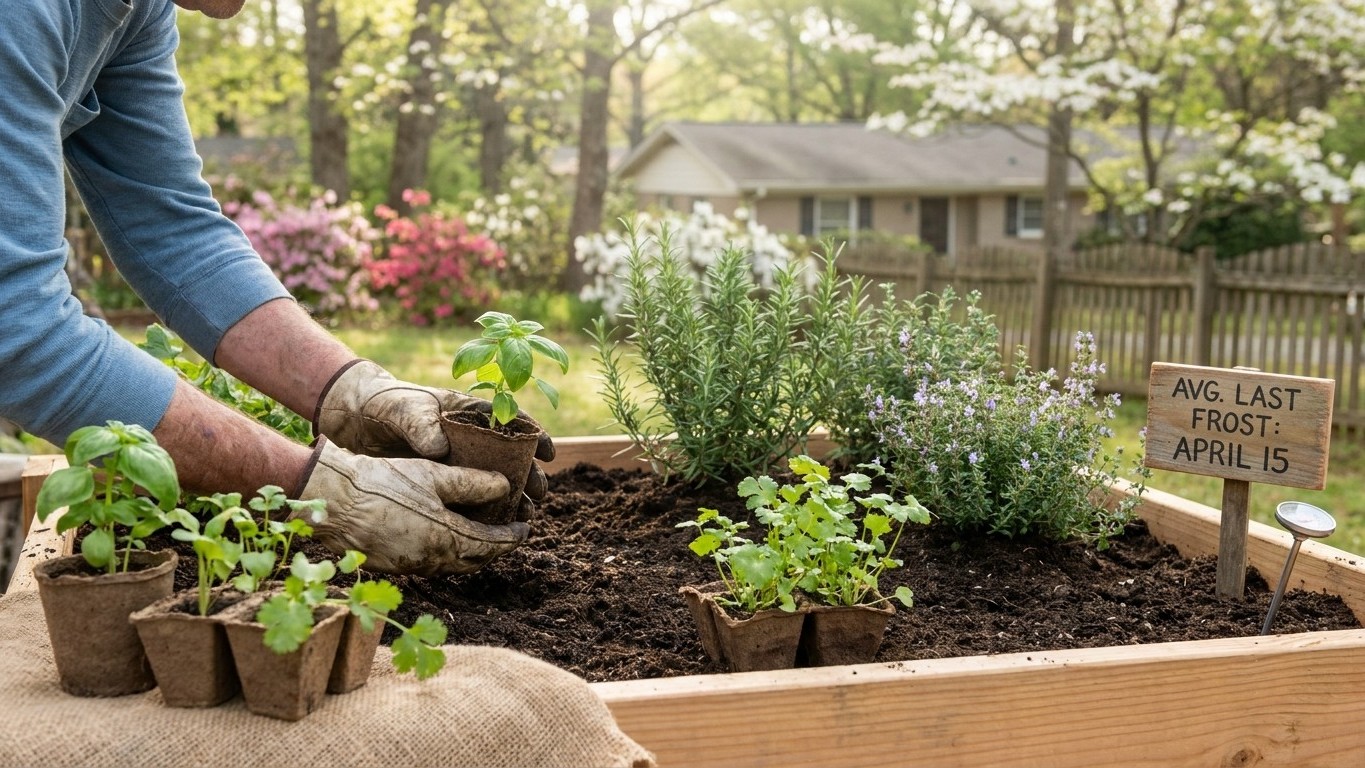

Nevada spans nearly seven USDA hardiness zones inside one set of borders, from low desert valleys to alpine basins, so there is no single date on which the whole state plants herbs. The window depends on where you garden: Las Vegas can start weeks before Reno, and a Carson City frost can linger long after Pahrump has moved on to summer crops.
The short answer for Nevada
The only Nevada frost data with enough history to quote comes from the Las Vegas airport station, and it puts the last spring freeze between January 7 and February 1 and the first fall freeze between December 8 and December 23, according to NOAA’s 1991-2020 Climate Normals. Those dates mark the 30 to 70 percent probability band for a 32°F freeze, meaning that on any given year there’s a real chance of frost outside that window too, not a guarantee it starts or stops exactly then.
Here’s the catch that makes those numbers nearly useless as a statewide planting guide: Las Vegas is a desert urban-heat-island extreme. Its winter lows average 39.6°F even in the coldest month, mild enough that some tender herbs barely notice January there. Reno, Carson City, and any Nevada garden with real elevation freeze months earlier in the fall and thaw out months later in spring than what that station records. Treating Las Vegas’s frost dates as “Nevada’s planting calendar” would send a Reno gardener out to transplant basil into ground that’s still solid with frost risk.
So the honest short answer is this: cool-season herbs like parsley, cilantro, and chives go in once your local last-frost date has passed, and warm-season herbs like basil go in once nighttime soil temperatures have stabilized above the mid-50s, but “your local last-frost date” in Nevada could mean early February in the low desert or late May at 5,000 feet. The state’s hardiness range of 4a to 10a is the tell. The next section points you to the tool that narrows it down for your county.
What will not work here

Two failure modes show up again and again in Nevada herb gardens, and both trace straight back to the numbers above. The first is planting tender herbs too early anywhere with real elevation. A gardener who reads about a mild Nevada winter and transplants basil or lemon verbena in March at altitude is gambling against a frost season that, away from the desert valleys, can run well into what feels like spring. Basil in particular turns black at the first touch of cold and won’t recover; there’s no replanting a mid-May freeze away.
The second failure mode is the opposite mistake: treating the low desert like anywhere else and watering herbs on a once-a-week schedule through a Las Vegas or Pahrump summer. A coldest-month low of 39.6°F tells you winter is mild in the reference station’s valley, but it says nothing about summer, and Nevada summers in the low deserts run hot and bone-dry. Herbs that need even soil moisture, cilantro especially, bolt to seed and turn bitter within days once heat stress hits. Rosemary and thyme tolerate that dryness; cilantro, chervil, and dill do not, and no amount of mulch fully substitutes for water they aren’t getting.
A subtler failure is choosing herbs by their seed packet’s generic “days to maturity” without checking whether your local frost-free season is long enough to deliver it. A short high-desert season defeats the slowest herbs outright, things like certain long-season sage or lavender varieties that need a full warm stretch to establish before their first winter. In a valley with a frost-free window measured in a few months rather than most of the year, planting something that needs 90 warm days to bulk up before frost is setting it up to fail, even if the seed germinates fine.
None of this means Nevada is a bad herb state. It means the two ends of the state fail for opposite reasons, cold at elevation and heat-plus-drought in the valleys, and a planting plan has to know which failure it’s actually up against.
What changes across Nevada
A hardiness range of 4a to 10a is not a rounding error; it’s one of the widest spreads any single state carries on the USDA map. Zone 4a means average extreme winter lows near -30°F, the kind of cold that kills back perennial herbs to the ground or further. Zone 10a means extreme lows rarely dropping below 30°F, mild enough to keep tender perennials like rosemary alive outdoors year-round without much fuss. Both of those zones exist inside Nevada’s borders, which is why a single statewide answer to “when do I plant” simply doesn’t hold up.
Practically, that spread means a gardener in the state’s high country, the mountain valleys and higher-elevation towns, should expect to shift almost everything weeks to months later in spring and earlier in fall compared with the low desert reference station. Perennial herbs that overwinter reliably in a milder zone, like rosemary or bay laurel left outside, may need container culture or winter protection at the colder end of that range. Annual herbs that get two full growing cycles in a long desert season might only manage one at elevation.
Guessing which zone your own yard falls into is exactly the kind of guess that gets someone’s basil frosted. The USDA Plant Hardiness Zone Map is built for that lookup: enter a ZIP code, get the zone tied to that specific location, not the state-level range. Nevada’s spread is the reason that step matters more here than it would in a smaller, more climatically even state.
Where to check this for your own county
The state-level numbers exist to explain the mechanism, not to replace a local recommendation. For the actual planting dates that apply to your county, the University of Nevada, Reno Extension is the source built for that job.
Once there, look for two specific things rather than browsing generally. First, a county-level or regional planting calendar, which will translate the frost-date mechanics discussed above into actual sowing and transplant windows for your part of the state, whether that’s the Truckee Meadows, the Carson Valley, or the southern desert counties. Second, look for variety trial results or recommended cultivars for your area specifically. An herb variety that thrives in a Reno extension trial, bred to handle a shorter season and colder nights, may outperform a generic seed-packet variety that was never tested against Nevada conditions at all.
A county recommendation beats a state one every time, because it’s built from local frost records, local soil, and local trial data rather than a single reference station’s history.
Checking this against your own garden
Every date, and every date the extension office gives you, is still a probability built from decades of averages. Your own garden this year can run ahead of or behind that average, and three simple checks tell you which.
Feel the soil with your hand a couple inches down before transplanting anything heat-loving like basil. If it feels cold to the touch even on a sunny afternoon, the soil hasn’t caught up to the air temperature yet, and warm-season herbs will sit and sulk rather than grow, no matter what the calendar says. Second, watch any herbs that self-seeded or overwintered from last year, cilantro, dill, or parsley volunteers are common in Nevada gardens. Their first true leaves emerging tell you the soil has warmed enough to support germination right where you’re standing, which is a more local answer than any zone map.
Third, watch for early bolting, the sudden shooting up of a flower stalk, on cool-season herbs like cilantro once the weather turns warm. That’s your garden’s own signal that heat has arrived hard and fast, often earlier in a low desert valley than the calendar average would suggest. None of these checks require a thermometer or a soil probe, just attention paid to what’s already growing, and in a state with as much microclimate variation as Nevada, that attention is worth more than any single date.
The Moon calendar is a separate, older custom: see when to plant herbs by the moon, written as tradition rather than fact.