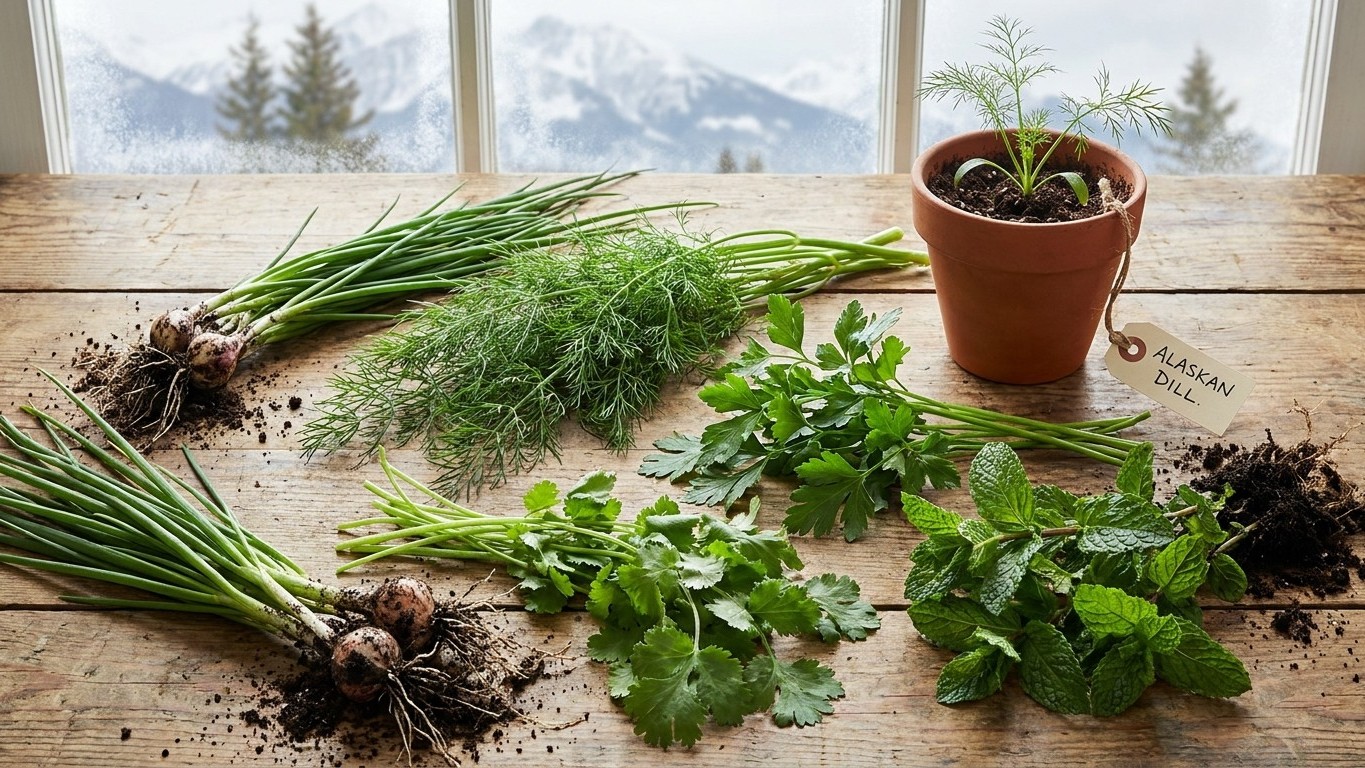

New Jersey gardeners get somewhere between seven and eight months of frost-free ground, enough for basil, dill, and cilantro to run their whole life cycle more than once. But the state’s winter minimums, not its summer length, decide which herbs you can leave in the ground year after year. Woody perennials like thyme and sage shrug off a Newark-area cold month averaging 25.5°F. Rosemary and French tarragon sit much closer to the edge, and drainage matters as much as cold.
The short answer for New Jersey
Do the math on Newark’s own frost data and the frost-free window runs somewhere between 212 and 232 days, depending on where a given year falls inside NOAA’s 30 to 70 percent probability band for last spring frost (March 29 to April 6) and first fall frost (November 4 to November 16). That’s a wide, forgiving stretch for most kitchen herbs, which is why the real decision in New Jersey is less about season length and more about which herbs can survive the winter in the ground versus which ones need to be treated as annuals or brought indoors.
Annual, tender herbs, basil, cilantro, dill, are the easy call. They only need 60 to 90 days to first harvest, so even the shorter 212-day version of the season leaves room for two or three succession sowings. Hardy perennial herbs, thyme, sage, chives, oregano, and most mints, are rated for winters colder than what Newark’s climate normals report, so a coldest-month average minimum of 25.5°F leaves them well inside their comfort zone across the state’s 6a to 7b range (USDA Plant Hardiness Zone Map, 2023). Rosemary, French tarragon, and bay laurel are the borderline cases: hardiness ratings put some rosemary cultivars near the edge of zone 6, but it’s usually wet winter soil, not the cold itself, that finishes them off. Parsley, a biennial, behaves like an annual in most gardens here but can limp through a mild winter and bolt to seed the following spring.
| Herb type | Examples | Survives NJ winter in ground? | Best approach |
|---|---|---|---|
| Tender annual | Basil, cilantro, dill | No | Sow after last frost, succession plant |
| Hardy perennial | Thyme, sage, chives, oregano | Yes, statewide | Plant once, mulch lightly |
| Borderline perennial | Rosemary, French tarragon, bay laurel | Only with good drainage or protection | Raised bed, container, or winter mulch |
| Biennial | Parsley | Sometimes, mild years | Treat as annual, replant yearly |
What will not work here

Lemongrass and other tropical or tender perennial herbs are the clearest no. A coldest-month average minimum of 25.5°F is nowhere near what these plants tolerate, and an occasional harder freeze during that window makes outdoor overwintering a non-starter anywhere in the state. If you want lemongrass or scented geraniums past one growing season, they need to come indoors before the first fall frost arrives, which at the Newark reference station lands somewhere between November 4 and November 16.
French tarragon fails in New Jersey for a different reason than cold. It’s a humidity problem. New Jersey summers, especially the stretch from July through August, bring the kind of sticky, still air that encourages root and crown rot in any soil that doesn’t drain fast. The same mechanism takes down lavender in the heavier clay-loam soils common through central Jersey, and it’s often what finishes off in-ground rosemary over winter, not the cold itself but soggy crowns that freeze and rot together.
Basil planted too early is a self-inflicted failure. Cold soil below roughly 50°F stunts basil seedlings or kills them outright, so sowing or transplanting before the tail end of the spring frost window (April 6 at the latest, per Newark’s data) is a common mistake that has nothing to do with air temperature and everything to do with what’s happening at root level.
Tight spacing is another quiet killer here. Humid New Jersey summers push powdery mildew hard on basil, bee balm, and mint planted shoulder to shoulder. Herbs that would tolerate close spacing in a drier climate need real airflow here, which means wider rows and thinner plantings than a seed packet grown for a Western state might suggest.
What changes across New Jersey
New Jersey spans USDA hardiness zones 6a through 7b, which is not a small spread. That range roughly reflects a 10 to 15 degree difference in average extreme minimum winter temperature between the coldest and mildest corners of the state, enough to change which borderline herbs are worth risking in the ground. There is no single statewide answer for rosemary, bay laurel, or French tarragon.
The northern highlands and higher inland elevations skew toward zone 6a, with colder pockets and typically a later thaw than the Newark reference dates suggest. Gardeners there should expect the practical frost-free season to run shorter than the 212 to 232 day range calculated from Newark’s normals, and should treat any borderline perennial as an annual unless it’s sheltered against a south-facing wall.
The southern counties and the immediate coastal strip skew toward 7b, with milder winters that make it more realistic to keep rosemary, and occasionally even bay laurel, in the ground with a decent mulch layer. Even within that milder end, though, drainage still decides more than the thermometer does.
Because the state covers that much ground, this page can’t tell an individual reader which zone applies to their own yard. The USDA Plant Hardiness Zone Map is the tool for that, and it’s worth checking against your specific address rather than assuming the Newark station represents your garden.
Where to check this for your own county
Rutgers Cooperative Extension, run through the New Jersey Agricultural Experiment Station, is the state’s land-grant extension service and the right next stop for county-level information: njaes.rutgers.edu.
Two things are worth looking for once you’re there. First, a county-level planting calendar, which will reflect local frost patterns more accurately than the single Newark station this page relies on, especially if you garden inland, at elevation, or along the shore where salt air and wind shift the numbers again. Second, any variety trial results specific to herbs, since Rutgers and county offices periodically test cultivars of basil, rosemary, and other borderline herbs under actual New Jersey conditions rather than a generalized hardiness rating.
A county recommendation will always beat a state-level one. This page is deliberately the state-level version, built from a single reference station’s climate normals and a statewide hardiness range. It’s a reasonable starting point, but your county extension office has data specific to your soil, your microclimate, and the varieties that have actually performed well nearby.
Checking this against your own garden
Every date and figure on this page comes from a weather station, not your backyard, and your own observation will beat all of it once the season gets underway.
Start with soil warmth by feel. Push a finger a few inches into the bed where you plan to sow basil or cilantro. If it still feels cold and damp rather than just cool, the soil hasn’t caught up to the calendar yet, regardless of what the frost dates say.
Watch how quickly your perennial herbs, thyme, sage, chives, push new growth after winter. Early regrowth compared to what you’d expect from the Newark reference dates suggests your spot runs warmer than the station data, maybe a south-facing slope or a wall that holds heat. Late regrowth suggests a cold pocket, and it’s a signal to hold off on anything borderline like rosemary next winter.
Finally, keep an eye on bolting in cool-season herbs like cilantro. If it throws up a flower stalk earlier than the seed packet promises, heat is arriving in your specific spot faster than the general date range suggests, and next year’s sowing should move up to compensate.