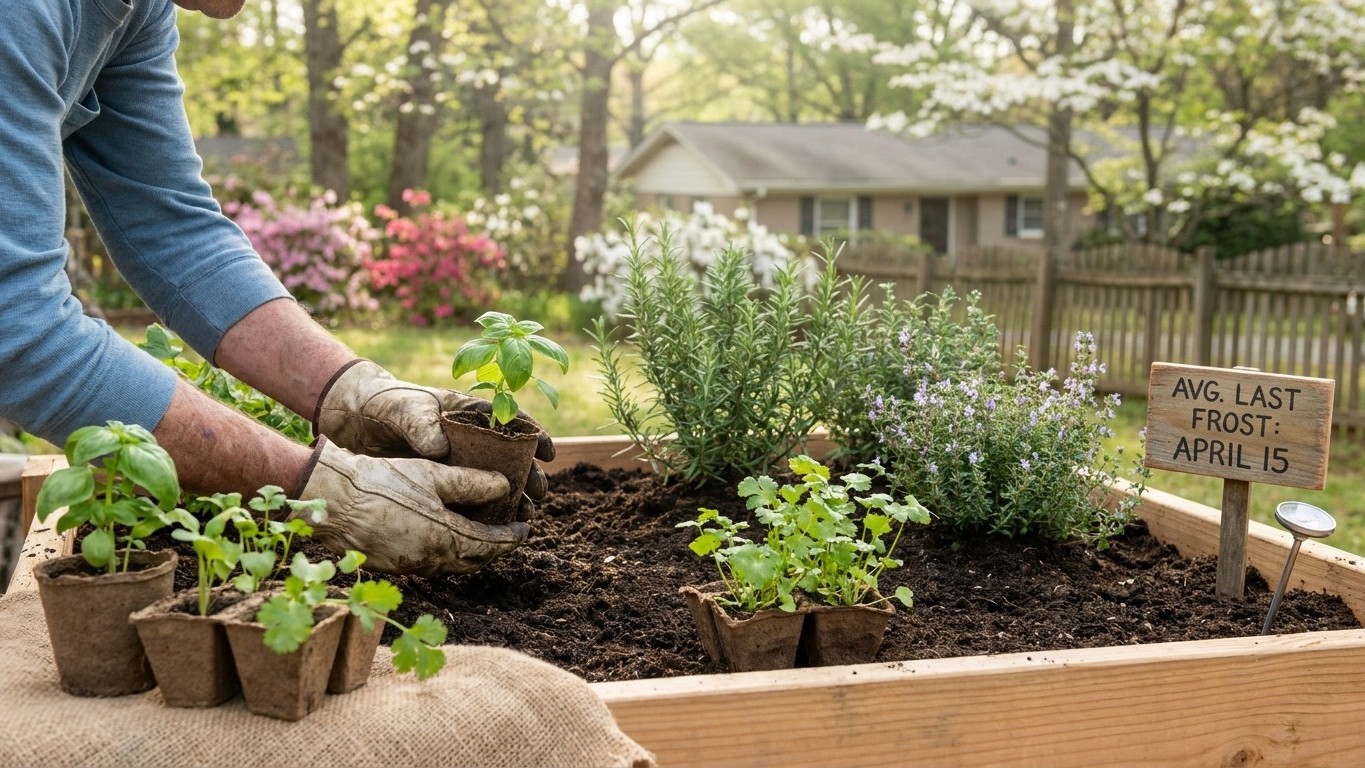

Herb seeds and transplants go into New Jersey soil once the last spring frost has passed, typically between March 29 and April 6 for cold-tender basil and cilantro, while hardy herbs like parsley and chives can go in three to four weeks earlier. The exact week depends on where in the state you garden and how that spot compares to the reference weather station used for these dates.
The short answer for New Jersey
The frost dates that anchor this calendar, March 29 to April 6 for the last spring freeze and November 4 to November 16 for the first fall freeze, come from NOAA’s 1991-2020 Climate Normals recorded at the Newark airport station. These aren’t fixed calendar days. They mark a 30 to 70 percent probability band for a 32°F freeze, meaning there’s a real chance of frost on either side of that window, not a guarantee that frost stops on April 6 and starts again on November 4.
That probability matters more than gardeners usually think. A tender herb like basil, sweet marjoram, or Thai basil can be knocked flat by one unlucky night even after the “safe” date arrives. The practical move is to treat early April as the earliest reasonable start for tender herbs, not the target date, and to hold transplanting until closer to mid-April if you want the odds solidly in your favor.
Hardy herbs play by different rules. Parsley, chives, cilantro, and dill tolerate light frost and can go into the ground two to three weeks before that last-frost window closes, sometimes even in late March in a mild year. Perennial herbs that are already established, like thyme, oregano, sage, and established chive clumps, break dormancy on their own schedule and don’t need to wait for a planting date at all; they respond to soil temperature, not the calendar.
On the back end of the season, the first fall frost arriving between November 4 and November 16 sets the cutoff for a second sowing of quick annual herbs like cilantro or dill, and it’s the signal to bring potted rosemary, bay, or lemon verbena indoors before a hard freeze. Between the last spring frost and the first fall frost, New Jersey’s reference station shows a growing season stretching from roughly late March/early April through early-to-mid November, which is enough time for nearly every common culinary herb to complete at least one full harvest cycle, provided the summer heat and humidity don’t get in the way first.
What will not work here

New Jersey’s growing season isn’t the limiting factor for most herbs; the season is long enough. What actually trips gardeners up here falls into two categories: winter cold that certain perennials can’t survive, and summer conditions that punish the wrong technique.
Winter cold rules out some perennials outright
The state’s hardiness zone spans 6a to 7b under the USDA system, which is built on one number: the average annual extreme minimum temperature. Combine that with the coldest month’s mean daily minimum of 25.5°F at the Newark reference station, and you get a clear answer for a few popular herbs. Rosemary, which is reliably hardy only from about zone 7 upward depending on variety, survives outdoors year-round in the milder 7b pockets near the coast but dies back or dies outright in the colder 6a stretches inland and to the north. Bay laurel is even less forgiving and needs to come indoors for winter almost everywhere in the state. Gardeners who plant these as if they were permanent landscape shrubs, without a container plan or winter protection, are setting themselves up for a spring replant.
Summer heat and humidity punish the wrong watering and spacing habits
New Jersey summers bring stretches of heat paired with high humidity, especially in the interior and south, and that combination fails two common shortcuts. Watering once a week and walking away works in a drier climate; here, it leaves shallow-rooted herbs like basil and cilantro wilting on the hottest afternoons because the soil dries faster than the schedule assumes and roots never establish depth. The fix is watering by feel, checking the top two inches of soil, rather than by a fixed weekly ritual.
Tight spacing is the other failure point. Basil, oregano, and mint planted shoulder to shoulder trap humid air between leaves, and that stagnant moisture is exactly what fungal diseases like powdery mildew and basil downy mildew need to take hold. Giving plants more room than the seed packet suggests, and pruning for airflow, matters more in New Jersey’s humid months than in a drier state where the same spacing would be fine.
What changes across New Jersey
New Jersey is not one garden, and the hardiness zone range makes that plain: 6a in the coldest interior and northern highland areas, up to 7b along parts of the southern coast and near Delaware Bay. That’s a real spread, not a rounding error, and it means there is no single frost date or winter-survival answer that applies to the whole state equally.
A zone 6a garden sees colder winter extremes, an average annual minimum in the -10°F to -5°F range, and it should treat marginal perennials like rosemary, tender lavender varieties, and bay laurel as container plants that come inside every winter, no exceptions. A zone 7b garden, by contrast, sits in the 5°F to 10°F extreme minimum range, mild enough that some of those same herbs can be tried in a sheltered, south-facing spot outdoors, particularly near the coast where the ocean moderates winter lows.
The spring planting window shifts too, even though the reference dates in this article come from one station. Higher elevation and interior locations, especially in the northwest, tend to warm up later in spring and cool down earlier in fall than the Newark-area numbers suggest, sometimes by a week or two. A gardener in the Pine Barrens or along the immediate coast is working with a different clock than one in the northern highlands, even though both are technically “New Jersey.”
What it can do is point to the USDA Plant Hardiness Zone Map, where entering a ZIP code gives the specific zone for that address rather than the state’s full range.
Where to check this for your own county
A statewide planting calendar smooths over real differences between a Sussex County garden and one in Cape May, and county-level guidance from a land-grant university extension office will always beat a state-level generalization because it’s built from local trial data and local frost records rather than one airport station.
Rutgers Cooperative Extension, part of Rutgers New Jersey Agricultural Experiment Station, is the state’s land-grant extension service and the right place to go next: njaes.rutgers.edu. Two things are worth hunting for there. First, a county-specific or regional planting calendar, if the county office publishes one, will reflect local frost patterns more accurately than the reference-station dates used here. Second, look for herb variety trial results or recommended cultivar lists specific to New Jersey growing conditions; these often flag which basil, rosemary, or thyme varieties have shown better disease resistance or cold tolerance in the state’s particular humidity and winter pattern, information a generic seed catalog won’t give you.
County extension offices, reachable through the Rutgers NJAES site, also field direct questions from home gardeners and can speak to conditions specific to your township in a way no article, including this one, is positioned to do.
Checking this against your own garden
Every date here is a probability drawn from one weather station’s thirty-year average. Your own garden, with its specific soil, sun exposure, and microclimate, is a better source of truth than any calendar once the season actually starts. Three things to watch outrank the printed dates.
- Soil warmth by feel: push a finger two to three inches into the planting bed. If it feels cold and damp rather than merely cool, tender herb seeds like basil will sit and rot rather than germinate, regardless of what the calendar says.
- New growth on established perennials: when overwintered thyme, oregano, or chives push visible new green shoots, that’s the plant itself confirming the soil has warmed enough to support active growth in your specific spot, sun exposure and all.
- First true leaves on seedlings: the initial pair of leaves after germination are seed leaves, not true leaves. Once the second, more mature-looking set appears, the plant has enough root and leaf structure to handle a slightly cooler night without setting back growth, a useful signal for deciding when it’s safe to move seedlings outdoors.
None of these require a thermometer or a soil probe, just attention. A garden tucked against a south-facing wall will run warmer and earlier than the state average suggests; a low spot that collects cold air on clear nights will run colder and later. Watching your own plants respond is the fastest way to learn which side of New Jersey’s range your particular yard falls on.
Some gardeners also time this by the Moon: when to plant herbs by the moon, as almanac tradition rather than fact.