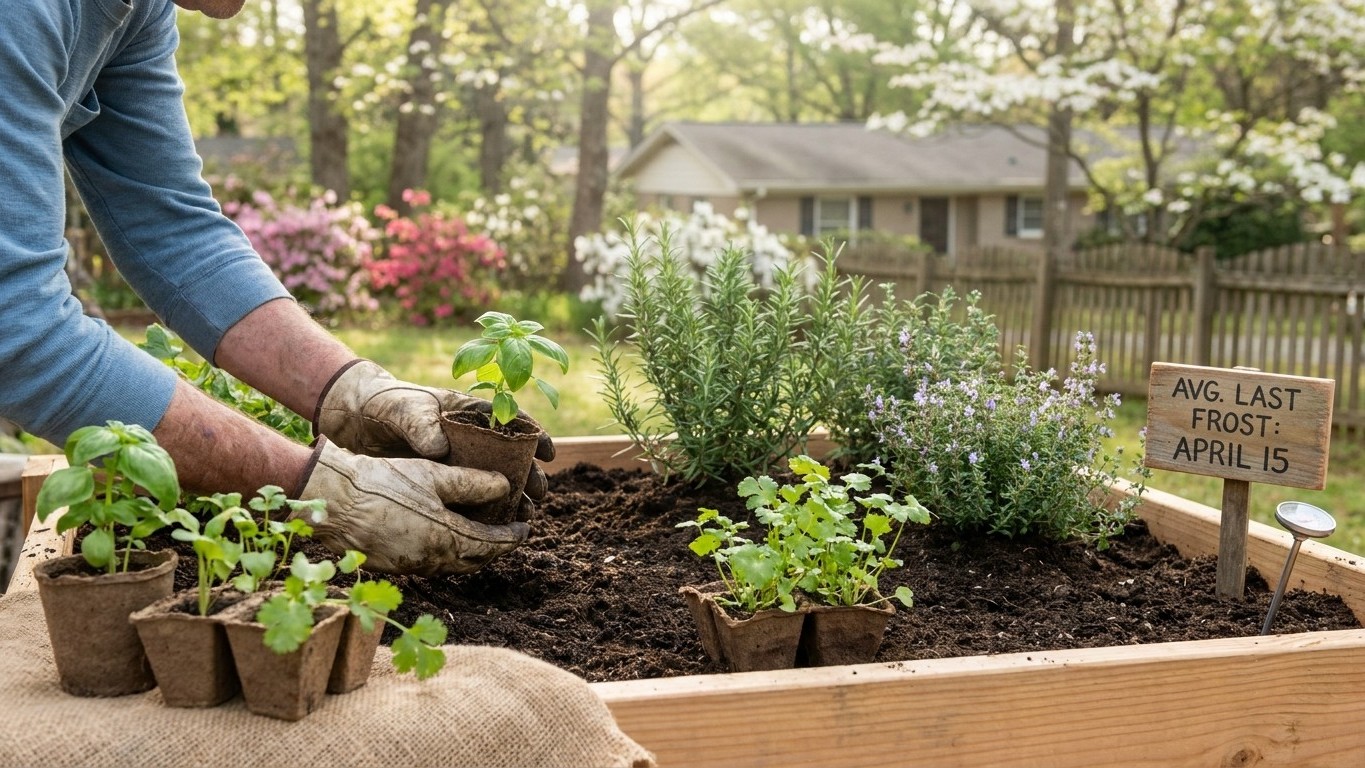

Oklahoma’s frost-free window runs roughly from early April to early November at the reference station in Oklahoma City, but the state’s herb garden really lives or dies on summer heat, not spring cold. Tender herbs go in after the last frost date passes; hardy perennials like sage and thyme can go in weeks earlier.
The short answer for Oklahoma
NOAA’s 1991-2020 climate normals put the last spring frost (32F) at Oklahoma City between March 28 and April 10, and the first fall frost between October 29 and November 8. Those dates mark a 30-70% probability band, not a guarantee. There’s still a real chance of frost after April 10 and before October 29 in any given year, which is why experienced gardeners in this state treat the window as a target range, not a calendar deadline.
For tender annual herbs like basil, cilantro grown for tender leaf, and dill, wait until after that spring frost window closes, then give the soil another week or two to warm before setting out transplants. Basil in particular sulks and yellows if soil temperatures sit in the 50s, so early April in most of the state is still too cool for it even once frost risk fades. Mid-to-late April is the more realistic target for basil transplants at the Oklahoma City reference point.
Hardy perennial herbs work on a different clock. Sage, thyme, oregano, and chives tolerate a light frost and can go into the ground two to three weeks before that last frost date, provided the soil isn’t waterlogged. These are the herbs that reward an impatient gardener: get them established while the air is still cool and they’ll be tougher through the first heat wave.
Parsley and cilantro grown for seed (coriander) split the difference. Both prefer cool soil and bolt fast once temperatures climb, so the practical move in Oklahoma is to sow them in that same late-March-to-early-April window, right alongside the frost date, rather than waiting for warmer soil the way basil needs.
For a fall crop, count backward from the first fall frost. Cilantro and parsley for a fall harvest can go in during late August, giving them roughly nine to ten weeks before that October 29-November 8 window arrives.
What will not work here

The single biggest failure mode for herbs in Oklahoma isn’t frost. It’s summer. The coldest month’s mean daily minimum at the Oklahoma City reference station sits at 27.0F, which is mild enough that most perennial herb roots survive winter without much drama in the warmer parts of the state’s zone range. The bigger threat is what happens from June through August, when daytime highs regularly punch past 95F and humidity swings from bone-dry to sticky depending on the week.
Basil planted too early and left to limp through a cool April, then hit with a sudden 90-degree week in May, tends to bolt to flower and lose leaf quality fast. The fix isn’t a different variety so much as timing: waiting until soil has genuinely warmed avoids the stunted start that later turns into premature flowering under heat stress.
Cilantro is the herb most commonly given up on in this state, and the reason is almost always heat, not frost. Cilantro bolts to seed once temperatures consistently sit above the mid-70s, which in much of Oklahoma happens by late May. Anyone sowing cilantro in April and expecting a summer-long harvest is fighting the plant’s own biology. The workaround is treating it as a short-lived spring and fall crop, not a season-long one.
Herbs that like consistent moisture and modest spacing, like mint or parsley planted too close together, run into trouble in Oklahoma’s humid stretches, particularly in the eastern half of the state. Tight spacing traps moisture around the base of the plant, and combined with summer humidity that invites fungal issues like leaf spot. Wider spacing than a seed packet suggests, especially for anything grown in a spot with limited afternoon airflow, tends to hold up better through a wet July.
Rosemary is the other common disappointment, though for a different reason. It’s borderline hardy across parts of Oklahoma’s zone range, and a rosemary plant that survives a mild winter can still be killed by a hard cold snap in a year when temperatures drop well below that 27.0F coldest-month average. Gardeners in the cooler parts of the state’s range treat rosemary as an annual or bring pots indoors rather than counting on it as a permanent perennial.
What changes across Oklahoma
Oklahoma is not one climate. The USDA Plant Hardiness Zone Map, built on average annual extreme minimum temperatures from the 1991-2020 normals, places the state across a genuinely wide spread: zone 6a in the cooler northern panhandle areas up to zone 8a in the milder southeastern and south-central parts of the state. That’s a two-zone difference within a single state’s borders, and it matters for which perennial herbs survive winter without protection.
A gardener in the 8a range can generally leave rosemary, and even some of the less hardy thyme varieties, in the ground year-round with only minor winter dieback. A gardener toward the 6a end needs to treat those same plants as far more marginal, either mulching heavily, growing in containers that come indoors, or simply replanting some perennials as annuals each spring.
Areas north and west of that reference point should expect both a later last spring frost and an earlier first fall frost than the March 28-April 10 and October 29-November 8 windows cited here. Areas at higher elevation, which in Oklahoma mostly means the western panhandle region, see the same pattern intensified: shorter frost-free seasons than the state’s own reference city.
There’s no single sowing date that covers a state spanning two full USDA zones. The USDA’s official Plant Hardiness Zone Map, searchable by ZIP code, is the tool for that.
Where to check this for your own county
Everything above comes from one weather station and one statewide zone map. Neither replaces a local recommendation, and Oklahoma has a better source available for free: the Oklahoma State University Extension service.
OSU Extension maintains county offices across the state, and each one works from data specific to that county rather than a single reference station in Oklahoma City. That distinction matters more in Oklahoma than in a lot of states, given the roughly two-zone spread already described. A county in the panhandle and a county in the southeast are simply not gardening on the same calendar, and a state-level page like this one can’t resolve that gap.
When looking up a county’s extension office, search for two things specifically. First, a local or regional planting calendar, which will adjust the frost-date windows above to reflect actual local conditions rather than a single airport station. Second, look for any variety trial results or recommended cultivar lists for herbs. Extension offices and university horticulture programs regularly test which basil, cilantro, or perennial herb varieties hold up best to local heat, humidity, and soil conditions, and those trial results are far more useful than a generic variety name from a seed catalog.
A county-level recommendation beats a state-level one every time, for the simple reason that it’s built on more relevant data. A county extension agent works from local soil temperature logs, local frost records, and local variety performance. That’s not a knock on a state-level starting point. It’s just an acknowledgment of what a state-level resource can and can’t do, and OSU Extension’s county network exists specifically to fill that gap.
Checking this against your own garden
Every date here is a probability built from decades of station data, not a promise about this particular spring in this particular yard. The soil in a raised bed against a south-facing wall warms differently than soil in an open, low-lying garden a mile away, even within the same county. Three things a gardener can check without any special equipment tend to say more than any calendar.
First, soil warmth by feel. Push a bare hand a few inches into the planting bed in the morning. If the soil still feels cold and slightly damp in a way that lingers, like a spring morning that hasn’t warmed up yet, it’s too early for basil and other tender herbs regardless of what the calendar says. Soil that feels closer to room temperature, even in the top few inches, is a better sign that transplants will actually grow rather than sit and sulk.
Second, watch existing perennial herbs already in the ground, if there are any. New growth pushing out on sage, thyme, or chives that survived winter is a decent sign the ground has warmed enough for related plantings nearby. If those perennials are still fully dormant, the microclimate in that spot is running cooler than the general county average, and tender herbs should probably wait.
Third, in fall, watch for the first morning the grass or garden foliage shows a light frost sheen at sunrise, even a faint one that melts within an hour. That’s a more reliable local signal than the October 29-November 8 window cited for the reference station, because it reflects what’s actually happening in that specific yard rather than an airport several miles away. A yard that gets that first light frost noticeably earlier than the state’s cited window sits in a cooler microclimate and should plan its next spring’s planting a little later.
Some gardeners also time this by the Moon: when to plant herbs by the moon, as almanac tradition rather than fact.