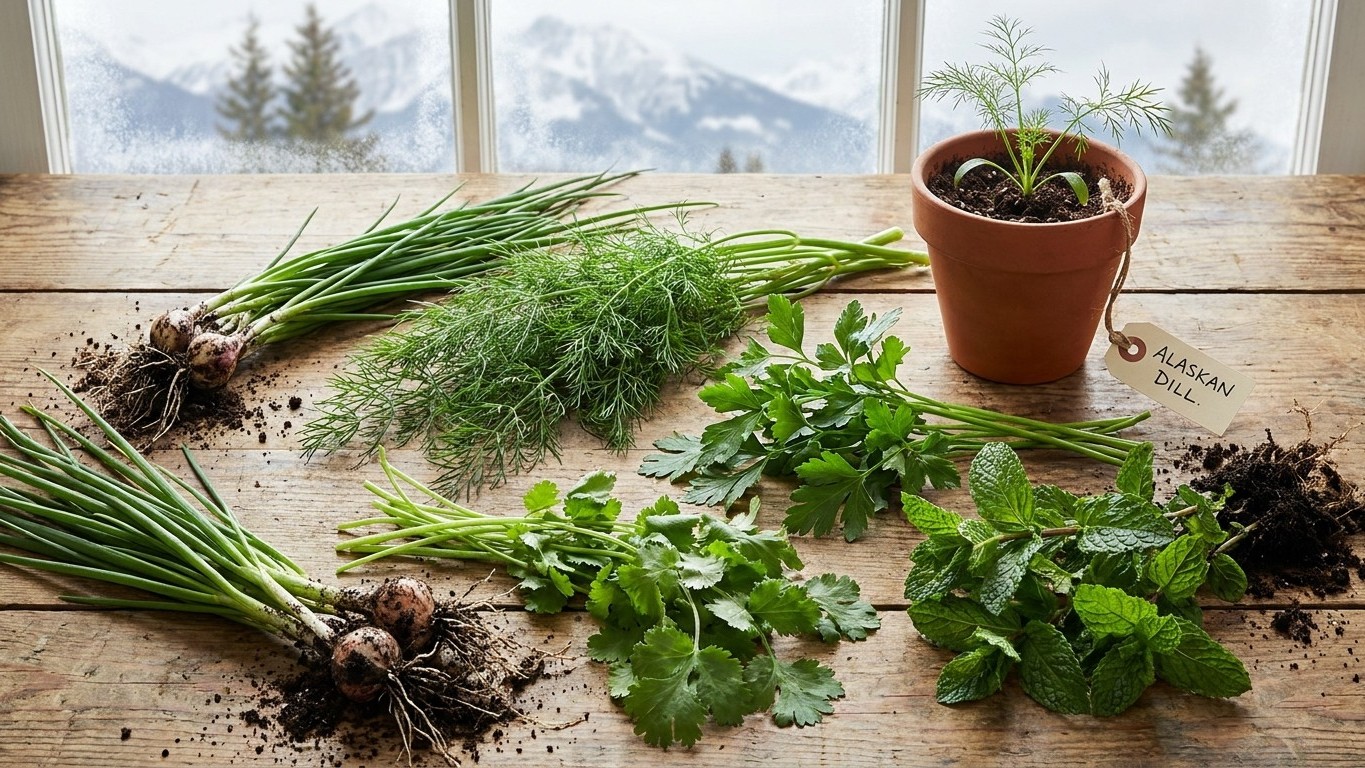

Ontario’s growing season runs about 169 days between the mean frost dates recorded at Toronto Pearson (April 30 to October 16), inside a Canadian hardiness zone of 7a for that reference station. That window rules out true tropical herbs and most woody Mediterranean perennials grown outdoors year-round, but it’s generous enough for hardy perennials like chives, thyme, and oregano, plus classic annuals such as basil, dill, and parsley. Which group you pick depends on whether you want something that comes back every spring or something you replant each year.
The short answer for Ontario
Start with the math, because it decides everything else. April 30 to October 16 is 169 days on the calendar, and that’s the average frost-free stretch at the Pearson station, not a guarantee. Environment and Climate Change Canada’s own normals mean that in roughly half of all years, frost arrives after April 30 or before October 16. Treat the window as a midpoint, not a safe date, and build in a buffer of a week or two on both ends if you’re transplanting anything tender.
Inside that 169-day frame, three categories of herbs make sense for Ontario gardens, and the decision comes down to what each one needs to finish its life cycle or survive the winter.
Herbs by type
| Type | Examples | Why it fits Ontario |
|---|---|---|
| Hardy perennials | Chives, thyme, oregano, sage, mint | Survive winter in Canadian zone 7a; the coldest month’s mean minimum of 13.6°F doesn’t threaten their root systems |
| Warm-season annuals | Basil, dill | Complete a full crop cycle well within 169 days once soil has warmed past frost risk |
| Cool-season annuals or biennials | Parsley, cilantro | Tolerate a cooler start and light frost at either end of the season, stretching usable growing days |
Chives are close to foolproof here: they’re one of the hardiest culinary herbs sold in Canada, and a 13.6°F mean minimum in the coldest month is well inside their comfort range. Basil sits at the other extreme. It needs soil that’s genuinely warm, not just frost-free, so pushing a transplant out right at the April 30 average is asking for stunted growth even if frost never touches it. Parsley and cilantro split the difference: they’ll take a light frost without dying, which means gardeners can sow earlier than the mean date and again in late summer for a fall crop before October 16 shuts things down.
What will not work here

The 169-day window and the 13.6°F winter minimum together eliminate a specific set of herbs, and it’s worth naming them rather than leaving readers to find out the hard way.
Cold kills what the season doesn’t
Rosemary and bay laurel are the two most common disappointments in Ontario herb gardens. Both are woody Mediterranean perennials bred for winters far milder than a mean coldest-month minimum of 13.6°F. Even a mature, well-established rosemary plant left outdoors through an Ontario winter is likely to die back to the ground or die outright, because that figure describes the average nightly low in the coldest month, not an occasional cold snap. The practical fix is growing both in containers and moving them indoors before the first hard frost, or treating them as annuals and starting fresh each spring.
Lemongrass, turmeric, and ginger fail for a different reason: 169 days isn’t enough runway. These are herbs that need a long stretch of sustained heat to bulk up rhizomes or stalks, and Ontario’s season, even at its most generous, doesn’t deliver the accumulated warmth those crops get in their native ranges. They can be grown in pots and treated as houseplants for part of the year, but they won’t establish as reliable outdoor perennials.
Humidity punishes crowding
Southern Ontario summers run humid, not dry, which flips a common piece of herb-garden advice on its head. Gardeners who plant basil at tight spacing to maximize a small bed often see downy mildew move through the row by midsummer, because damp air sits too long between crowded plants and never fully dries the leaves. Mint suffers a similar fate in dense, poorly ventilated clumps, developing rust spots that weaken the plant even though mint itself is otherwise nearly indestructible here. Wider spacing than a seed packet suggests, and a bed that gets morning sun to dry dew quickly, does more to prevent these problems than any spray.
What changes across Ontario
None of the numbers above describe the whole province, and that’s worth saying plainly. The 7a Canadian hardiness zone cited here belongs to the Toronto reference station used by Natural Resources Canada, and Ontario stretches roughly 1,000 miles from its southernmost tip near Lake Erie to its northern reaches along Hudson Bay. A province that size does not have one climate, and it does not have one hardiness zone. Southwestern Ontario and the Niagara region tend to run milder than the Toronto figures suggest, while central and northern Ontario drop into noticeably colder zones, sometimes by several full zone steps.
The same spread applies to frost dates. A gardener well north of Toronto should expect a later average last spring frost than April 30 and an earlier average first fall frost than October 16, which shrinks the 169-day window described above. How much it shrinks depends on latitude, elevation, and proximity to the moderating effect of the Great Lakes, none of which show up in a single provincial average.
Because Ontario spans several hardiness zones rather than sitting inside one, there’s no single zone number that applies to a reader based on province alone. Natural Resources Canada maintains the official plant hardiness map for exactly this reason, and checking it by location is the only way to know which zone actually applies to a specific garden.
Where to check this for your own county
Provincial averages pulled from one weather station are a starting point, not a final answer for any specific garden. Ontario’s own agricultural resources, published through the Ministry of Agriculture, Food and Rural Affairs at ontario.ca/page/agriculture-and-food, break planting guidance down by region rather than treating the province as one climate zone.
Two things are worth looking for there specifically. First, a regional or county-level planting calendar, which will reflect actual local frost timing rather than the Pearson airport average. Second, information on herb and vegetable varieties that have actually been trialled in that specific county or growing region, since a variety that performs well in the Niagara Peninsula’s longer, milder season may struggle in a shorter-season district further north or inland.
A county or regional recommendation will always beat a provincial one, for a simple reason: a single station’s normals applied as a general reference cannot capture a province with wildly different microclimates. Local extension guidance accounts for soil type, local frost pockets, lake effects, and elevation in ways a single number never can. Treat the figures here as the floor a local recommendation should be checked against, not the ceiling of what’s knowable about a specific garden.
Checking this against your own garden
Every date and figure here is an average pulled from decades of weather records at one airport station. A reader’s own garden will confirm or contradict those averages faster than any calendar, and three simple observations do most of the work.
Soil warmth, checked by hand rather than any tool, is the first and most reliable signal. Pushing fingers a couple inches into the bed on a sunny afternoon reveals whether the ground has actually warmed enough for something like basil, regardless of what the calendar says about April 30 having passed. Cold, damp soil that still feels chilly in late May means local conditions are running behind the provincial average, whatever the reason.
Second, watch how hardy perennials respond after winter. New growth pushing up from chives, thyme, or oregano crowns by mid-spring confirms that the coldest month’s actual minimum in that specific yard stayed within what those plants can tolerate, which is the real test of any hardiness figure. A perennial that fails to return despite a mild-seeming winter points to a colder microclimate, maybe a low spot where cold air pools, than the provincial average suggests.
Third, track how fast direct-sown annuals like dill or cilantro produce their first true leaves after the seed leaves open. Quick, vigorous true-leaf growth signals a warm, active microclimate running ahead of the provincial averages; slow, stalled growth suggests the opposite, and that later plantings might do better waiting past the calendar dates given here.