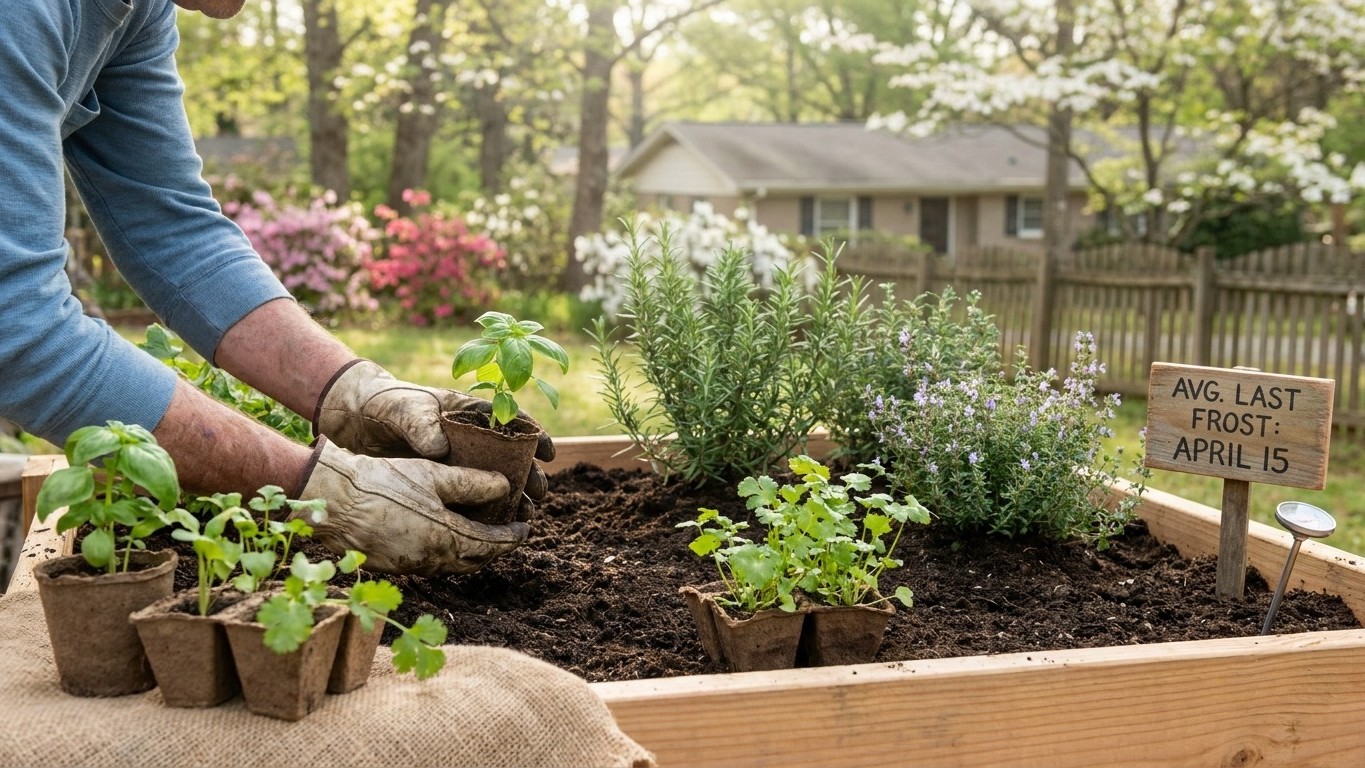

The mean last spring frost in Ontario falls on April 30, and the mean first fall frost lands on October 16, based on the Toronto Pearson station normals. That gives roughly 169 frost-free days on paper. But those are averages, not guarantees, so hardy herbs can go in the ground weeks before that date while tender ones need extra insurance after it.
The short answer for Ontario
Start with what “average” actually means here. Environment and Climate Change Canada’s April 30 last-frost figure is a mean date pulled from the 1981-2010 normals at Toronto Lester B. Pearson. That’s a midpoint, not a safe line: in one year out of two, frost shows up after April 30. Treat it like a coin flip rather than a calendar deadline, especially if you garden anywhere colder than the airport corridor around Toronto.
That distinction changes how you plant. Hardy herbs, chives, parsley, cilantro, dill, tolerate a light frost and can go into the ground as transplants or direct-sown seed about two to three weeks before that April 30 mean, so early-to-mid April is workable for most seasons. Their leaves shrug off a cold night; a hard freeze might set them back but rarely kills an established seedling.
Tender herbs play by different rules. Basil, in particular, sulks and browns at anything below the mid-40s Fahrenheit, and its roots rot in cold, wet soil even without a frost touching the leaves. Because the April 30 date is only a 50-50 bet, gardeners who want reliable basil, tarragon divisions, or lemongrass outdoors are better off waiting until mid-May, giving a buffer past the mean rather than planting to it. Starting basil indoors around late April and hardening it off gradually is the more forgiving path than direct outdoor sowing.
The fall side works the same way in reverse. October 16 is the mean first frost, again a midpoint where roughly half of all years see frost arrive later and half see it arrive earlier. Tender herbs need harvesting or moving indoors before that window opens, not on the date itself. Hardy perennial herbs like chives, oregano, thyme, and sage keep producing well past that mean date in most years, and some, like parsley, can survive light frosts into November if the plant is established and mulched.
So the honest planting calendar for Ontario isn’t one date. It’s two brackets: hardy herbs from early-to-mid April through late October, tender herbs from mid-May through early-to-mid October, both brackets built around mean dates that carry real uncertainty on either side.
What will not work here

The number that does the most damage to unrealistic herb plans isn’t the frost date. It’s the coldest month’s mean daily minimum: 13.6°F. That’s not a record low or a single cold snap, it’s the average low temperature through the coldest stretch of a typical Ontario winter, and it’s the figure that decides which perennial herbs survive outdoors at all.
Rosemary is the classic casualty. Most rosemary cultivars struggle once winter lows regularly dip into the mid-teens Fahrenheit, and a mean daily minimum of 13.6°F sits right at or below that threshold for an unprotected outdoor plant. In practice, that means treating rosemary as an annual, or moving it into a pot that comes indoors for winter, rather than expecting it to overwinter in open ground the way it does farther south.
Bay laurel is an even clearer no. It’s reliably damaged well before temperatures approach freezing hard, let alone the teens, so outdoor bay in Ontario is a container plant with a winter indoors, full stop. Anyone shopping for bay expecting a permanent garden shrub is planning around a climate this province doesn’t have.
Lavender sits in a gray zone and depends heavily on which cultivar and which microclimate. Hardier lavender types can survive winters where the mean coldest-month minimum hovers near 14°F, but they need sharp drainage and a spot that doesn’t sit wet in spring, since the combination of cold and damp roots kills lavender faster than cold alone.
Season length trips up a different group of herbs. With a frost-free window built around an April 30 to October 16 mean, roughly five and a half months, slow growers started from seed outdoors rather than transplants can run out of time. Rosemary and lavender grown from seed are notoriously slow to size up, often needing well over 100 days before they’re a usable size, which eats most of the available season and leaves no cushion if frost arrives early on the unlucky half of the coin flip.
The other common failure isn’t about cold at all. Basil and other tender herbs pushed into the ground right at the April 30 mean, rather than after it, sit in soil that’s often still too cold for good root development, and a late frost in the following two or three weeks (which happens in half of all years by definition) can wipe out an entire tray of seedlings in one night.
What changes across Ontario
Ontario is not one climate, and the hardiness figure for Toronto proves it. The 7a rating cited here, using the Canadian system, applies specifically to the Toronto reference city in the Natural Resources Canada dataset. It is not a province-wide number, and Canada’s own hardiness mapping shows enormous internal variation across a territory this large.
Worth repeating clearly: the Canadian hardiness system is not the USDA system used elsewhere on this site, and the two don’t convert on a simple scale. Natural Resources Canada itself notes that a single Canadian zone can span nine different USDA zones. So a 7a Canadian rating for Toronto tells you nothing directly comparable to a USDA zone number you might know from a garden center tag grown in the US.
The bigger issue for Ontario gardeners is geography. The province stretches from the Windsor and Niagara areas in the far south, some of the mildest ground in the country, up through cottage country, and into the vast northern reaches near Hudson Bay, where winters are dramatically harsher. There is no single hardiness zone or frost-date pair that fairly represents that whole span, and treating the Toronto figures as valid for Thunder Bay or Kenora would be a real mistake.
A gardener in the north, or at any real elevation gain inland, should assume both frost dates shift against them: the last spring frost likely arrives later than April 30, and the first fall frost likely arrives earlier than October 16, which shrinks the frost-free window on both ends. That means tender herbs need an even later start and an earlier fall rescue than the Toronto-based figures suggest.
Rather than guessing at that shift, use the official Canada’s Plant Hardiness Site map to find the zone rating for your own municipality before deciding when to risk tender herbs outdoors.
Where to check this for your own county
This page describes Ontario using one reference station and one reference city. That’s useful for a province-level picture, but it is not a substitute for what your own county or region actually experiences, and Ontario’s growing conditions vary too much for a single set of dates to serve every county well.
The place to check that is Ontario’s Agriculture and Food resource. That’s the provincial extension-equivalent resource, and it’s the right first stop before assuming Toronto-based frost dates and hardiness figures apply directly to your garden.
Once there, look specifically for two things. First, any regional or county-level planting guidance that gives frost dates or growing-season length closer to your own location rather than the Toronto airport reference station used here. Second, look for information on which herb varieties have actually been trialled or recommended for your part of the province, since a variety that thrives in the Niagara microclimate may struggle in a colder inland county even at a similar latitude.
A county-level or regional recommendation will always beat a province-wide one, for the simple reason that it’s built on conditions closer to your own soil and microclimate. Treat the numbers here as the frame, and treat whatever your regional resource says as the fine print that actually applies to your backyard.
Checking this against your own garden
Every date here is an average pulled from one weather station. Your own garden will tell you something more accurate than any calendar, provided you know what to watch for.
Soil warmth is the first and most reliable signal, and you don’t need a thermometer to read it. Push a finger a couple of inches into the planting bed on a dry morning. If the soil still feels cold and slightly damp-chilled rather than merely cool, tender herb seeds and transplants are still at risk even if the April 30 mean frost date has already passed. Basil in particular resents cold soil regardless of what the air temperature says.
The second signal is how your hardy herbs are behaving nearby. Once perennial herbs like chives or oregano are pushing new green growth vigorously rather than sitting stalled, that’s a decent sign the ground has warmed enough for other hardy herbs to go in as well. If those plants are still slow and reluctant, tender herbs will struggle even more.
The third signal is watching what happens after you’ve already taken a calculated risk. If a light frost nips the tips of newly planted parsley or cilantro but the plant recovers within a few days, that’s useful information about your specific microclimate, not just bad luck. It tells you your garden runs slightly milder, or slightly harsher, than the province-wide averages, and that observation is worth more for next year’s timing than any single date.
If you follow the almanac, here is when to plant herbs by the moon. It is a tradition, not a proven method.