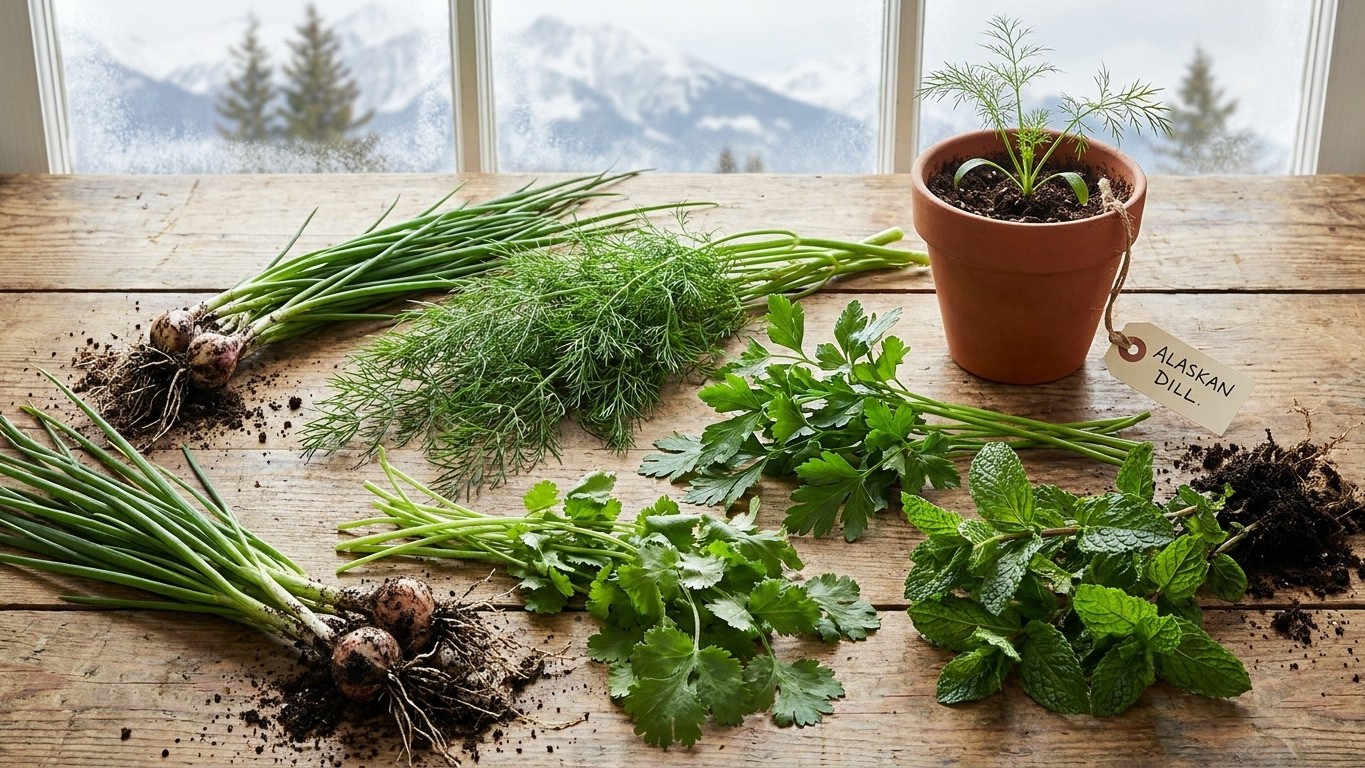

Oregon’s herb answer splits by geography before it splits by plant. West of the Cascades, the long, mild, damp season favors perennial Mediterranean herbs and slow-bolting greens like parsley and cilantro. East of the mountains, the high desert’s short window and cold nights push gardeners toward fast annuals and hardy perennials that can shrug off a brutal winter minimum.
The short answer for Oregon
Start with the perennials, because Portland’s coldest month has a mean daily minimum of just 36.2°F. That’s not a record low, it’s the average low across January, and it tells you something specific: winters here rarely deliver the kind of sustained hard freeze that kills rosemary, sage, thyme, oregano, and chives outright. Those four or five plants are the backbone of an Oregon herb garden west of the Cascades, and once established, most gardeners treat them as permanent fixtures rather than annual replants.
Basil is the trickier call. It wants heat, and it wants it consistently, not in bursts. The frost-free window in the Portland area runs from roughly March 6 to March 21 on the early side, to November 11 through November 27 on the late side, which on paper gives seven-plus months of growing room. But that window measures freeze probability, not warmth. A frost-free June evening in the Willamette Valley can still sit in the 50s, and basil sulks in cool soil regardless of whether frost is a risk. Gardeners who wait until nighttime lows are reliably above 55°F, usually late May into June, get a stronger crop than anyone who plants on the calendar date alone.
Cilantro and dill flip the logic. Both are annuals that bolt to seed the moment heat arrives, so the same long, mild season that helps rosemary actually shortens cilantro’s useful window. The fix most Willamette Valley gardeners use is succession planting: small sowings every three weeks from the last frost date through midsummer, rather than one big spring planting that goes to seed by July.
East of the Cascades, in the high desert around Bend or Burns, none of the frost dates above apply. That region’s growing season is measured in weeks, not months, and the USDA hardiness zone for Oregon spans 4a to 9b statewide, a range wide enough that a plant thriving in a Portland dooryard bed can die outright in a Deschutes County winter.
What will not work here
Basil grown on an aggressive early schedule is the single most common failure west of the Cascades. Gardeners transplant it in April because the calendar says frost risk has dropped, then watch it stall, yellow, or rot at the stem. The plant isn’t reacting to frost, it’s reacting to soil in the 45 to 50°F range, and Oregon’s marine-influenced spring keeps soil cool well past the last frost date. Waiting an extra three to four weeks past the frost-free date costs nothing and usually doubles the eventual yield.
Lavender and rosemary fail for the opposite reason: not cold, but wet. Willamette Valley winters deliver steady rain over heavy clay soils in a lot of yards, and both herbs tolerate a 36.2°F average winter low just fine. What kills them is root rot from standing in saturated soil for weeks at a stretch. Raised beds, amended sandy soil, or containers moved under an eave solve this far more reliably than any amount of winter mulch.
Close spacing on any herb bed in this region invites powdery mildew, particularly on mint, oregano, and bee balm relatives. The same humidity and cloud cover that make the Willamette Valley hospitable to slow bolting also keep leaf surfaces damp longer after rain or morning dew. Standard seed-packet spacing, written for drier climates, is often too tight here. Gardeners who widen spacing by 20 to 30 percent and prune for airflow midseason see far less mildew by August.
Weekly watering schedules, common advice in hotter, drier states, don’t map onto Oregon’s dry-summer, wet-winter split. The rainless stretch from roughly July through September means container herbs and raised-bed plantings can go bone dry fast, especially in the high desert east of the Cascades where daytime heat is sharper and humidity lower. Anyone gardening on a fixed weekly watering habit in that region, rather than checking soil moisture directly, tends to lose basil and cilantro to drought stress mid-summer even though the region gets plenty of rain annually, just not when the herbs need it.
What changes across Oregon
A hardiness range of 4a to 9b is not a rounding error, it’s the difference between a garden that can overwinter rosemary outdoors without protection and one where rosemary needs to come inside every fall. That’s roughly the spread between the mildest pockets of the Rogue Valley or the Portland metro and the coldest high-desert basins near Lakeview or the eastern edge of the state. No single planting date, frost window, or perennial list can honestly cover both ends.
Elevation drives a lot of that spread inside relatively short distances. A garden at 200 feet in the Willamette Valley and one at 3,000 feet in the Cascade foothills can differ by a full USDA zone or more, even along the same highway corridor. Cold air pools in valley bottoms on clear nights, too, so a garden at the base of a hill sometimes runs colder than one partway up the slope, a pattern local growers sometimes notice before any map confirms it.
The practical shift for a reader in the colder pockets, whether that’s higher elevation, an eastern-Oregon basin, or a valley-floor cold sink, is to treat every perennial herb as a plant that needs either winter protection or container flexibility, rather than assuming it survives outdoors the way it would in a milder zone. Someone at the warmer end of the range can push those same plants as permanent, unprotected fixtures.
None of this means guessing. It means checking where a specific property falls on the USDA Plant Hardiness Zone Map before betting a rosemary plant’s life on a statewide average that was never meant to describe one backyard.
Where to check this for your own county
Oregon State University Extension is the state’s land-grant extension service, and it’s the right next stop for anything county-specific: extension.oregonstate.edu. Oregon in broad strokes is useful for deciding which herbs to consider at all, but a county-level recommendation from OSU Extension will always outrank a statewide one for the actual planting date and variety choice.
Two things are worth pulling up specifically. First, the local planting calendar for the reader’s county or nearest OSU Extension office, since frost timing in, say, Jackson County’s Rogue Valley runs on a different clock than Multnomah County near Portland, and neither matches the high desert around Deschutes County. Second, the variety trial results or master gardener recommendations for herbs actually tested in that county’s conditions, rather than generic seed-packet advice written for a national audience.
County extension offices also track things this state-level page can’t: local disease pressure (certain basil downy mildew strains have hit specific Oregon counties harder than others in recent seasons), soil-test-based amendment advice, and which perennial herbs have proven reliably hardy in that specific microclimate over multiple winters. That kind of ground-truth data comes from local master gardener programs and county-based trial gardens, not from a statewide climate normal.
Checking this against your own garden
Every date and range is a probability built from decades of averages, and a reader’s own garden will sometimes disagree with it. Three direct observations settle the disagreement faster than any calendar.
Soil warmth by feel is the first and most reliable. Push a finger two to three inches into the bed where basil or cilantro is headed. If it feels cool to the touch rather than merely damp, roughly the sensation of a refrigerated vegetable drawer, the soil is still too cold for basil regardless of what the frost calendar says. Waiting until it feels closer to room temperature is a better trigger than any calendar date.
The first true leaves on any direct-sown herb, the second set that appears after the small rounded seed leaves, tell a gardener whether germination conditions were actually favorable. A long delay between seed leaves and true leaves usually means the soil was colder or wetter than ideal, a common story in a Willamette Valley spring, and it’s a signal to hold off on the next succession planting for a week or two.
Watching how fast cilantro or dill send up a central flower stalk is the third check, and it’s specific to Oregon’s mild-summer bolting problem. A plant that bolts within three to four weeks of germination is reacting to heat or day length in that particular yard faster than the regional average predicts, which means the next succession sowing should move up on the calendar rather than following the standard three-week spacing.